Microwave kilns for fusing glass use a microwave-absorbing liner to convert microwave energy into heat around a small glass project. They can be useful for hobby-scale pendants, test pieces, and simple fused forms, but results depend on kiln design, microwave power, glass compatibility, load size, and a controlled heating and cooling procedure.
This guide explains the main decisions buyers, engineers, and service teams should document before selecting or ordering microwave kilns for fusing glass.
The microwave does not normally heat the glass evenly by itself. A susceptor layer in the kiln lid or body absorbs microwave energy and becomes hot, creating a compact high-temperature chamber.
Because domestic microwaves cycle power differently, time settings from another oven may not reproduce the same thermal history.
Glass pieces must have compatible expansion behavior. Mixing unknown bottle glass, window glass, and tested fusing glass can create residual stress or delayed breakage.
Use glass from a documented compatible system and keep scraps labeled. Compatibility labels do not eliminate the need for a suitable firing and annealing cycle.
Follow the kiln and microwave manufacturers’ instructions.
A microwave kiln offers limited temperature measurement, chamber size, ramp control, and annealing control. Large, thick, layered, or structurally important pieces are better handled in equipment with a programmable controller and verified schedule.
Microwave kilns are not a shortcut for modifying tempered safety glass. Tempered glass may shatter when cut or reheated.
Use a microwave and location approved for the process, maintain clear space, wear suitable eye and heat protection, and treat the kiln and shelf as extremely hot. Do not use metal tools inside an operating microwave unless the equipment instructions explicitly permit them.
Avoid food preparation in equipment dedicated to glass work, and control dust from separators according to their safety information.
If the part needs repeatable dimensions, optical quality, strength evidence, controlled annealing, or volume production, develop the process with an industrial glass supplier or programmable kiln.
Kanger’s custom processed glass programs are drawing-led; a microwave hobby process should not be used as evidence for an OEM part.
For a drawing-led project, review Kanger’s custom processed glass and send the application, dimensions, material requirement, annual quantity, and validation criteria with the enquiry.
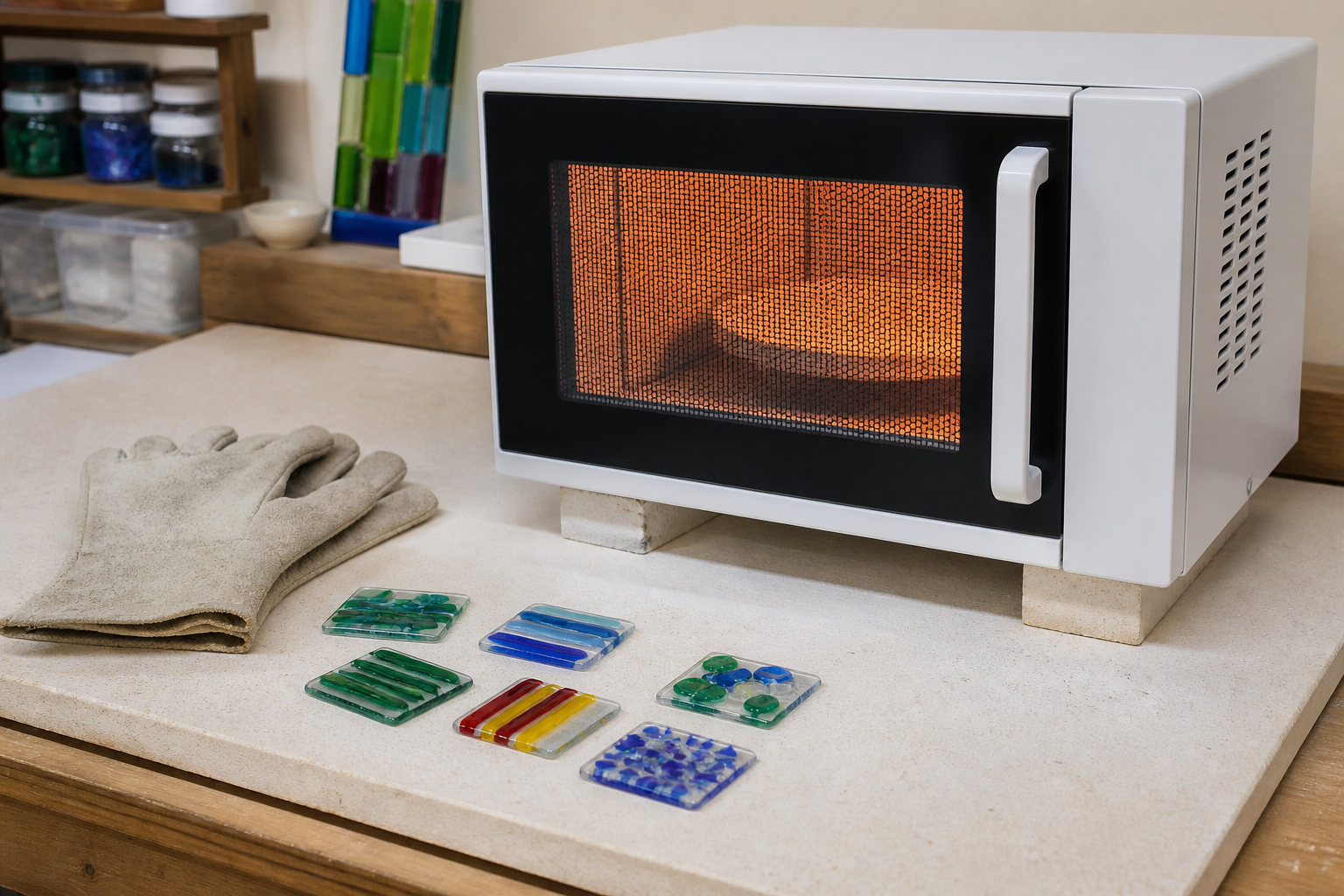
A microwave kiln is best treated as a small experimental system. It may suit compatible glass pieces, jewelry-scale projects, color tests, and simple fusing trials. It is not a substitute for a controlled production kiln when the work requires uniform large panels, documented thermal histories, tight dimensions, repeatable annealing, or qualification to an industrial specification.
Microwave output labels do not directly state the temperature inside the kiln. Coupling changes with the microwave, kiln liner, load, shelf, glass color, mass, and position. Use the kiln supplier’s compatible appliance and firing guidance, begin with conservative trials, keep written records, and never assume a schedule transfers unchanged to another microwave or kiln.
Cooling is part of the firing cycle. Opening the kiln too soon or moving hot glass can create thermal gradients and permanent stress. Finished pieces can look sound while retaining stress that later contributes to failure. For any item used near heat, food, pressure, structural loads, or people, obtain competent material and process guidance rather than extending a craft result into an engineering claim.
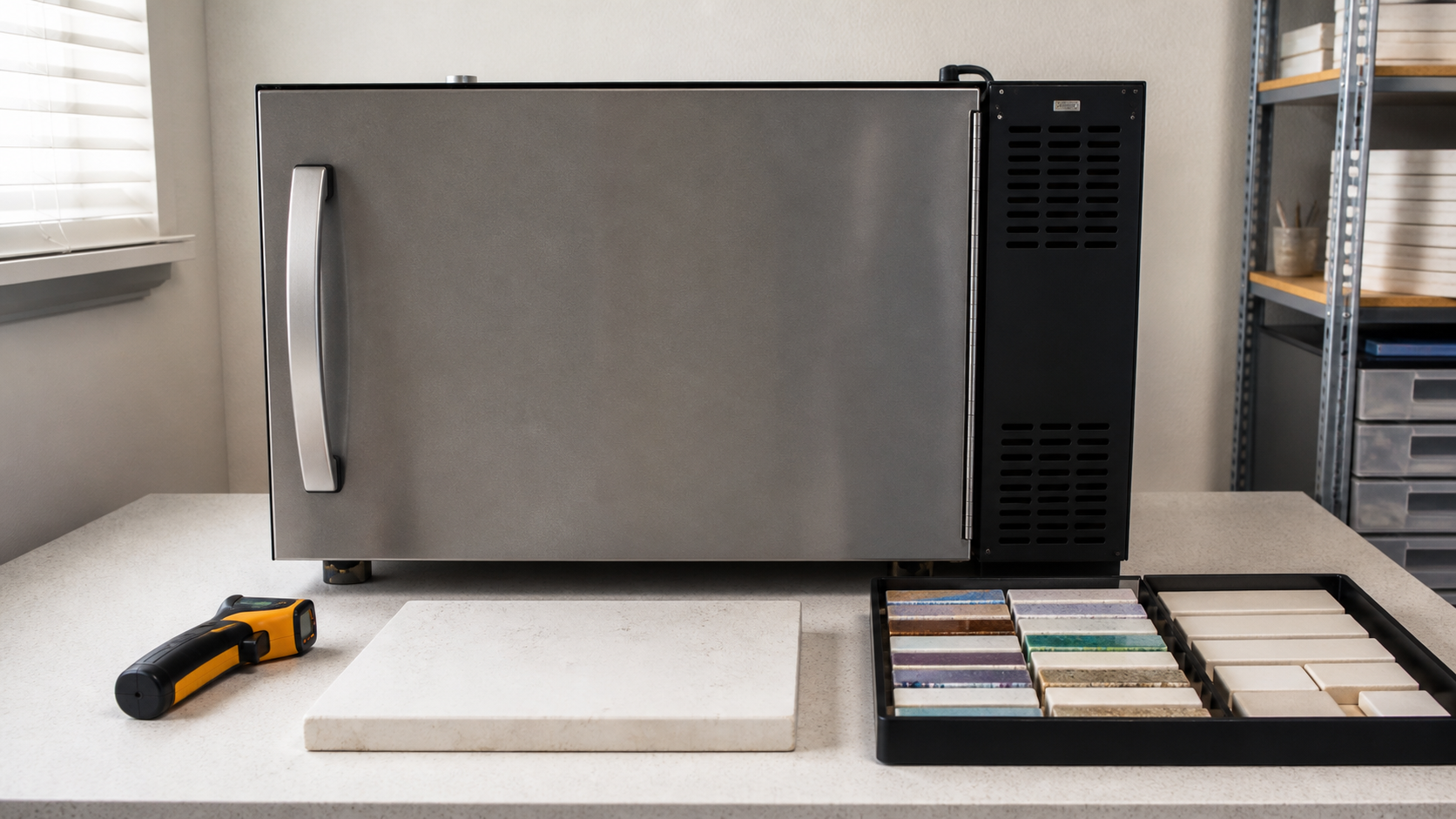
A reliable answer to this topic begins with a decision statement: whether the small kiln and microwave combination can produce a repeatable craft result without unsafe extrapolation. That statement prevents a broad material claim from replacing an application-specific requirement. The team should identify the small compatible glass test piece made with the exact kiln, microwave, shelf, load position, and cooling practice as the qualification unit. Testing only a convenient coupon can miss interfaces, edge conditions, supports, coatings, seals, or process history that determine whether the finished product works. The approved drawing, revision, test sample, and operating assumptions should therefore use the same configuration.
Build the validation sequence around the damage and variation that the part will actually experience: microwave power variation, coupling, load mass, glass color, firing duration, closed-kiln cooling, handling, and repeated trials. These exposures should not be selected as impressive numbers without context. Their severity, order, dwell, recovery period, and sample orientation need to be written down. Combined exposure is often more revealing than isolated tests because cleaning can weaken a hot surface, a thermal cycle can change a seal, and handling damage can become critical only after the assembly is loaded.
Record evidence that can be compared before and after exposure. For microwave kiln glass fusing, the useful evidence includes shape, fusion level, bubbles, devitrification, cracks, surface quality, dimensional change, and a written firing record. Define the instrument or inspection condition, sample count, acceptance limit, and treatment of borderline results before testing begins. Photographs help with traceability, but they do not replace measurements where a specification calls for a number. Conversely, a single numeric result does not replace a whole-part visual and functional inspection.
The failure review should remain tied to plausible mechanisms. In this case, appliance wattage does not equal kiln temperature; opening early creates gradients; apparently sound glass can retain stress. When a result fails, preserve the sample and process record, identify where the change began, and decide whether the cause lies in material, geometry, processing, assembly, operation, or the test itself. Repeating the same test without correcting an uncontrolled variable can produce a reassuring result without resolving the underlying risk.
Use staged approval. First confirm material identity and drawing completeness. Next approve a representative first article. Then run the defined durability or service simulation. Finally, verify that production controls can reproduce the qualified part. Limit use to the kiln maker’s compatible materials and process; do not assign structural, food, pressure, or heat-service claims from craft trials. Any later change to material source, geometry, surface treatment, thermal recipe, support, seal, or test method should trigger a documented review rather than an automatic carry-over of the old approval.
For purchasing, request a concise evidence package instead of a generic claim. It should contain the controlled drawing, material designation, critical-process statement, inspection method, acceptance criteria, sample or lot identification, and nonconformance path. For engineering, keep a signed master sample where appearance matters and store raw measurements with the report. This makes supplier comparisons fairer, shortens root-cause work, and prevents a marketing phrase from becoming an undocumented safety or lifetime promise.
| Stage | Control | Evidence | Why it matters |
|---|---|---|---|
| Compatibility | Kiln maker, microwave type and glass family | Manufacturer instructions | Avoids unsupported combinations |
| Trial setup | Small clean load, shelf, position and mass | Photograph and written record | Makes comparison possible |
| Heating | Incremental supervised firing | Observed fusion and surface condition | Avoids blind schedule transfer |
| Cooling | Closed kiln in a fire-safe location | No movement until adequately cool | Reduces thermal gradients |
Educational video: Fusing and Slumping by The Corning Museum of Glass. This neutral explainer supports the material or safety principle discussed above; it is not a substitute for the product drawing, appliance manual, or qualification test. Watch on YouTube.
Approval is not the end of the microwave kiln glass fusing process. Record the approved supplier, material designation, drawing revision, manufacturing route, inspection method, reference sample, and test-report identifier in one controlled release file. Purchasing should require advance notice when any of those inputs changes. Engineering can then decide whether the change needs document review, limited confirmation testing, or full requalification. This is especially important when two parts have the same nominal dimensions but differ in glass composition, edgework, coating, thermal history, support, gasket, or packaging.
Incoming inspection should verify the characteristics that can drift or be damaged before assembly, while periodic audits should confirm the properties that cannot be checked economically on every part. Keep nonconforming samples long enough to support root-cause analysis, and link corrective actions to the affected lots and assemblies. A clear deviation process allows a temporary concession only when the responsible engineer has reviewed function, safety, appearance, and traceability. Verbal approval or a supplier’s general datasheet should never silently replace the controlled product requirement.
Use only a microwave and kiln combination permitted by the equipment instructions and local safety requirements.
Do not mix unknown compositions. Incompatible expansion can cause cracking.
Tempered glass can release stored stress when reheated or damaged; it is not a normal fusing material.
Cooling in the kiln may help small pieces, but it does not provide the control of a programmable annealing kiln.