Kanger Glass-ceramic Co., Ltd.
Float glass and tempered glass describe different aspects of a glass product. Float describes how a flat glass substrate is formed; tempered describes a strengthening treatment applied to a suitable finished blank. A pane can therefore be both float-derived and tempered. When comparing float glass vs tempered glass for an appliance, specify the substrate, treatment, geometry, surface system, and qualification requirements together. Do not treat the two labels as complete material grades or assume that tempered soda-lime glass can replace glass-ceramic in a hot cooktop simply because both are flat panels.
Start with the substrate and the treatment state
Commercial discussions often use “float glass” to mean an untreated or annealed float pane. That shorthand can cause confusion because a tempered pane may start with the same type of substrate. Ask whether the supplier is comparing annealed float glass with fully tempered glass, or comparing different compositions. The distinction changes the engineering question and the evidence needed.
A useful quotation names the substrate and treatment separately. It also identifies thickness, finish, dimensions, holes, cutouts, print, and coating. An OEM drawing that only says “glass” leaves important decisions to interpretation. An order that only says “tempered” can still omit the composition and finished-part requirements. Clear naming prevents a substitute from being accepted merely because it shares one familiar label with the original pane.
Understand what tempering changes
Thermal tempering introduces a stress state through controlled heating and cooling of a suitable pane. NGA’s technical material describes the resulting compressive surface zones and tensile interior. This treatment affects the mechanical and breakage behavior, but it does not convert the substrate into glass-ceramic or make every surface feature and assembly condition irrelevant.
Discuss performance at the finished-part and complete-product levels. A supplier’s general statement that tempered glass is stronger does not establish an allowable load for a panel with a specific span, holes, edge condition, and support. Likewise, a particular break pattern does not prove that a complete appliance meets its applicable safety requirements. Ask which standard, test, or qualification record applies to the actual component and intended use.
Decide the fabrication sequence early
Cutting, hole drilling, notching, and edge treatment should be planned before thermal heat treatment for conventional tempered flat glass. NGA’s guidance warns against fabricating after heat treatment because modification can weaken or break the pane. This makes the drawing release and first-article check important before production tempering. A late change to hole position is not simply a workshop adjustment to a finished panel.
Annealed blanks can provide an opportunity to verify dimensions and fit before the treatment stage, but they are not substitutes for finished-part qualification. The production pane may have different shape and optical characteristics after processing. Verify the final state as well as the pre-treatment blank. Keep machining and tempering responsibilities clear when more than one supplier handles the component, so the drawing revision is consistent across the process chain.
Compare breakage behavior without calling either material unbreakable
Untreated and fully tempered panes can break differently, and the consequences depend on the application and assembly. A design team should consider where fragments could go, whether a pane supports another component, and how a broken panel affects the appliance enclosure. A general comparison chart cannot establish whether an unretained pane, a laminated assembly, or a particular mounting design is acceptable.
Avoid replacing the risk assessment with slogans such as “safety glass cannot hurt anyone” or “tempered glass never cracks.” Edge damage, mounting contact, impact, and exposure remain important. If breakage would expose energized or hot parts, the complete appliance needs an appropriate protection and qualification strategy. The material description is one input to that decision, not the entire safety case.
Keep optical and cosmetic requirements separate
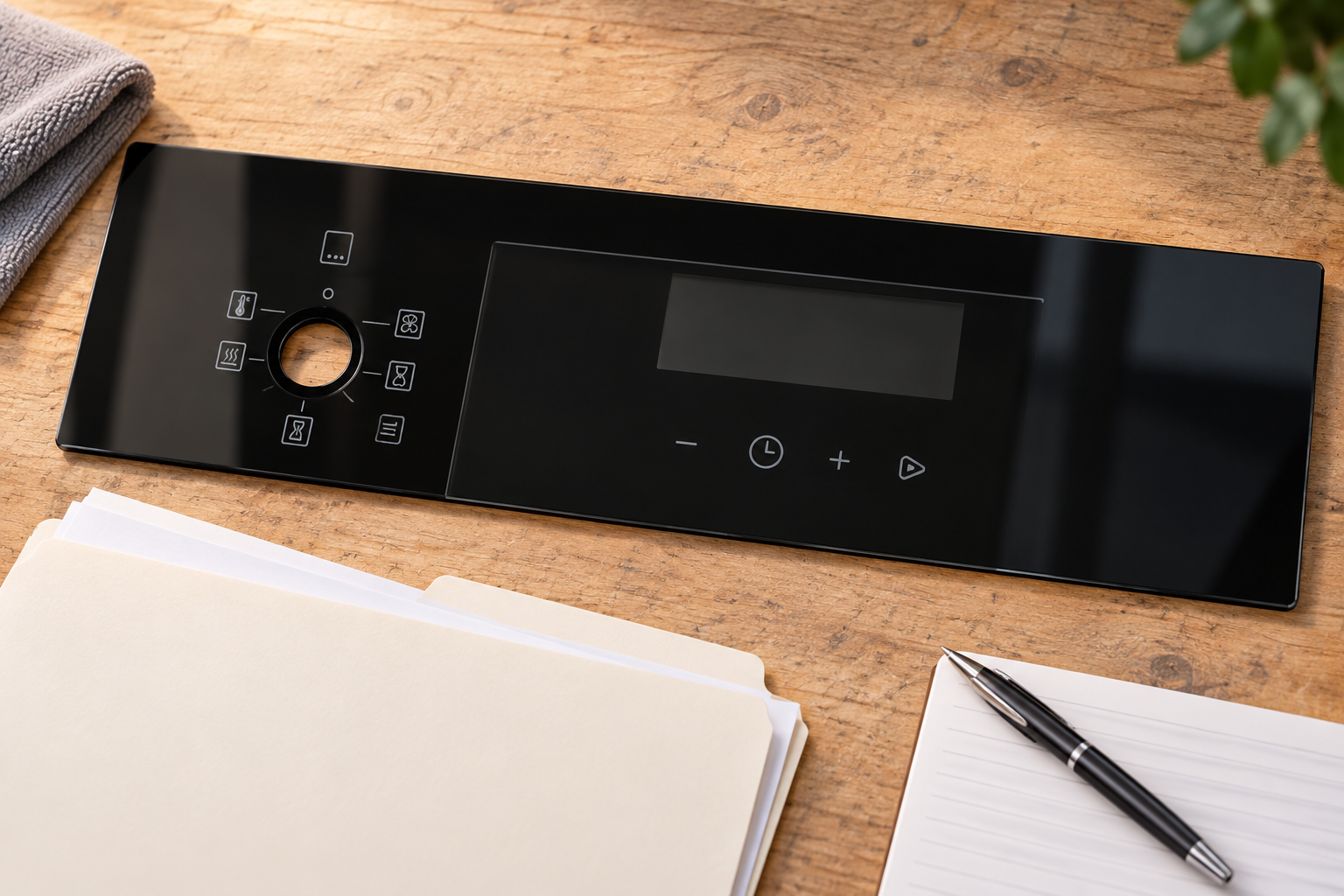
Appearance can depend on base-glass color, thickness, surface finish, print, coating, and heat-treatment effects. The GGF glazing manual discusses optical characteristics in its architectural context. For an appliance fascia, define the relevant viewing condition and functional zones rather than borrowing a building-glass cosmetic allowance. A display aperture and an opaque printed border may need different evaluation methods.
Compare samples with the same background, illumination, orientation, and assembly state. A loose clear pane viewed on a white table is a poor reference for a dark printed panel installed over a display. If the design depends on transmission, backlighting, or touch behavior, include the actual module in qualification. Document the approved sample and the limits of that approval so a later material or finish change triggers a proper review.
Match the material to the thermal application
An appliance control panel, an oven viewing pane, and a glass-ceramic cooktop can experience different thermal conditions and serve different functions. The choice should reflect the actual material family and grade, temperature distribution, support, and product requirements. Do not use a single internet temperature figure as a universal limit for every glass composition or finished assembly.
If a proposed substitution changes the substrate or treatment, request the supporting material data and plan the necessary qualification. Review seals, coatings, adhesive, printing, and neighboring components as well as the pane. A glass that is suitable in one appliance location may be unsuitable in another. The supplier should confirm the exact request rather than inferring that all panels shown on a product page are interchangeable.
Comparison checklist for an OEM order
| Question | Annealed float-glass request | Tempered-glass request |
|---|---|---|
| What does the label identify? | A float-derived substrate, often discussed in its untreated state | A treatment state that still needs an identified substrate |
| When is geometry finalized? | Fabrication can be planned for the untreated blank | Cutting, holes, notches, and edgework should be resolved before heat treatment |
| What evidence matters? | Substrate, dimensions, finish, and application suitability | Those same inputs plus the specified treatment and finished-part qualification |
| How is load suitability decided? | From the real geometry, support, material data, and design requirements | From the real geometry, support, treatment, and design requirements |
| How is appearance accepted? | Against the agreed surface and optical criteria | Against agreed criteria that account for the processed finished part |
| Can it replace glass-ceramic automatically? | No; the material family and application must be reviewed | No; tempering does not turn soda-lime glass into glass-ceramic |
| Does the name establish appliance approval? | No; complete-product requirements remain | No; a component label does not certify the complete appliance |
This qualitative table explains specification differences. It does not provide load ratings, operating-temperature limits, or a claim about Kanger’s supplied grades.
Resolve a substitution request with a controlled comparison
Suppose a buyer asks to replace an existing annealed component with tempered glass to improve resistance to handling damage. The review should identify the original substrate, final geometry, damage mechanism, assembly interfaces, and acceptance requirements. A treatment change may help address one issue, but a sharp support contact or poor packaging can still damage the replacement. Correct the demonstrated process weakness as well as reviewing the material.
Compare production-intent samples under the relevant inspection and functional conditions. Document dimensions, surface appearance, print alignment, fit, and any test required by the product. Agree on what evidence will justify the change before testing begins. This is an example of a review process, not a statement that a particular substitution is safe or that Kanger has validated it for a customer’s appliance.
Information to send with an appliance-glass inquiry
Send the material description, treatment requirement, finished drawing, print and coating system, application, and required evidence. Explain whether the pane is decorative, a control interface, a viewing window, or another functional component. Include the mating interface when support or clearance matters. If an old sample is the only reference, distinguish measured observations from confirmed original specifications.
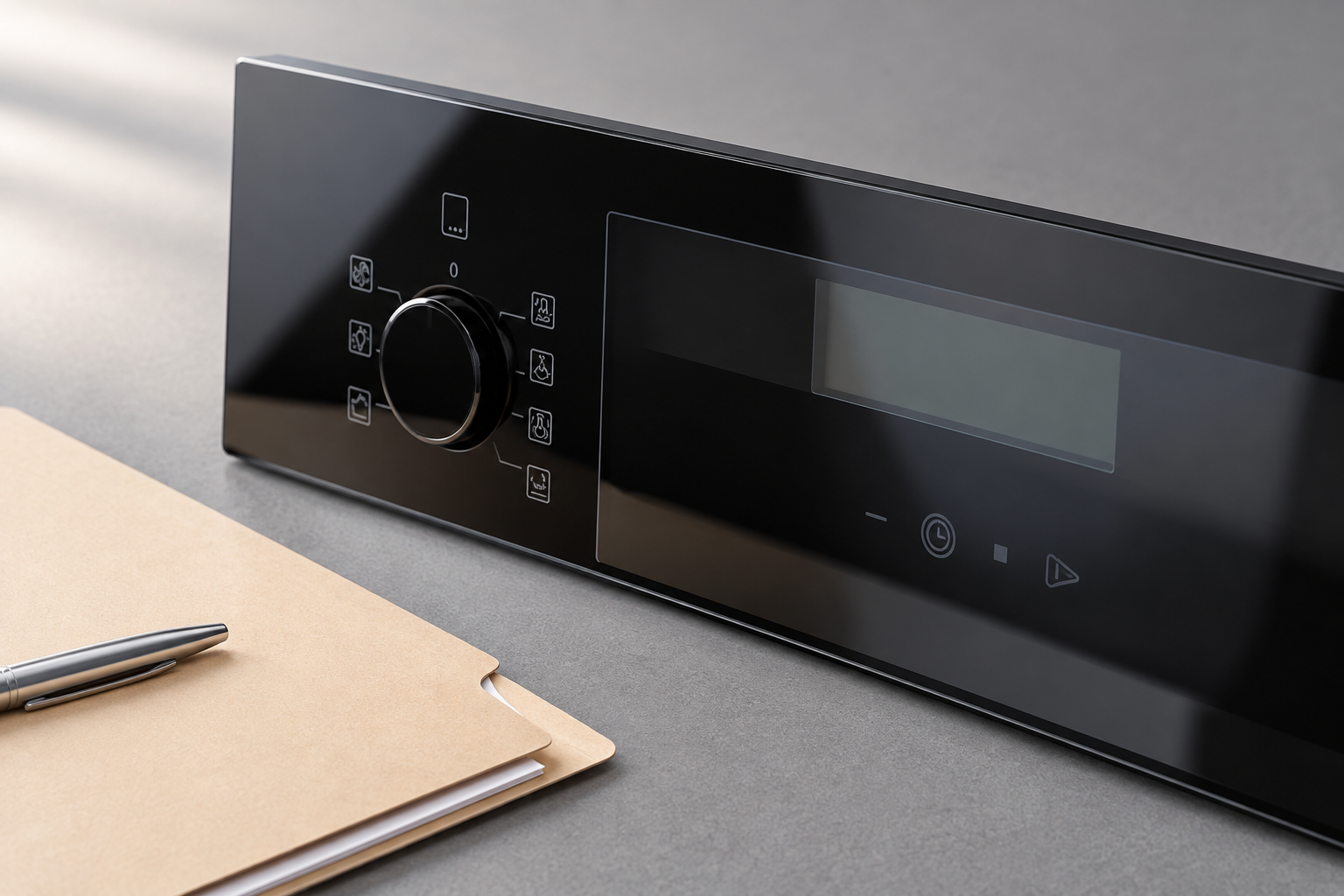
Kanger’s tempered appliance-panel page provides a relevant starting point for discussing control glass. Confirm thickness, geometry, finishing, treatment, and availability for the actual part through the supplier’s response. Keep approved changes in the released drawing and order acknowledgement. A complete specification makes later production and replacement orders reproducible without relying on the ambiguous choice between two glass labels.
Frequently asked questions
Can float glass also be tempered?
Yes. Float describes the forming route of a flat substrate, while tempering describes a treatment. The final product description should state both the substrate and the required treatment.
Is tempered glass always the correct choice for a cooktop?
No. Identify the material family, thermal application, design, and qualification requirements. Tempered soda-lime glass is not automatically interchangeable with glass-ceramic.
Can I drill a hole after a pane has been tempered?
Conventional thermal-tempered flat glass should have fabrication resolved before treatment. Do not plan post-treatment drilling as a routine adjustment; revise and remake the correctly fabricated part when required.
Does a tempered label prove a finished appliance is safe?
No. Complete-product safety depends on the pane, support, enclosure, operating conditions, and applicable qualification. The component treatment is one part of that evidence.
Related appliance-glass resources
- Thermal Shock Resisitance Tempared Glass For Household Appliances Panel Product
- Tempered Glass Appliance Panels: OEM Specification Guide
- Ceramic Glass vs. Tempered Glass: Which One Should You Choose?
- Toughened Glass: How It Is Made, Where It Works, and How to Specify It
Sources and further reading
- NGA — fabrication before heat treatment
- GGF Glazing Manual — architectural-glass context, not an appliance specification
- NIST — measurement uncertainty
Educational video: Annealing and Tension in Glass
This museum explanation introduces tension and thermal history in glass. It supports the material discussion; it is not a heat-soak procedure or a failure diagnosis.

Watch Annealing and Tension in Glass from Corning Museum of Glass