Kanger Glass-ceramic Co., Ltd.
Toughened glass spontaneous breakage describes a pane that breaks without an immediately observed impact. It does not identify the cause. Inclusions, earlier edge damage, mounting contact, assembly loads, and thermal conditions can require investigation. Preserve the scene and available fragments, identify the part and lot, and document the installation before changing anything. For appliance glass, isolate the product safely and involve the responsible service or engineering team. A delayed break is not enough evidence to blame nickel sulfide, and a heat-soak record is not proof that every other cause has been eliminated.
Make the product safe and preserve useful evidence
Follow the appliance’s isolation and service procedures. Keep people away from exposed fragments, unsupported components, and any damaged enclosure. Collection and disassembly should be handled by personnel equipped for the task. Do not energize an appliance simply to reproduce a failure, and do not remove a hot or loaded pane for an informal demonstration. The first priority is a safe condition with the original evidence preserved as far as practical.
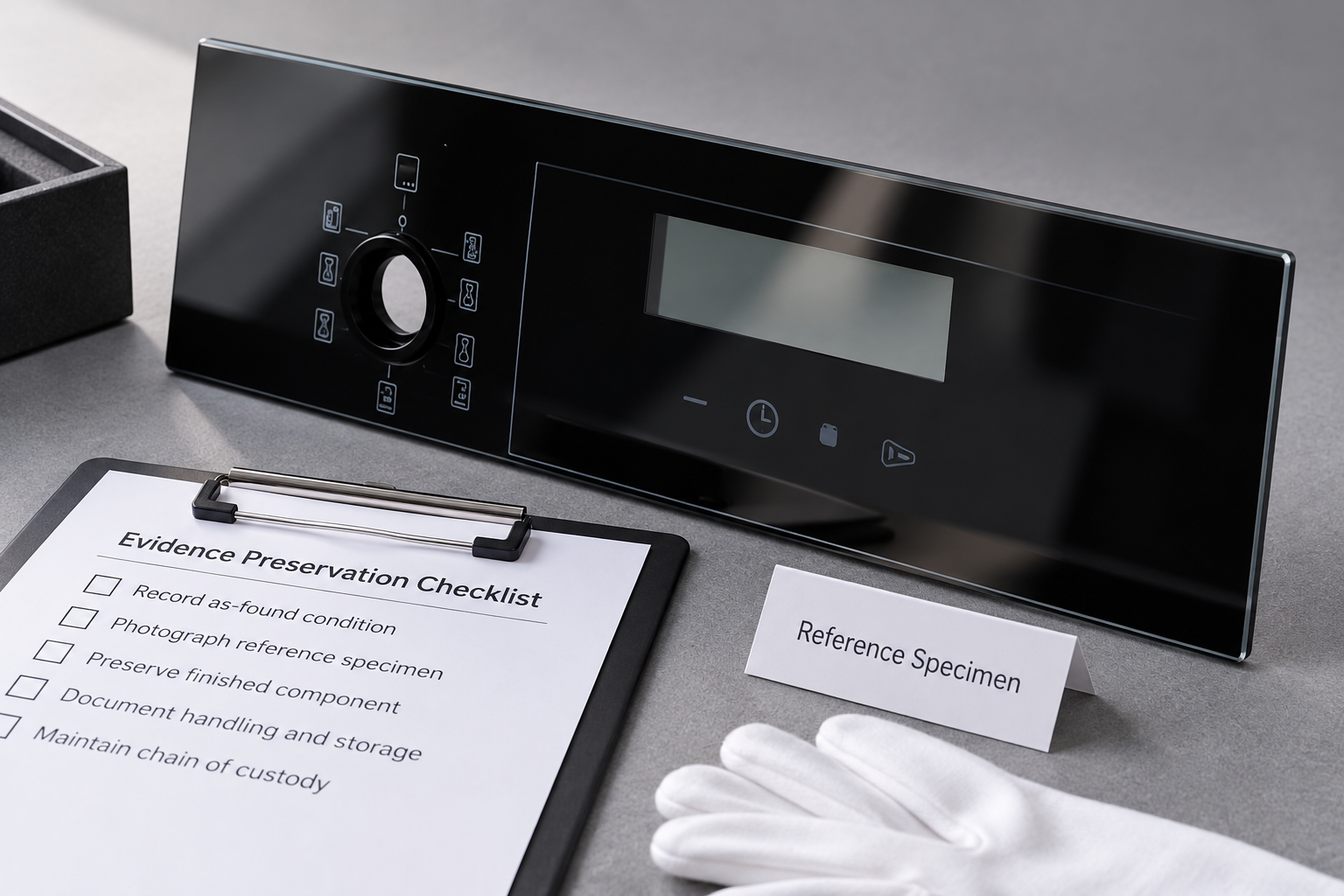
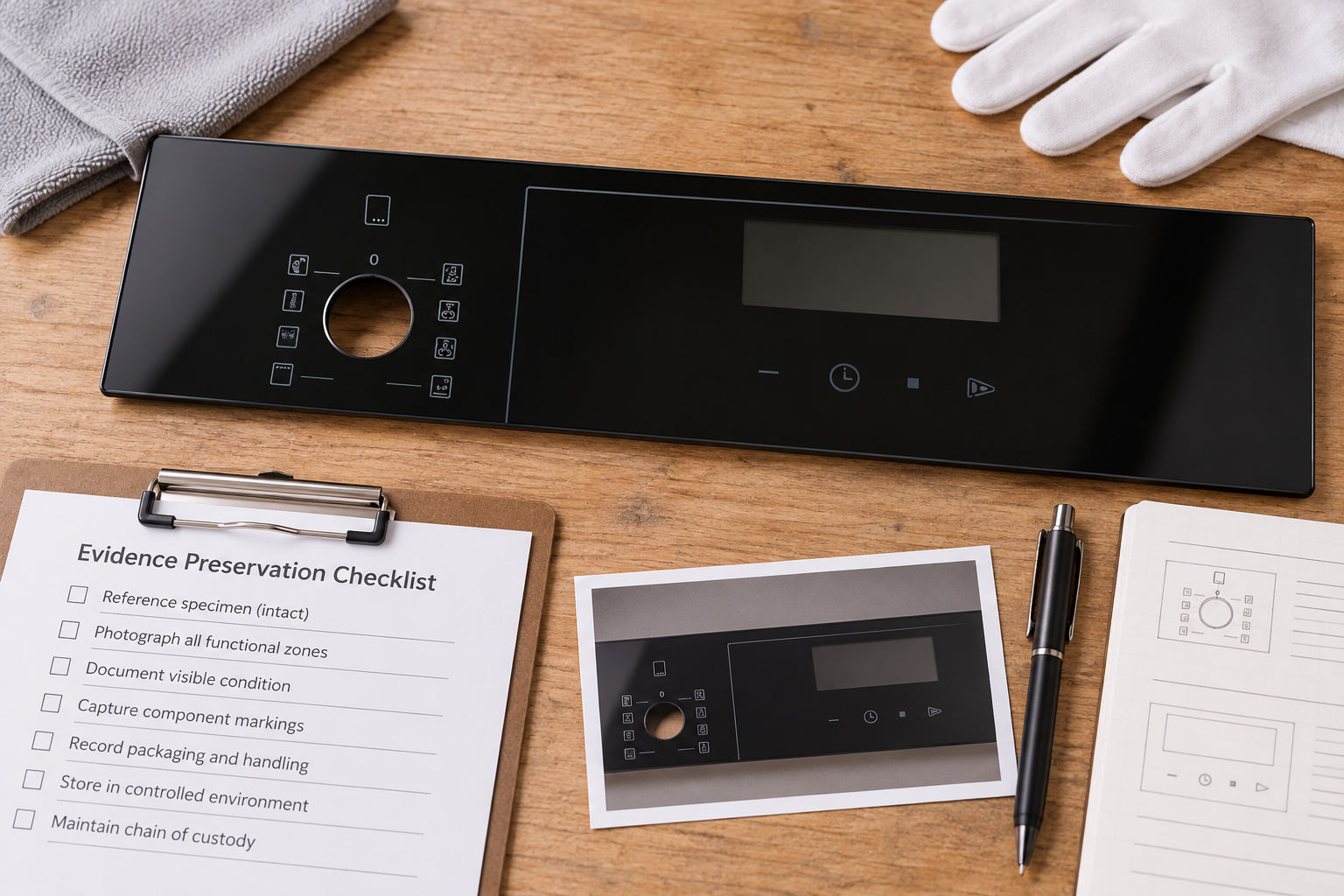
Photograph the overall product, the pane position, supports, retainers, nearby surfaces, and the fragment distribution. Include part orientation and identifiable references. Record what was moved or cleaned before the investigation began. If fragments can be retained safely, keep their relationship to the original pane and avoid mixing several failures together. An unlabeled bag of fragments with no scene photographs makes later analysis substantially harder.
Record the sequence of events without filling gaps
Ask what the appliance was doing before the break: installation, routine use, cleaning, cooling, transport, or service. Record the last known intact condition, any recent impact, and changes to frames, seals, fasteners, or surrounding parts. Separate a witnessed event from an assumption. “No one observed an impact” is more accurate than “there was no impact” when the product was unattended.
Include the panel’s age in service and any replacement history when available. A part installed incorrectly during repair can fail later, while a handling chip may have been present before the original assembly. Keep the investigation open to both manufacturing and installation causes. Avoid using a failure date to assign responsibility without considering the process and service records that connect the pane to its condition.
Check the glass identity and treatment evidence
Identify the substrate, treatment state, finished geometry, print, coatings, and drawing revision. Appliance control glass is not automatically equivalent to a glass-ceramic cooktop, a borosilicate window, or an architectural tempered pane. Material identification affects which explanations and tests are relevant. A product photograph or a supplier’s generic brochure cannot establish the failed pane’s exact identity.
Request the lot and treatment records that belong to the part. If heat soaking was specified, check its coverage and traceability rather than assuming that every pane in a shipment received it. Keep the qualification record and incoming-inspection result linked to the failed part where possible. Missing records are an evidence gap; they do not themselves establish that an inclusion or a process fault caused the break.
Examine edges, supports, and contact points
Look for features that could load the pane locally: hard contact at a corner, a distorted bezel, uneven support, a misplaced gasket, a retaining clip, or fasteners that draw an assembly out of shape. Inspect neighboring components for witness marks and compare them with the drawing. Take measurements before adjusting the assembly when it is safe to do so. Retightening a fastener can erase useful evidence.
Use an intact comparison part to understand the intended interface, but do not force it into the suspect frame. If the frame or mounting condition is out of specification, determine whether that condition existed during use or resulted from the break. The investigation should consider both possibilities. Edge chips and contact marks matter, yet interpreting the fracture origin may require specialist examination rather than a visual guess by the assembly team.
Review thermal conditions and local exposure
Describe the actual temperature history and gradients relevant to the panel. A cavity setpoint, room temperature, or label on the appliance is not necessarily the temperature of the glass edge, printed area, or bezel. Include start-up, shutdown, local cooling, cleaning while hot, blocked ventilation, or another unusual event only when supported by observations or records.
If a reproduction test is necessary, the engineering team should define a safe test configuration and the measurements needed. Do not subject an intact pane to improvised hot-to-cold shocks and treat the outcome as proof of the original cause. A test that creates a different failure only adds confusion. Compare representative production-intent components under controlled conditions and state where the test differs from the failed assembly’s history.
Treat inclusion failure as a hypothesis to verify
Nickel sulfide inclusions are a recognized concern in certain fully tempered soda-lime glass. NGA’s glazing manual explains the relationship and the purpose and limitations of heat soaking. That background supports an investigation hypothesis; it does not diagnose an individual appliance failure. A delayed event or a particular fragment appearance is insufficient by itself to identify an inclusion.
Where inclusion analysis matters, retain the suspected fracture-origin area and involve a qualified laboratory or glass-failure specialist. Ask what examination is needed and what conclusions the evidence can support. If the critical fragment is missing, the final conclusion may remain limited. It is better to record an unresolved cause than to write a confident inclusion claim that the retained evidence cannot establish.
Failure-evidence checklist
| Evidence category | Record or sample to retain | Question it helps answer |
|---|---|---|
| Scene | Overall and close photographs before cleanup or adjustment | Where was the pane, and what was its support condition? |
| Event history | Witnessed activity, last intact condition, recent repair, and operating state | Which exposures and changes are actually known? |
| Part identity | Drawing revision, substrate, treatment, lot, and supplier records | Which material and process explanations are relevant? |
| Edges and mounting | Contact marks, support dimensions, gasket condition, and frame geometry | Could the assembly impose a local load? |
| Fragments | Safely retained, labeled pieces with origin information where possible | Is a fracture-origin investigation still possible? |
| Thermal information | Measurements or supported operating records, with their limitations | Is a thermal explanation consistent with the real exposure? |
| Comparison parts | Identified intact parts from relevant lots and assemblies | Is the suspected condition isolated or repeatable? |
| Final conclusion | Confirmed findings, rejected hypotheses, missing evidence, and owner | Does the proposed corrective action follow from the evidence? |
The table organizes an investigation. It provides no universal fracture signature or numerical pass/fail temperature for an appliance pane.
Separate containment from a permanent correction
Containment might involve holding a lot, inspecting mounting conditions, stopping a suspect assembly process, or replacing affected parts according to an approved plan. Those actions can be appropriate while the cause remains under investigation. Label them as containment so the team does not mistake a temporary response for a verified solution. Set an owner and a condition for releasing held material.
A permanent action should target a demonstrated cause. If edge damage is linked to one handling transfer, changing that transfer and verifying the edge condition is meaningful. If an inclusion cause is established, the material and risk-control discussion follows a different route. Adding heat soaking to every case without reviewing mounting and handling may leave the real cause unchanged. Verify the correction with an inspection or test that measures the relevant condition.
Build an appliance-glass inquiry from the findings
Send Kanger or the responsible supplier the identified part, relevant drawings, evidence package, and the specific question to resolve. Ask for records that belong to the lot and for the supplier’s interpretation of the retained evidence. Avoid demanding a universal “unbreakable” replacement: glass selection and support need to match the actual appliance and its qualification requirements.
Keep commercial responsibility discussions connected to the technical findings, but do not let them replace the investigation. A documented result may be a confirmed cause, a probable explanation with stated limitations, or an unresolved event. Each can support a different next action. The useful deliverable is a traceable record and a correction whose effect can be checked, rather than a confident defect label without evidence.
Frequently asked questions
Does spontaneous breakage prove a nickel sulfide inclusion?
No. It describes the observed timing, not the mechanism. Mounting, earlier damage, and thermal history also need review. Inclusion identification requires suitable evidence and qualified examination.
Can a panel break long after it was damaged?
Earlier damage can be relevant to a later event, so review handling, installation, and service history. The time interval alone does not establish which cause applies to the individual pane.
What should be kept after an appliance pane breaks?
Preserve photographs, orientation, part and lot identity, assembly conditions, witnessed history, and safely collected fragments. Record any cleanup or adjustments already made.
Does a heat-soak certificate close the investigation?
No. Check its actual coverage, then continue to examine other possible causes. Additional treatment cannot replace correct mounting, edge protection, and product-specific qualification.
Related appliance-glass resources
- Thermal Shock Resisitance Tempared Glass For Household Appliances Panel Product
- Tempered Glass Appliance Panels: OEM Specification Guide
- Does Tempered Glass Shatter? Key Facts and Practical Guidance
- How to Set Mounting Clearances for Appliance Control Panel Glass Under Thermal Expansion
Sources and further reading
- NGA GANA Glazing Manual — heat-soak process scope and limitations
- NGA — fabrication before heat treatment
- NIST — measurement uncertainty
Educational video: Annealing and Tension in Glass
This museum explanation introduces tension and thermal history in glass. It supports the material discussion; it is not a heat-soak procedure or a failure diagnosis.

Watch Annealing and Tension in Glass from Corning Museum of Glass