An induction hob griddle plate needs approval for the exact appliance and intended zone arrangement, as well as an induction-compatible base. A rectangular shape or a magnetic underside does not establish that it may span separate zones. Read the plate and hob instructions together, including positioning, heating, grease handling and care limits. If the hob does not permit the arrangement, choose another approved cooking method. Do not conduct an empty high-power test to see whether an uncertain plate works. Start with the product documents and a cold fit assessment before planning a normal cooking task.
A griddle plate is removable cookware with a cooking surface, base and often a grease channel or handles. The glass cooktop panel is part of the appliance beneath it. Their use conditions answer different questions. Replacing or specifying glass does not automatically authorize a particular removable plate. Conversely, a cookware compatibility statement does not establish the appliance’s hidden heating arrangement or glass specification.
The Kanger black glass-ceramic cooktop panel is relevant as the visible glass surface, while the black glass-ceramic material overview explains the material family. Keep the supplier discussion precise: identify whether the concern is the removable cookware, the appliance’s permitted zone layout or the sourced panel. This avoids treating a cooking result as evidence of a glass defect without checking the full assembled system.
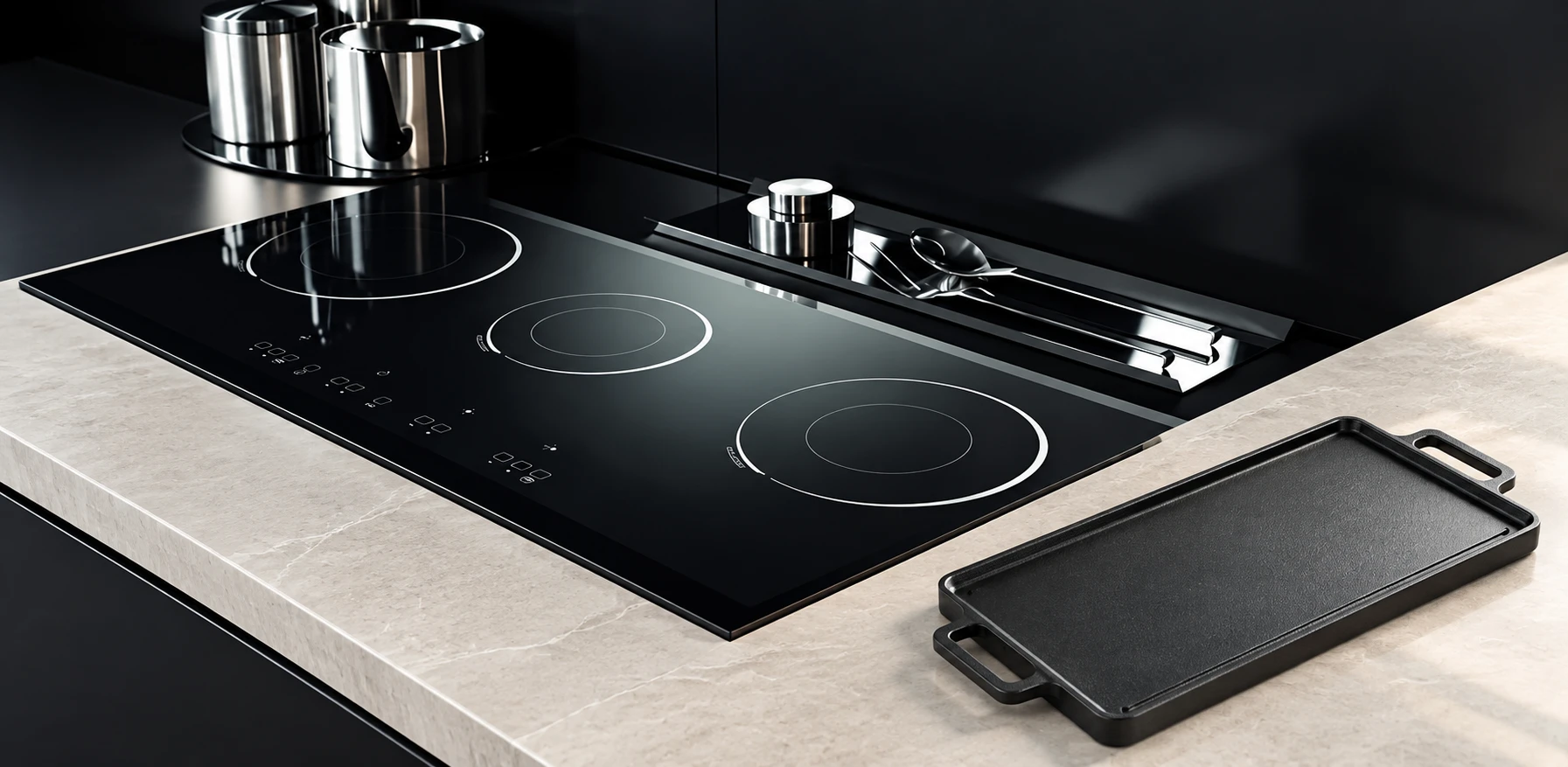
Read the plate maker’s induction designation for the exact model and size. A similarly named griddle may be designed for a barbecue, oven, gas burner or another heat source. Do not assume that a product photograph showing a dark flat surface identifies induction use. If the instructions are incomplete, obtain clarification from the manufacturer before putting the plate on the hob.
ENERGY STAR guidance on induction cooking describes the need for suitable ferromagnetic cookware and a magnet as a practical screening aid. That principle does not approve the full griddle construction, its coating or its placement across zones. Ask about those separately. An induction designation also does not establish oven conditions for handles, lids or removable accessories. Keep each claim tied to the component it actually describes.
A plate’s advertised width and length may describe its top rim rather than the area that rests on the hob. Use the dimensions required by the appliance instructions. Identify feet, raised ribs or a shaped underside that may affect the intended contact or position. Do not grind, bend or modify those features to make the plate appear to fit.
Our usable cookware-base sizing explains the difference between nominal cookware size and usable base dimensions. For a rectangular plate, record both relevant directions rather than comparing a single number with a circular zone marking. Avoid treating the visible outline as a measurement of the internal coil. The markings and the appliance manual must be interpreted according to the exact product’s instructions.
Some appliances provide a defined linked or bridge arrangement. Its existence on another model does not mean that any two zones can be used under one plate. Read the placement and operating requirements for your own appliance. Do not independently turn up adjacent zones as an experiment when the plate’s size or geometry falls outside the permitted arrangement.
Our linked and bridge cooking functions addresses how linked cooking functions are identified and used. This article concerns the plate you propose to place on that arrangement. Successful detection is useful operational information but does not certify uniform heating over every part of the cooking surface. Ask the equipment suppliers what performance and limitations are documented for the specific plate-and-hob combination.
| Decision | Evidence to request | Assumption to avoid |
|---|---|---|
| Intended heat source | Exact griddle model designated for induction | Any iron plate works on any hob |
| Placement | Permitted base dimensions and zone arrangement | Two adjacent rings form a bridge |
| Heating procedure | Plate and appliance operating instructions | Empty boost is a useful trial |
| Grease handling | Channel, collection and cleaning instructions | A shallow rim prevents every spill |
| Handling | Grip points, protection and lifting guidance | Cold fit proves loaded usability |
The checklist gives documentary checks rather than universal dimensions, temperatures or preheat times. Those values depend on the actual equipment. Retain the product instructions and any supplier clarification with the purchase record. If the documents conflict, resolve the conflict before use instead of choosing whichever instruction allows the preferred cooking method.
Inspect the plate’s grease channel, any collection feature and the maker’s permitted operating position. A channel is not a promise that grease cannot overflow. Do not change the plate’s angle with improvised supports or add an unapproved container on the hob. Consider how contents will be removed using the specified procedure and where the plate can safely remain while it cools.
U.S. Fire Administration cooking-safety guidance advises attending cooking and keeping items that can burn away from the stovetop. Apply that guidance to the whole task, including nearby cloths, packaging and utensils. This article does not provide a grease-fire procedure or replace the applicable safety instructions. Do not rely on a routine cleanup plan to manage a situation that requires stopping cooking or seeking emergency assistance.
A griddle may have small integral handles or projecting grips. Check whether the user can reach the operating area without moving a hot plate or reaching across the cooking surface. Include other cookware that will be used at the same time. A plate can fit the permitted cooking area but still make the intended multi-pan task impractical.
Check the handling instructions for weight, loaded lifting and required protection. An empty plate on a cold counter does not demonstrate that a loaded hot plate is manageable. Arrange a suitable landing area before cooking begins. Do not plan to slide the plate across the glass or to balance it partly on the hob edge while emptying its contents.
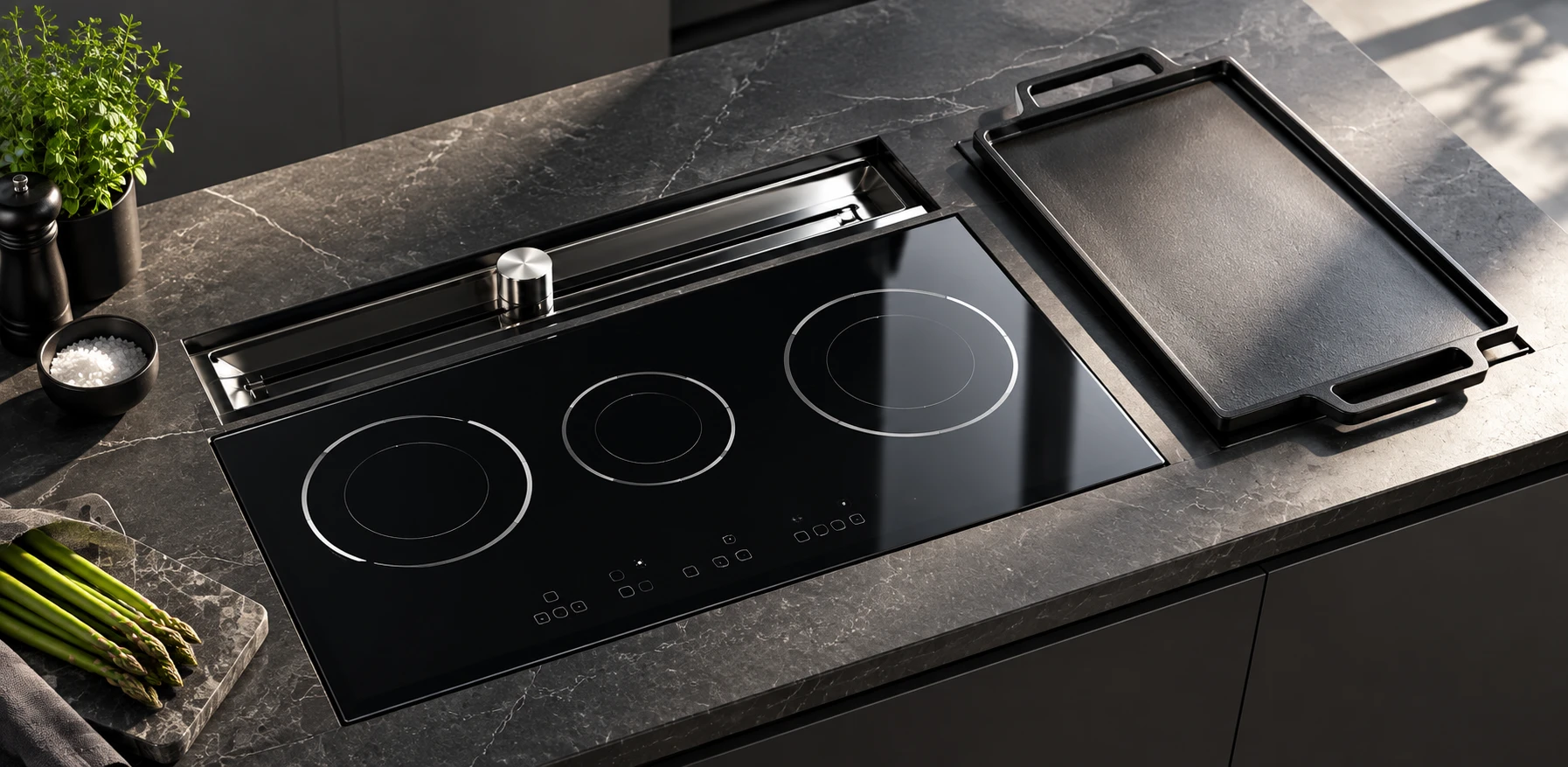
If both manufacturers permit the arrangement, evaluate a normal supervised task under the stated instructions. Record the plate model, appliance model, zone configuration and selected function. Avoid comparing different foods or quantities and attributing every cooking difference to the appliance. An informal meal is not a laboratory test of efficiency or temperature uniformity.
Do not create an empty-heating stress test or use maximum power to compensate for an uncertain fit. If heating is unsuitable, stop and consult the equipment guidance. Record whether the issue concerns detection, placement or cooking response. Those are different observations and need different follow-up questions. A single observation should not become an unsupported claim about all induction griddles.
An induction-compatible griddle can have a coated, seasoned or other cooking surface. Follow the instructions for the exact finish, including utensil choice, cleaning and storage. Compatibility at the underside does not remove those care limits. Do not transfer a cleaning method from an uncoated plate to a coated one solely because both have a magnetic base.
Our nonstick cookware use and care discusses nonstick cookware questions, while glass surface marks and scratches considers scratches and marks on the glass surface. Keep the cold underside free from grit and residue using the approved method. Inspect damage as the manufacturer recommends. Do not scrape the base with improvised tools, add foil beneath it or use a protective mat unless the exact appliance instructions permit that arrangement.
Retain the complete model identities, base dimensions, permitted heat sources and care sheets. Describe the intended food task and how grease will be collected. If a supplier approves a particular arrangement, retain the written response with its conditions. Approval for one plate size or appliance model should not be silently extended to another product during a later purchase.
For OEM discussions, evaluate the sourced glass panel and assembled appliance separately from the removable griddle. Use drawings and agreed test conditions for panel acceptance. Keep cookware observations attached to the actual assembly and operating arrangement. That separation supports a useful investigation without inventing a Kanger performance guarantee or assuming the visible glass reveals the induction system underneath.
Technology Connections explains induction and cookware geometry. The demonstration provides physical background; it does not certify the material, coating, base or size of a particular vessel, or approve accessories for your appliance.
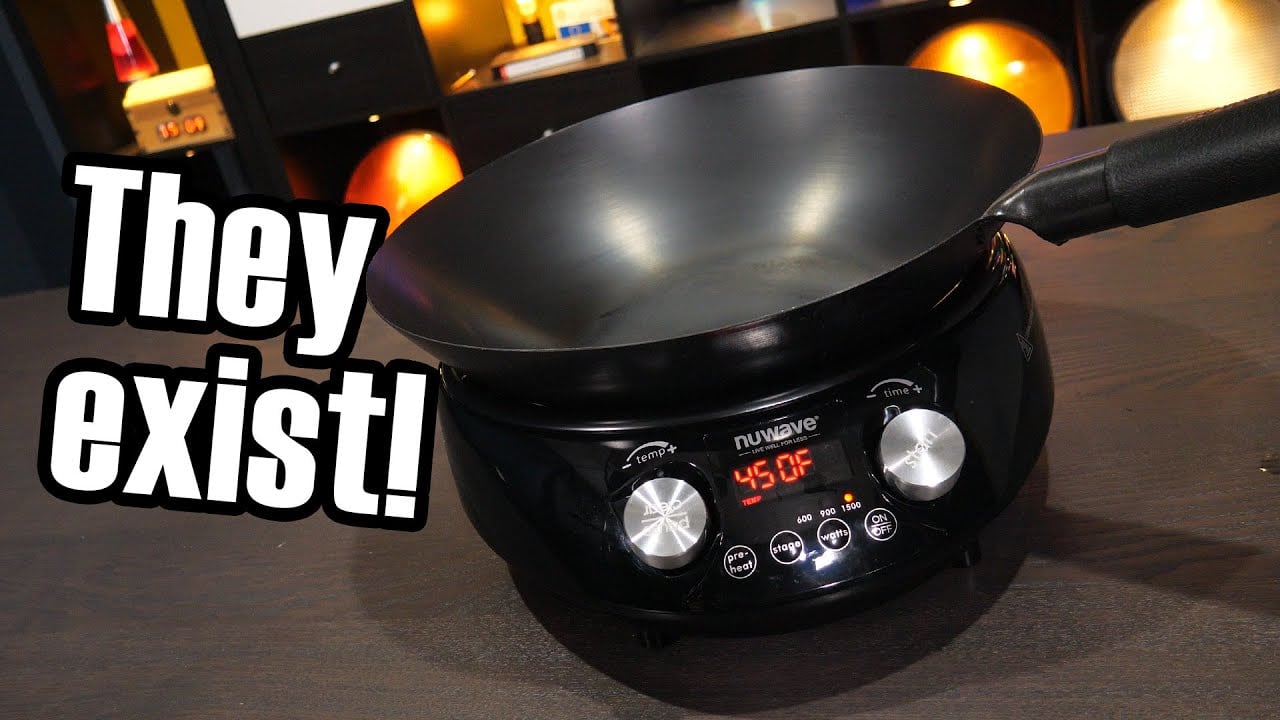
Video: Induction cooking – but what about woks?, Technology Connections. Open the educational video on YouTube.
Only if the exact hob and cookware instructions permit that arrangement, including any required linked function.
No. Verify the model designation, permitted dimensions, placement and care instructions as well.
No. Do not use empty high-power trials to resolve missing approval or unclear instructions.
No. Detection does not certify temperature distribution across the complete cooking surface.



