An induction hob casserole dish must be explicitly suitable for the hob, and any planned oven transfer needs separate approval for the complete dish, lid and handles. The word casserole can describe a stovetop vessel, an oven-only baking dish or a serving piece. Those products are not interchangeable. Start with the exact model and its permitted heat sources, then check base fit and a manageable lifting arrangement while everything is cold.
This guide concerns a lidded casserole used as cookware. It does not promise that all ceramic dishes, all enameled pots or all products called Dutch ovens work on induction. Nor does it supply a universal oven temperature. Its purpose is to separate compatibility, access and transfer decisions so a buyer can obtain the right documentation before combining several cooking stages.
Read the product’s instructions rather than relying only on the category name. An oven baking dish may be labeled casserole while having no permission for direct hob heating. A stovetop casserole can have restrictions on its lid or handles. Check the full model and size and match the information to the delivered item, including any accessories included in the purchase.
ENERGY STAR guidance on electric cooking products explains the magnetic interaction involved in induction cooking. That supports verifying the designated base rather than treating the outer finish as proof of suitability. Ordinary ceramic appearance does not establish an induction construction, and an enameled surface does not reveal every layer beneath it. If the selected version’s instructions are unclear, ask the responsible manufacturer before use or choose a documented alternative.
Make two entries in the purchasing record: permitted hob use and permitted oven use. Then identify which components each statement covers. The pot body, lid, knob and handles may require different attention in the instructions. A broad oven-safe claim in a retailer’s heading is insufficient if it does not identify the complete arrangement being purchased.
Do not infer an oven limit from another size or a visually similar casserole. Keep the exact product guidance with the item, and follow the recipe only where it is compatible with that guidance. This article deliberately provides no temperature or time table. If the recipe assumes a capability that the equipment does not document, change the equipment or use an appropriate documented method before starting.
A casserole’s generous upper width can conceal a smaller working base or a curved transition at the wall. Obtain usable base dimensions and compare them with the appliance instructions. Our guide to measuring the usable pan base explains why overall diameter is not the whole recognition question. Make the comparison for the exact size rather than a product-family photograph.
Inspect the empty, cool vessel on a stable surface. Check that the bottom is clean and rests as intended. Do not force a distorted base flat or assume that a heavy lid corrects instability. If the pan cannot be placed within the model’s permitted arrangement without obstructing controls, select another suitable option. A large cooking capacity does not justify partly offsetting the vessel from its required position.
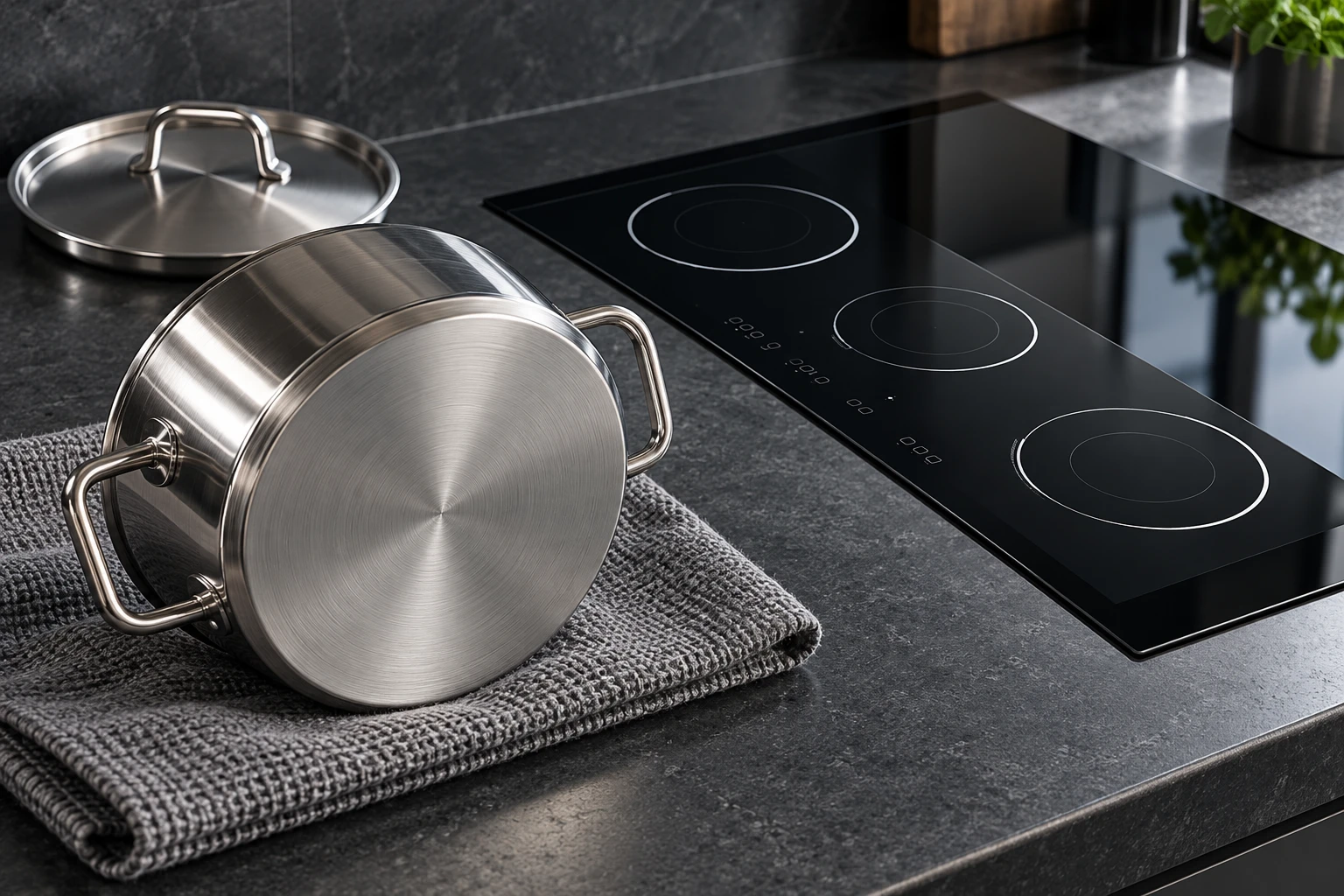
Rehearse access to both grips while the casserole is cold. Include the lid because it can affect the view and movement of the loaded vessel. Check that the user can approach without reaching across another active pan and that the handles do not obstruct the control area. Our guide to keeping cookware handles clear of controls explains that access needs more than a vessel fitting inside a printed circle.
Read the maker’s requirements for protection and lifting. Do not assume handles remain cool because the heat source is induction. The intended complete load and the user’s ability matter to the task, but they do not create a generic permitted appliance load. Obtain any relevant loading guidance from the appliance maker rather than estimating a limit from glass thickness or casserole weight alone.
The induction principle follows ENERGY STAR guidance on electric cooking products. Every limit or transfer permission must come from the specific cookware and appliance instructions. This table is a record of questions to resolve, rather than a source of universal limits for every lidded pot.
| Question | Evidence required | Action if missing |
|---|---|---|
| May it sit on induction? | Exact model and size designation | Resolve before direct hob heating |
| Does its bottom fit? | Usable base and hob cookware guidance | Choose a permitted placement or different vessel |
| May the full set enter the oven? | Body, lid, knob and handle instructions | Do not infer approval from the pot body alone |
| Can it be moved as intended? | Grip instructions and clear route | Rehearse empty and cold |
| Where will it rest? | Stable surface appropriate to the cookware | Prepare a suitable resting area before cooking |
With the casserole empty, rehearse the approach to the oven and intended placement according to the equipment instructions. Consider the door movement, working height and other nearby obstacles. A short route can still involve an awkward turn or blocked grip. Do not discover these problems after the pot contains hot food and both hands are occupied.
Prepare an appropriate stable resting surface before the task. Keep it separate from the hob controls and from unsuitable counter materials. Follow the relevant product guidance for supports and protective equipment. The presence of a trivet in a photograph does not certify that every trivet or worktop suits every vessel. Choose the actual supporting arrangement with the same care as the cookware.
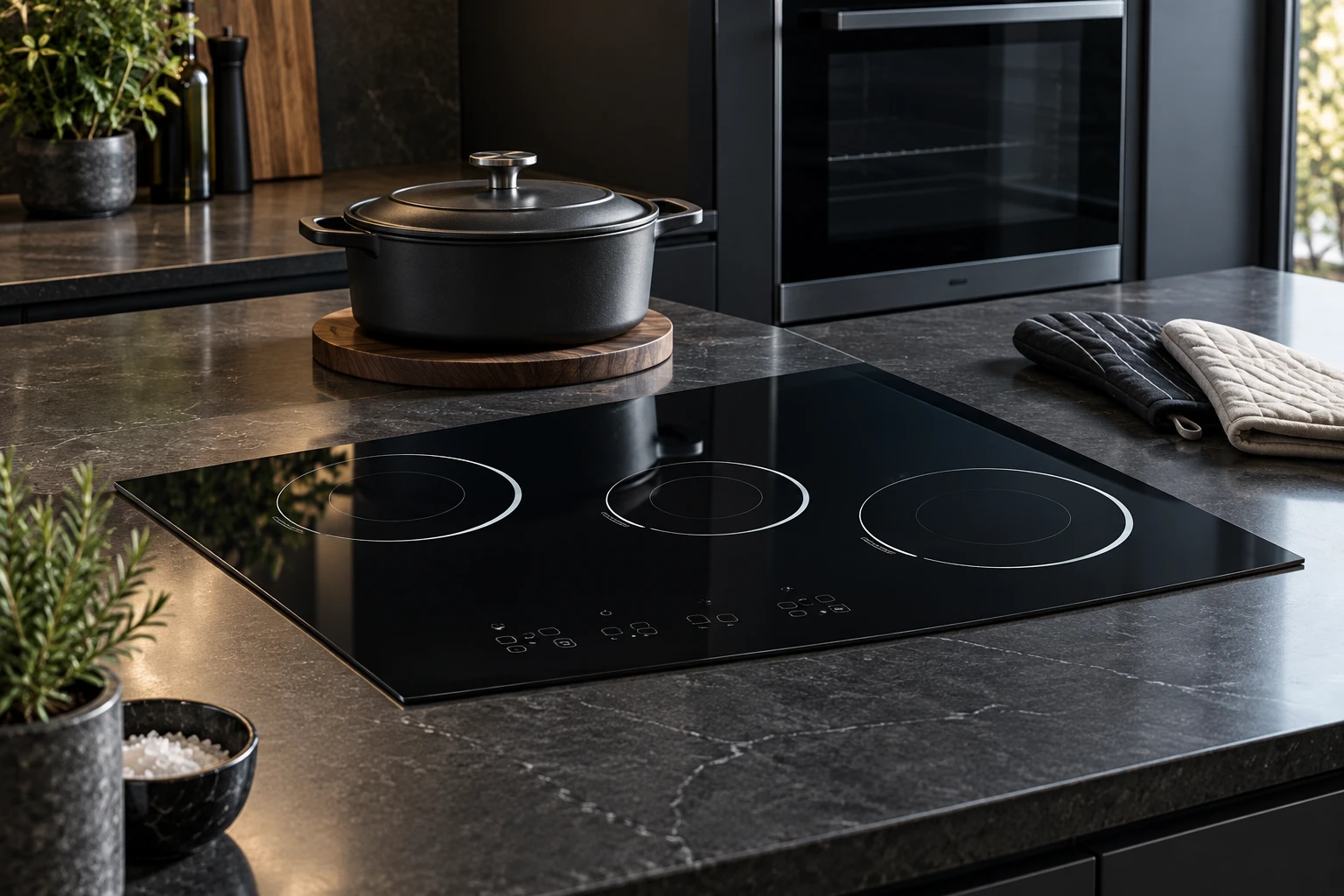
Use the documented working fill and recipe requirements together. An advertised capacity is not automatic permission to fill to the rim, and a large lid does not eliminate the need to supervise the contents. Check how the lid should be removed and where it rests. Do not cover or modify a feature to imitate pressure cooking or change the product’s designed operation.
Keep conventional lidded cookware separate from pressure appliances. A close-fitting lid does not establish a pressure rating or a food-preservation process. This guide does not prescribe canning, holding or processing times. Use suitable task-specific instructions and equipment where those requirements matter, rather than treating a cookware compatibility article as a validated cooking procedure.
Follow the casserole and hob instructions for starting and adjusting heat. A setting used successfully on another appliance is not a universal equivalent. Do not assume boost is needed because the vessel is heavy or because a recipe calls for browning. Resolve any conflict between the cooking task and the equipment instructions before use.
U.S. Fire Administration cooking-safety guidance advises attending cooking and keeping combustible materials away from the stovetop. Prepare utensils, ingredients and a resting area before heating. An oven timer or covered pot does not replace supervision of the active hob stage. Keep the controls accessible and follow the relevant instructions if the appliance displays an abnormal message or the cookware becomes unstable.
If the hob does not recognize the vessel, check the exact casserole designation, usable base and permitted position against the appliance guidance. Record the displayed message. Do not repeatedly increase power, add an unapproved adapter or drag a loaded pot between zones to force operation. The word induction on a listing does not answer every model-specific placement question.
If the uncertainty concerns an oven knob or lid, direct the question to the cookware maker with the exact part details. A saucepan’s instructions cannot settle a casserole lid’s permitted use. Describe observations without diagnosing a panel defect from a recipe result. Separate the base-recognition question from cooking performance and transfer handling so each can be answered by the appropriate documentation.
Follow the product-specific cooling, cleaning and drying sequence for the body, lid and handles. Do not carry a method from bare cast iron to an enameled or differently finished vessel without checking. Inspect the underside and seating surfaces before the next use. Avoid treating an apparently clean surface as evidence that damaged cookware has been made suitable again.
Lift the vessel rather than sliding it over the glass. Our guide to understanding glass surface marks separates residue from concerns needing service advice. Visible damage, a distorted base or a loose attachment requires the relevant support process. Do not experiment with grinding, bending or unapproved repair on the appliance surface to make the item fit.
Record the complete casserole model, size, matching lid, permitted heat sources and hob model. Retain the instructions and written clarifications. Recheck the combination after a replacement knob, lid or vessel changes the original set. Shared kitchens should pass this information to the user, since a purchasing description alone does not communicate the full handling sequence.
Kanger’s Kanger black glass-ceramic cooktop panel and black glass-ceramic material overview concern the glass component in the cooking surface. They do not certify a casserole’s oven use or approve every finished appliance arrangement. OEM buyers should define panel and integration requirements separately and validate finished-appliance cookware use through the responsible project process. That distinction gives component sourcing a clear role while preserving the exact cookware instructions for the user.
This neutral explanation covers induction heating and cookware geometry. It helps explain the lower base, but does not approve a particular saucepan, casserole, tagine, accessory or installation.
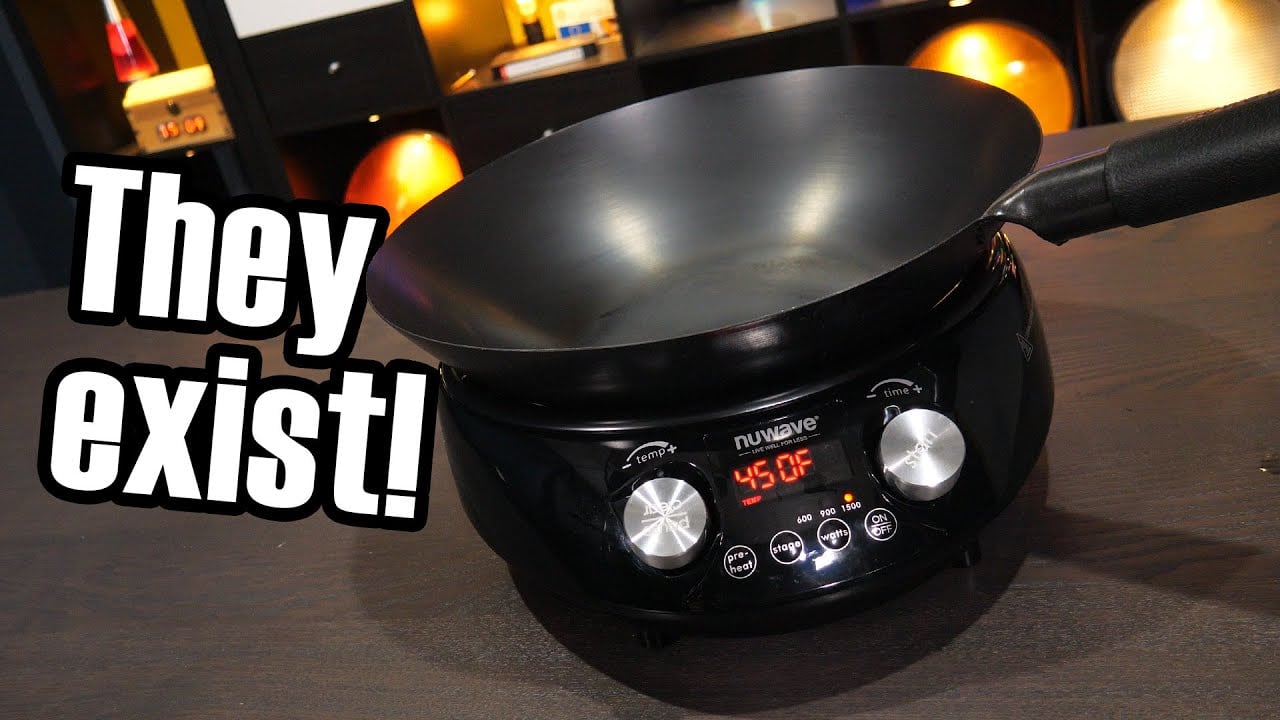
Video: Induction cooking – but what about woks?, Technology Connections. Open the educational video on YouTube.
Do not do so without explicit permission for the exact model. Oven suitability and induction suitability are separate questions.
No. Check the lid, knob and handle instructions as part of the complete cookware set.
No. Check the actual product designation and base construction rather than relying only on the outer finish.
Confirm permitted use of every component, grip instructions, the cold lifting route and an appropriate stable resting area.