 Kanger Glass-ceramic Co., Ltd.
Glass stove top pitting means small depressions where the surface is no longer smooth; it is different from a deposit sitting on top of the glass. Once material is actually missing, ordinary cleaning cannot put it back. Hot sugary spills and melted plastic are important damage risks identified in appliance care instructions, but a photograph alone cannot establish the cause or whether a damaged cooker may continue operating. Stop using an appliance with cracks, uncertain damage or another warning, and obtain model-specific service advice. Do not fill, sand or polish a suspected pit as a home repair.
First distinguish a pit from something stuck to the surface
A dark speck can be baked-on food, transferred material, a printed mark, a reflection or an actual depression. A white dot can also be residue rather than a missing piece of glass. Start with the appliance switched off and fully cool, following its care instructions. Inspect under ordinary light and then from a low angle. Do not scrape, pick at the mark or run a sharp object across it to decide whether it is a pit.
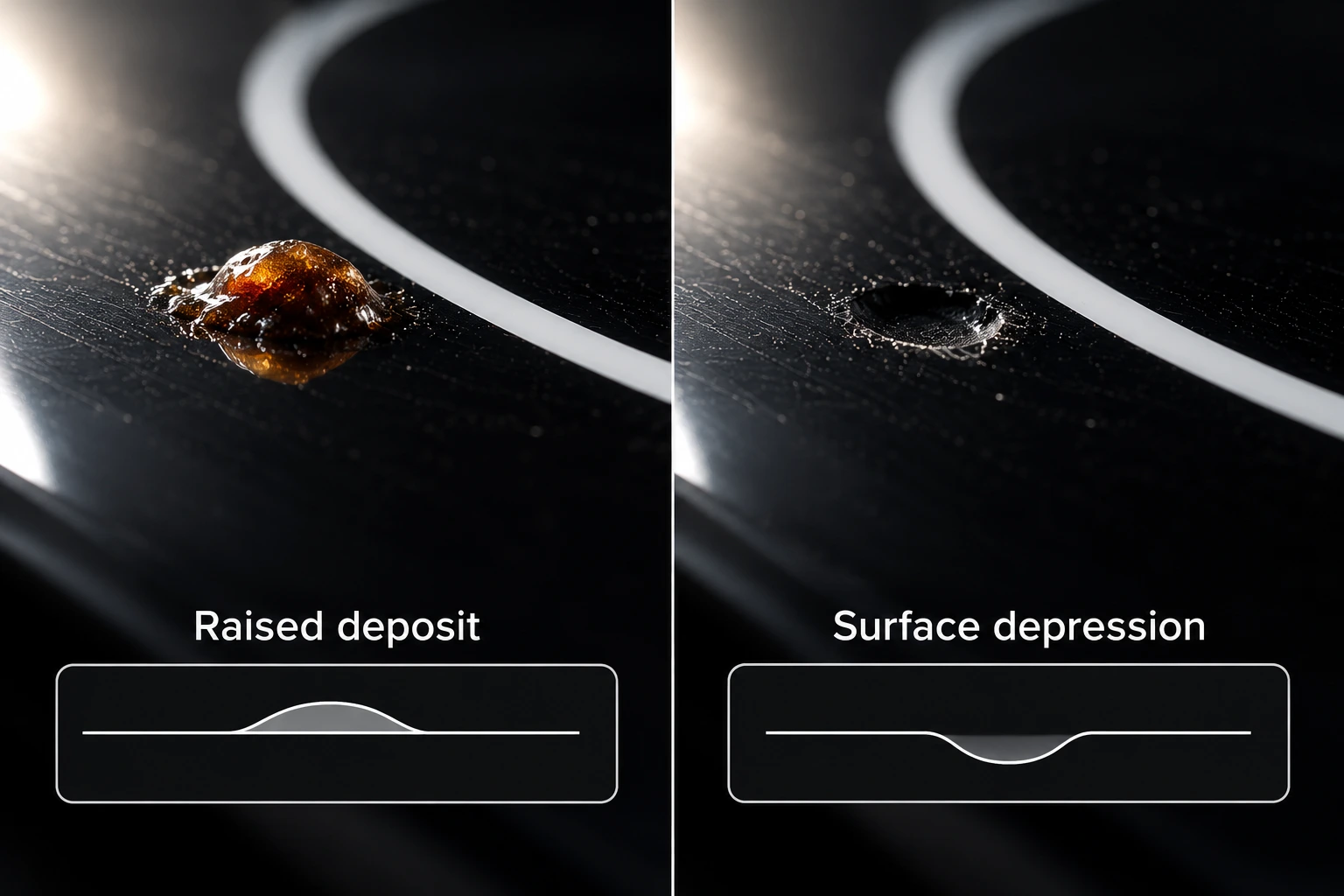
If normal cleaning is allowed for the condition, use only the process and accessories approved for that appliance. Record what changes after that single controlled cleaning step. A deposit may diminish or disappear; a persistent mark still does not automatically prove a pit. Where the surface appears broken, a crack is present or the condition is uncertain, stop the cleaning experiment and ask for an inspection instead.
The purpose of this article is damage identification and the service decision. For routine care of an intact surface, see our glass cooktop cleaning and maintenance guide. Keeping those tasks separate prevents a damaged surface from being treated as a stubborn stain that simply needs more force.
Why sugar and melted material deserve special attention
The Whirlpool ceramic-glass maintenance guidance warns that sugary spills allowed to cool can adhere and cause pitting or permanent marks. The special-care section of this GE appliance manual also identifies sugary spillovers and melted plastic as pitting risks. These are concrete examples of why a spill response should be planned before cooking, rather than improvised after material has bonded to the top.
Hot-spill procedures differ from normal cool-surface cleaning and can carry a burn risk. Read the exact appliance instructions, including protective equipment and approved tools. Do not apply an online scraper angle from another model or another manufacturer’s page as a universal rule. If you cannot safely perform the specified response, prioritize personal safety and contact the appliance support team. Never put bare fingers into hot syrup or attempt to pull bonded material away by hand.
A later pit should not automatically be blamed on sugar. The history matters: what was cooked, whether a spill was present, which cleaning steps were taken and whether an impact occurred. Without that evidence, an assertion about the cause is speculation. For a supplier discussion, describe the observation first and attach the history separately. This is especially useful when the panel, printed decoration and appliance assembly are supplied by different parties.
| Observation on a cool surface | Possible category | Next appropriate step |
|---|---|---|
| Raised dark residue that changes after approved cleaning | Adhered soil or transferred material | Follow the model’s care process; stop if damage appears |
| Persistent small depression under side lighting | Suspected material loss | Document and obtain service assessment |
| Colored sheen without a visible depression | Film, deposit or optical effect | Assess as discoloration before assuming pitting |
| A line spreading away from a spot | Possible crack | Stop use and follow isolation/service instructions |
| Chipped edge or damage near a cutout | Localized mechanical damage | Do not load or manipulate the panel; request inspection |
The categories above are observational, not a safety classification. They help prepare a useful report without claiming that the cause or remaining strength has been measured.
Can you keep cooking on a pitted glass top?
Do not make that decision from the size of a spot or a reassuring comment on a forum. Whether a damaged appliance may remain in service depends on the actual condition and its manufacturer’s instructions. A tiny visible mark does not reveal its depth or the condition below it. A panel that still heats food has not thereby passed a damage assessment. If the appearance is new or uncertain, arrange qualified advice before further operation.
If you see a crack, follow the appliance’s stop-use procedure. Do not pour water over a hot top to inspect it, deliberately cycle the zone to see whether the damage grows, or press on the spot. A cool photograph may be useful for triage, but it cannot establish strength or electrical safety. Explain whether the mark is near an edge, cooking zone, control area or cutout; the location helps the service provider decide what information is needed.
Our induction and infrared glass-ceramic comparison explains why similar-looking surfaces can belong to different systems. Induction does not make damage irrelevant, and a radiant cooker should not be assessed using assumptions taken from a different heating technology.
Why fillers, sanding and polishing are poor repair choices
A filler may disguise a mark without restoring the approved panel structure or the intended working surface. Its appearance at room temperature does not establish its behavior under repeated cooking, cleaning and thermal cycling. Do not use resin, windshield repair liquid, nail coating or a household adhesive to make a damaged cooktop look whole. No compatibility or safety claim for those repairs is established here.
Sanding or aggressive polishing removes more surface material and can alter the finish or decoration. It is not the same as removing a deposit with an approved cleaner. Do not use a drill-mounted abrasive or a metal tool to chase a pit until it disappears. If material is missing, the next task is an assessment and an approved replacement or service decision, not progressively stronger cosmetic treatment.
Keep before-and-after photographs if an approved cleaning step has already been attempted. Report the exact cleaner, pad or tool used instead of describing it as gentle. This helps distinguish the original condition from changes introduced during cleaning and avoids repeating a process that may make the surface harder to assess.
Build a useful damage record
Photograph the whole cool appliance so the location is clear, then take a closer view under diffuse light and a second view with light coming from the side. Keep the camera angle and lighting consistent if you document a change. Place a scale beside the area only if this can be done without contacting or loading suspect damage; do not claim a depth from a two-dimensional photograph.
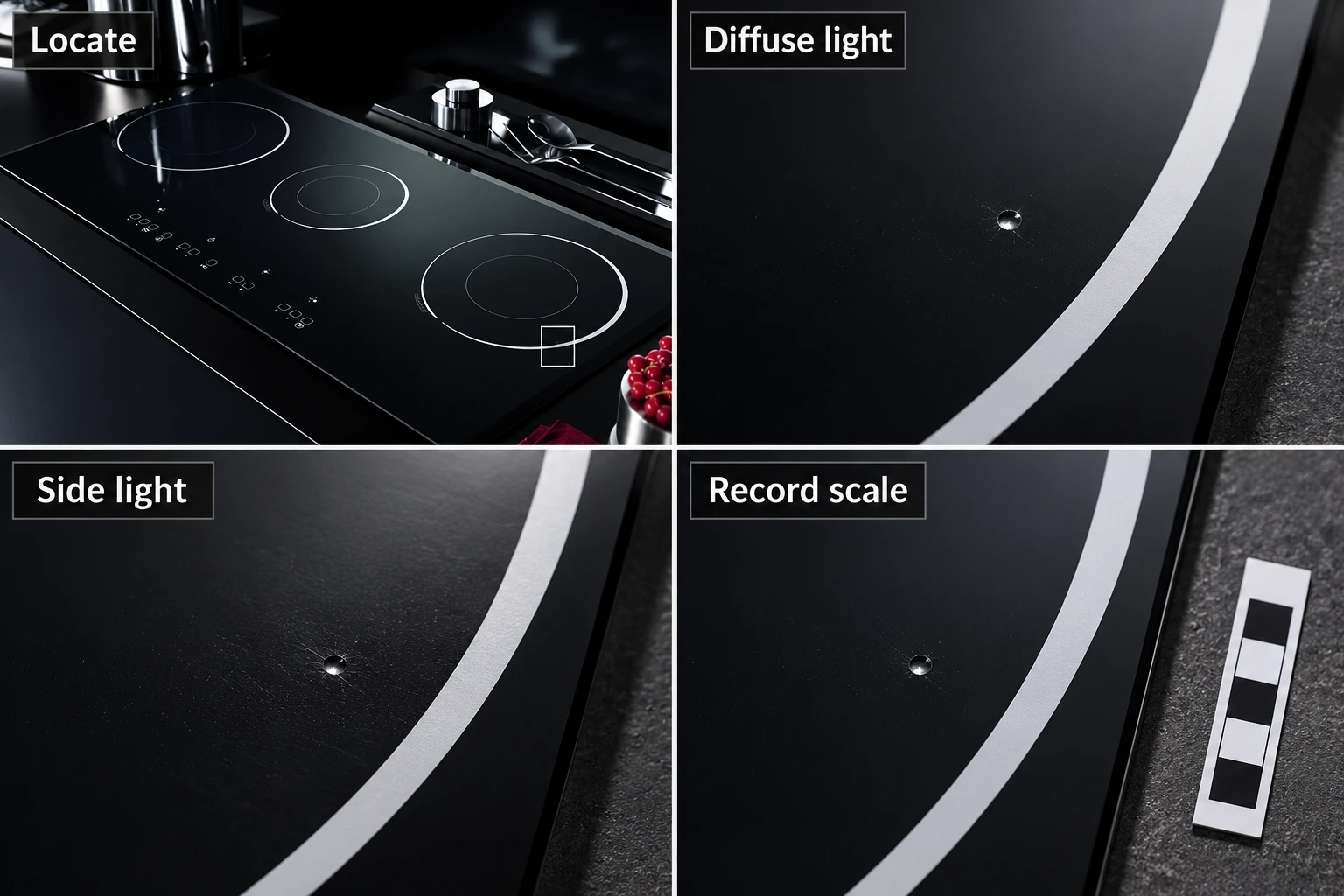
Record the date the mark was first noticed, the zone used, cookware, food or spill involved, and the cleaning history. Distinguish what you witnessed from what you infer. For example, “noticed after cooking jam” is an observation; “manufacturing failure caused by jam” combines two unverified conclusions. If there was an impact, note the object and circumstances without trying to recreate it.
Send the appliance model, serial information and photographs to the responsible service channel. Ask whether use must remain stopped, whether an in-person inspection is needed, and whether an approved replacement assembly is available. A materials supplier may need the drawing and glass batch information as well, but the appliance owner should not remove the top just to obtain those details.
Prevent the next incident through handling and preparation
Keep pan bases clean and lift suitable cookware rather than dragging it over the surface. Avoid storing hard heavy objects where they can fall onto the top. Keep plastic packaging and other meltable items away from cooking zones. Read the spill procedure in advance so the recommended tool and protection are available without reaching across hot cookware.
Routine care should preserve evidence as well as appearance. If the same type of mark keeps recurring, record the cookware, cleaner and operating sequence instead of repeatedly applying more abrasive force. A supplier or service team can then evaluate a pattern. For an OEM program, use our panel cleaning and handling documentation guide to make those instructions repeatable.
What OEM buyers should ask a panel supplier
Reference the actual drawing, material designation, decoration and intended appliance use when discussing damage. Kanger’s black glass-ceramic cooktop product is the relevant product reference, but a website picture cannot define the acceptance criteria for your assembly. Request the approved specification, care compatibility requirements and the process for investigating returned samples.
Agree who evaluates surface marks, who makes the appliance service decision, and what evidence must accompany a return. Preserve representative unused samples where the quality plan requires them. Compare damage records against receiving inspection rather than assuming every mark arose either in production or in use. The value of the record is that it supports a traceable decision without inventing a cause.
Further learning: observing and cleaning glass
The Corning Museum of Glass video introduces the examination and conservation of glass objects. Use it as background for careful observation, not as a cleaning procedure for an installed cooktop or a repair for missing material. Follow the appliance manual.
Video: Glass Conservation, Corning Museum of Glass. Open the educational video on YouTube.
Frequently asked questions
Can a cleaner remove a real pit?
A cleaner can remove some deposits, but it cannot replace glass that is missing. A persistent suspected depression needs an assessment rather than stronger cleaning.
Is a pit the same as a scratch?
No. They describe different visible shapes, and neither description by itself establishes cause, depth or safe continued use.
Should I fill a pit with glass repair resin?
Do not use an improvised filler on a cooking surface. Ask the appliance manufacturer for the approved service or replacement route.
Can a photo prove that sugar caused the damage?
No. A photograph can document appearance, but the spill history, cleaning record and inspection are needed before attributing a cause.


