 Kanger Glass-ceramic Co., Ltd.
If a hot surface light stays on after cooking, it may be warning about residual heat rather than saying that a heating element is still switched on. The meaning depends on the appliance model and the exact light or symbol. Read the manual, confirm the controls are off without touching a suspect surface, and keep people and objects away while it cools. If the warning never clears under the conditions described in the manual, appears without recent use, or accompanies uncontrolled heating or another fault, stop using the appliance and request service. Do not bypass the indicator or replace the glass based on the light alone.
Identify the indicator before diagnosing the problem
A cooktop can have a power light, an element-on light, a residual-heat symbol, a warming-zone indicator and fault messages. They are not interchangeable. Record the exact label, icon or letter and which part of the display is lit. A photograph taken from a safe distance is often more useful than describing every illuminated symbol as a burner light.
Find the model’s control description and match the symbol to it. Some appliances use H or h; others use words, a colored lamp or a zone display. The Samsung electric-cooktop operating guide is an example of a manufacturer explaining a hot-surface warning that remains after switch-off. It applies to the models and features described there, not to every cooker with a similar-looking glass top.
Also distinguish a warning from a visible radiant element. A dark zone is not proof that its surface is cool. A light that says the control is on does not necessarily measure the glass temperature. When the symbol is unfamiliar, keep the surface clear and consult the manual rather than experimenting with controls until it disappears.
Why heat can remain after the controls are off
Switching off electrical input does not instantly remove energy stored in cookware and surrounding materials. A hot pan can continue transferring heat to the top, and a radiant cooking assembly can remain hot after its element stops glowing. Induction heats suitable cookware through a different mechanism, but the working surface can still receive heat from the pan. For that reason, an induction label is not permission to touch a recently used zone.
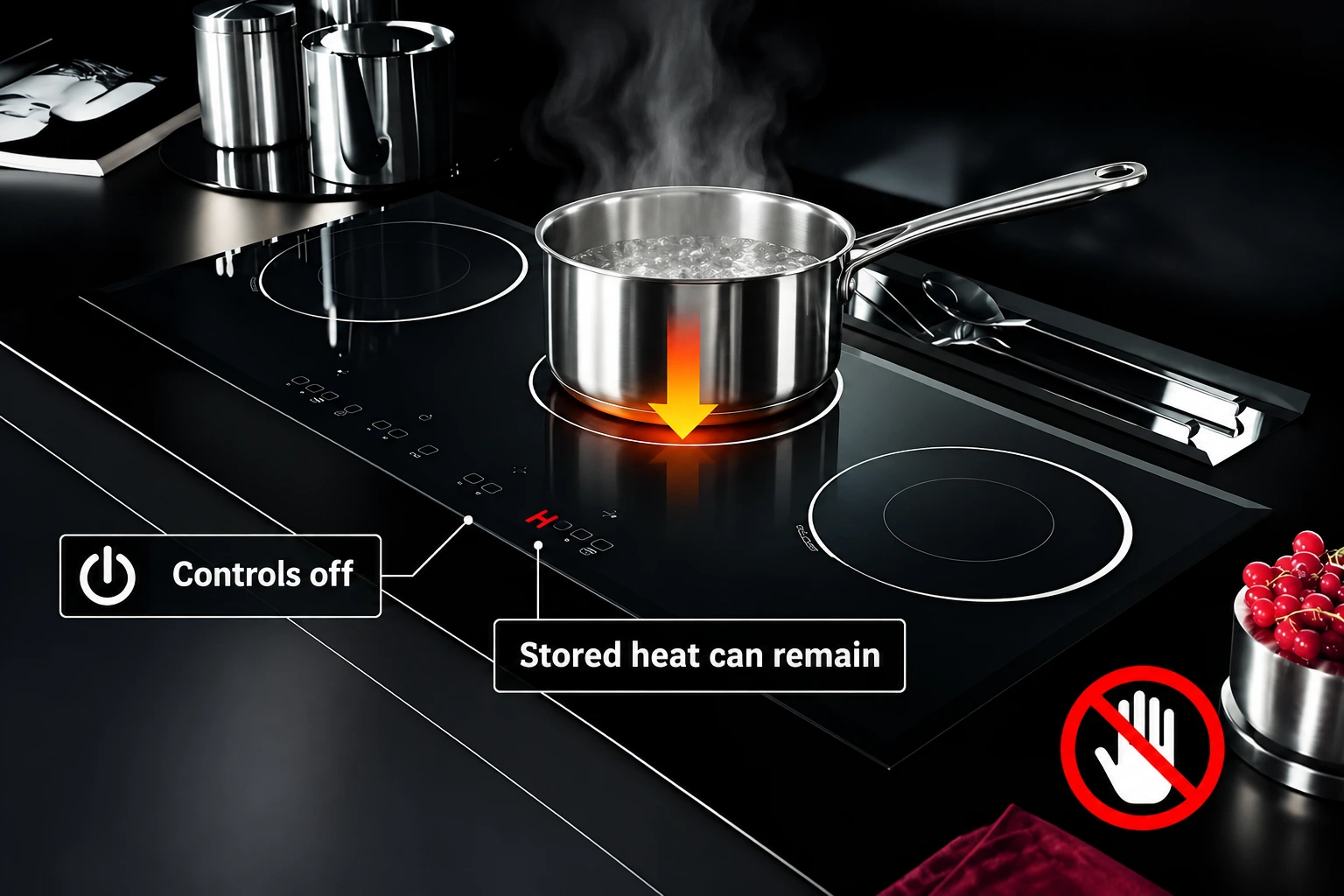
The GE explanation of a hot glass smooth-top surface describes retained heat and the purpose of surface warnings. Cooling depends on the preceding cooking conditions and the installed system. There is no universal number of minutes after which every cooktop indicator must turn off. A long, high-power cooking task should not be compared casually with a short warm-up.
Do not cool the top with poured water, ice or a wet towel. Do not touch it to prove that the warning is wrong. Keep children, pets and meltable items away and follow the model’s cooling instructions. If a hot pan is moved, use normal safe cookware handling and the approved heat-resistant resting location; never move it merely to perform an unnecessary diagnostic experiment.
| What you observe | What to establish | Safe next step |
|---|---|---|
| Warning remains immediately after cooking | Is it the model’s residual-heat indicator? | Keep clear and follow normal cooling instructions |
| A power or element-on lamp remains | Are all relevant controls correctly off? | Read the control description; seek advice if behavior is unexplained |
| Warning persists without recent cooking | Was the appliance recently used, reset or exposed to another heat source? | Record history and contact support rather than touching the top |
| Heating continues unexpectedly | Is there a possible control or appliance fault? | Stop use and follow safe isolation/service instructions |
| Warning disappears after power interruption | Could heat still be present despite the dark display? | Continue treating the surface cautiously |
This is a decision aid for observations. It does not identify a failed component or certify a surface temperature.
Confirm the operating state without opening the appliance
Check that the controls for every used cooking zone, including any warming area, are off according to the manual. On some products, the oven control and cooktop controls perform different tasks, so pressing one off button may not address every function. Do not force a stiff knob, repeatedly cycle a suspect switch or remove it to investigate an electrical fault.
Record when cooking ended and whether a hot pan remains on the top. Note which zone was used, the approximate cooking duration and whether another appliance function was operating nearby. These details help support interpret the observation. They are not a reason to recreate a fault with another heating cycle, particularly if the cooker behaves differently from its instructions.
Our induction and infrared panel comparison explains the distinction between heating systems. Similar black glass surfaces do not establish identical controls, temperature sensors or warning logic. Identify the complete model rather than selecting a troubleshooting method from appearance alone.
Know when a persistent warning needs service
Contact the appliance maker when the indicator does not behave as the manual describes, never appears when expected, or remains unexplained after the specified normal cooling process. The Samsung temperature-issue support page directs users to service for an indicator that does not operate correctly. That is a model-support boundary, not an instruction to replace a particular sensor yourself.
Stop using the cooker immediately if there is uncontrolled heating, smoke, a burning smell, visible cracking, an electrical warning or another serious abnormality. Follow the manufacturer’s safe shutdown and isolation process. If you cannot identify a safe way to isolate the appliance, get qualified help. Do not pull out a built-in cooker or reach behind a hot unit to look for wiring.
Resist online suggestions to bridge a switch, disconnect a lamp or defeat a warning simply because cooking still appears possible. An indicator can be part of a wider safety arrangement. A disconnected display hides information without correcting its cause. This article provides no energized measurements, panel-removal steps or internal repair procedure.
A reset is not proof that the surface is cool
Use a reset only if the exact model’s instructions prescribe one for the observed condition and you can perform it safely. Record the display and timing first so useful information is not lost. Repeated resets can obscure a recurring fault, and an indicator that briefly disappears is not evidence that the underlying condition has been resolved.
A power interruption can also remove a visible warning while heat remains. For example, the residual-heat warning in this Dacor induction-cooktop manual explicitly discusses the loss of displayed heat information when power is interrupted. Follow the instructions for your own appliance and never use a dark display as a touch test.
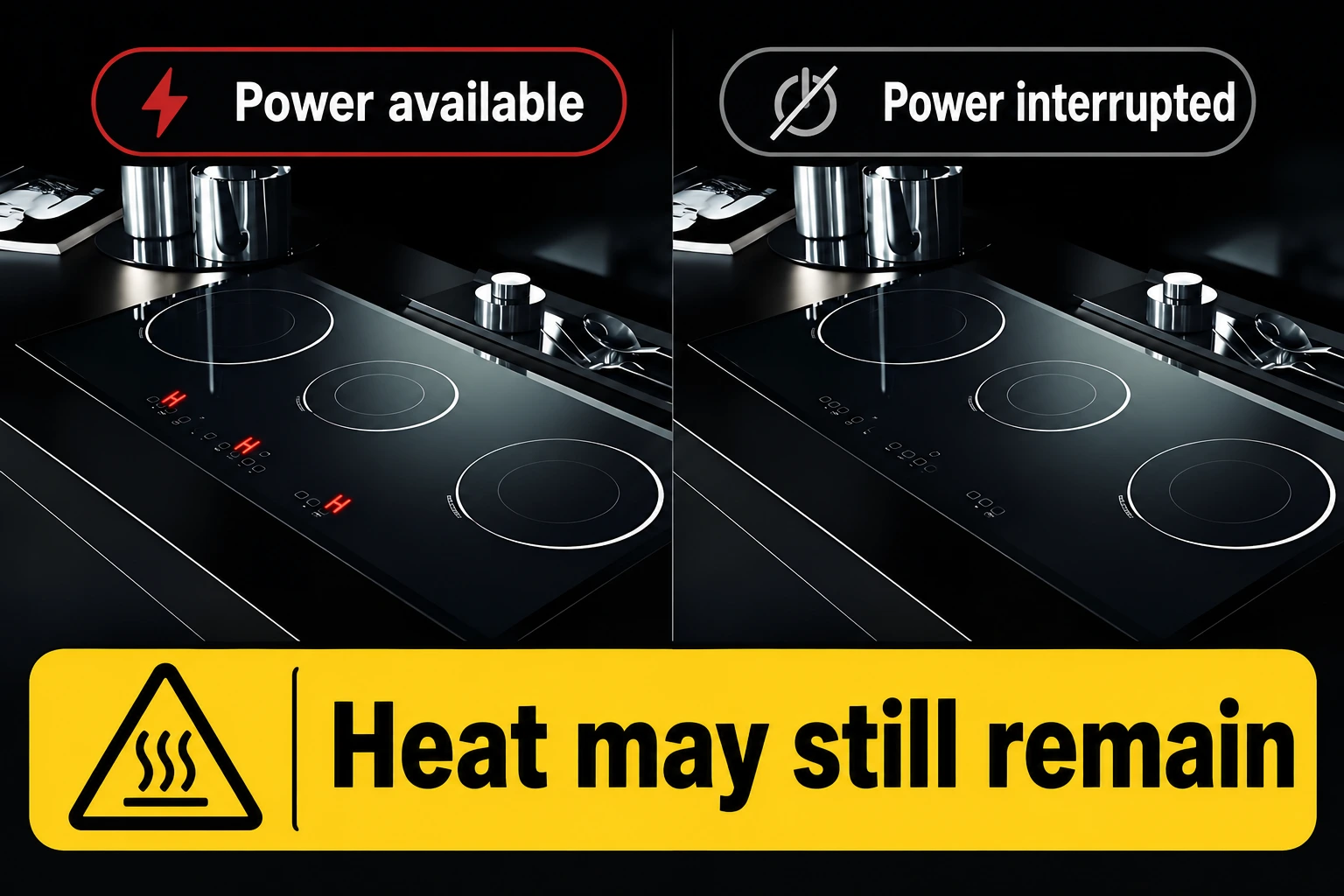
After an approved reset, follow the model’s directions about further use and service. Do not deliberately heat a zone just to see whether a warning returns when the original fault remains unexplained. If support asks for another observation, confirm that it is appropriate for the actual condition and remain within the user-level checks in the manual.
Prepare information that helps the service team
Send the model, serial information, exact indicator, affected zone and when the display first behaved unexpectedly. Include the cooking history, any power interruption, error code and whether there was an unrelated installation or cleaning change. Separate witnessed facts from assumptions: “H remained visible after the controls were off” is clearer than “the glass thermostat is broken.”
Provide photographs of the whole control area and a closer view of the symbol, obtained without leaning over hot cookware. Do not include a claim that the surface is cold unless it was established by an appropriate method; touching it is not an acceptable way to prove that. Let the service team decide whether inspection or measurement is needed.
If another symptom occurred, describe it separately. A failure to detect cookware belongs with the pan-detection checks; noise belongs in a sound record. Combining several symptoms into a guessed glass defect can send the investigation in the wrong direction.
Why replacing the glass is not the first diagnosis
The top panel, printed symbols, sensing arrangement, control electronics and installed heating system are separate parts of an appliance design. A persistent warning does not identify which part, if any, is faulty. Replacing glass without a qualified diagnosis can leave the original issue unresolved and introduce fit or assembly risks. Use the appliance manufacturer’s approved replacement and service route.
Kanger’s black glass-ceramic cooktop product is the material and surface reference for this article. The illustrative H symbol in our images is a concept, not a claim that every Kanger panel includes an electronic indicator. Buyers must specify the approved drawing, decoration and complete appliance interface rather than infer features from an illustration.
What OEM teams should verify at approval
Define the warning symbol, visibility, control description and test conditions with the appliance engineering team. Keep the panel drawing revision with the approved appliance configuration. Check that printed markings and instructions remain understandable under the specified viewing conditions. If behavior is temperature-based or time-based, the appliance documentation should explain the intended user response accurately.
Record the operating sequence used for qualification, including what happens at switch-off and after a power interruption. Agree responsibility for the finished appliance test rather than asking a loose panel photograph to prove warning performance. Use our panel handling and care documentation guide to keep cleaning instructions consistent with the approved surface.
Further learning: stored thermal energy
Khan Academy explains heat capacity and the energy associated with a temperature change. This provides background for understanding why switching off a control does not instantly remove stored heat; it is not a model-specific fault diagnosis or repair procedure.
Video: Heat capacity | Thermodynamics | AP Chemistry | Khan Academy, Khan Academy. Open the educational video on YouTube.
Frequently asked questions
Does an illuminated hot-surface light mean the burner is on?
Not necessarily. A residual-heat warning can remain after heating input is off. Identify the exact indicator in the model’s manual.
How many minutes should the warning stay on?
There is no universal time. The appliance design and previous cooking conditions matter; use the model’s guidance and contact support for unexplained behavior.
Can I touch the top to check whether the light is wrong?
No. Treat the warning cautiously and do not use your hand as a temperature test.
Should I replace the glass if the warning never clears?
Do not diagnose the glass from the light alone. Stop use when appropriate and obtain the appliance’s approved service assessment.


