An induction hob saute pan should be designated for induction, fit the hob’s cookware requirements and leave usable access to its handles and controls. The straight-sided body is useful to evaluate separately from a flared skillet or a deep saucepan. Check the selected model, its usable bottom and any matching lid before buying. A large top diameter or a stainless finish alone cannot establish compatibility, working capacity or comfortable handling.
This guide concerns choosing a straight-sided saute vessel for a glass-surface induction appliance. It addresses the working area, turning tools, lid handling and lifting route rather than ranking brands or prescribing recipes. Begin with the task you need the pan to perform. Then obtain the exact cookware and hob instructions so the decision rests on documented suitability rather than a photograph or a cookware-set description.
Product names are not consistent across suppliers. Look at the shape as well as the word saute: a straight-sided shallow vessel differs from a conical saucier or a flared frying pan. Confirm which body, handle and lid are supplied in the selected size. A photograph of a product family may show accessories that are sold separately or belong to a larger version.
Write down the purpose of the purchase in practical terms. You might need a broad cooking floor, room to turn food with a utensil, or a compatible lid for a later covered stage. These requirements point to different checks. Avoid buying by advertised capacity alone when the real limitation is how much usable floor space or handle access remains on your hob.
ENERGY STAR guidance on electric cooking products explains that induction transfers energy through magnetic interaction with appropriate cookware. That supports checking the actual base designation. The wall material and surface finish do not describe every part of a multilayer bottom. Obtain the model-specific compatibility information and use any supplier-recommended magnet check only as preliminary screening, not a substitute for the appliance’s cookware guidance.
Check the delivered pan as well as the sales listing. Record its model and size, and compare the usable bottom dimensions with the hob instructions. Our guide to measuring the usable pan base explains why an upper-rim diameter is not the entire fit question. Do not assume that every size within an induction-labeled cookware range has the same recognition behavior on every appliance.
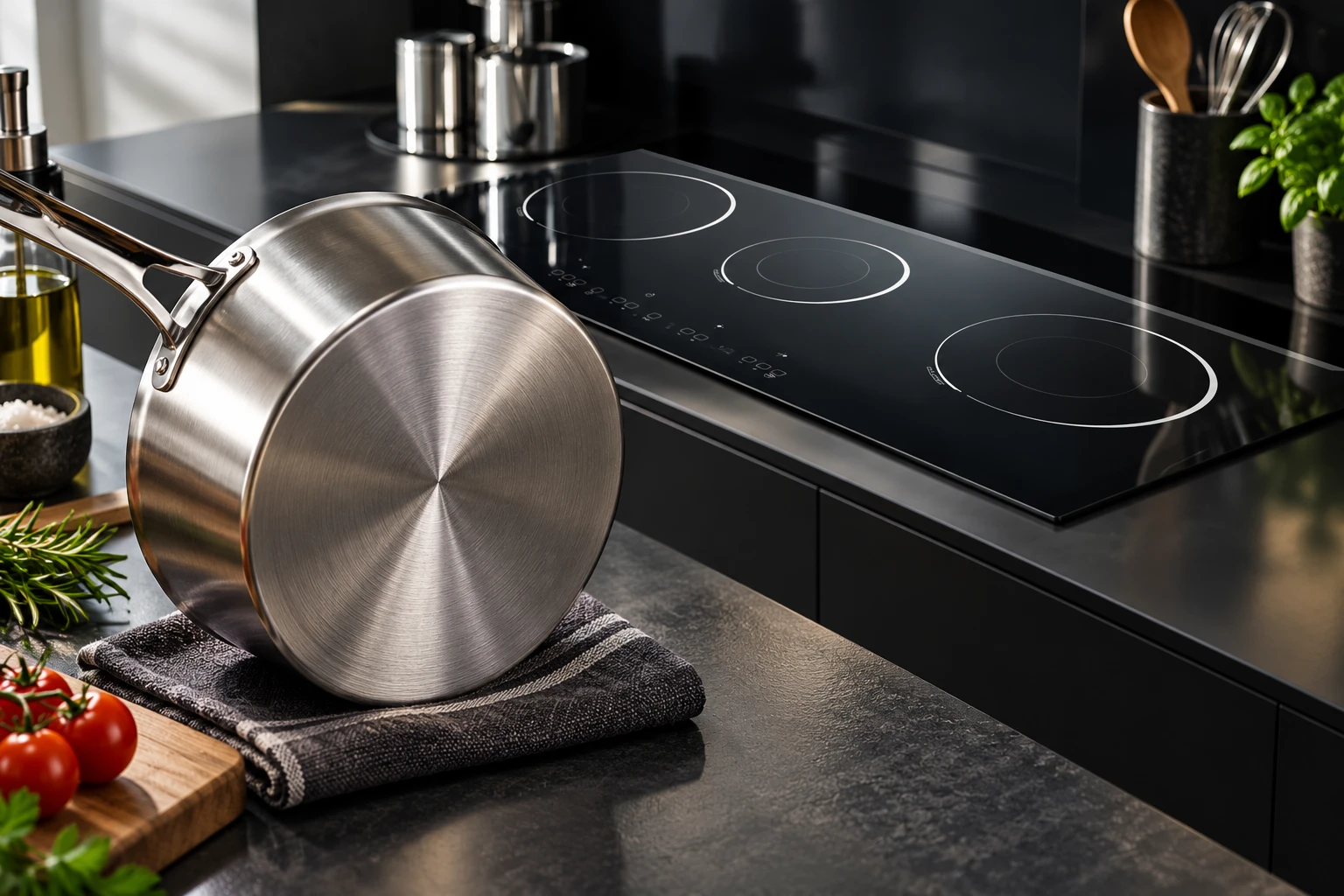
Measure the dimensions the manufacturer identifies as relevant rather than inventing a heating area from the nominal size. The cooking floor, wall transition and upper rim describe different things. A straight wall can give a different approach for a spatula than a flared edge. Rehearse the intended stirring or turning movement with a cool, empty pan and an appropriate utensil.
The useful question is whether the task is manageable without leaning over another cooking position or pushing the vessel away from its required placement. If the tool cannot reach comfortably, another vessel shape or size may be more suitable. Do not solve an access problem by tilting the pan onto its edge or repeatedly dragging it across the glass during operation.
Confirm whether the pan includes a lid and whether that lid is intended for the exact rim. Similar diameter labels do not prove the seating depth, knob clearance or handling method matches. Check the maker’s instructions for removing the lid and for placing it on a suitable resting surface. Treat replacement lids as components needing their own fit check.
Keep hob use and oven use separate in the purchasing record. If a recipe includes an oven stage, the body, handles, lid and knob all need the relevant permission. This guide supplies no universal temperature limit. A lid that fits well on the hob is not automatically approved for an oven, grill or other heat source simply because the pan body is.
The induction principle below follows ENERGY STAR guidance on electric cooking products. Product dimensions, operating limits and handling requirements must come from the actual pan and appliance documentation. This table is a purchasing checklist rather than a set of numerical limits for every saute pan.
| Question | Evidence to collect | Practical decision |
|---|---|---|
| Does the base suit the hob? | Exact induction designation and usable bottom dimensions | Compare with the appliance cookware guidance |
| Is the floor accessible? | Body shape and intended utensil | Rehearse turning with the pan cold and empty |
| Does the lid match? | Specified lid model and rim fit | Resolve missing parts before a covered task |
| Can the load be handled? | Grip arrangement and maker’s handling method | Choose a manageable vessel and lifting route |
| Is oven transfer intended? | Separate approval for all components | Do not infer a limit from appearance |
A pan can fit a zone while its handle creates an awkward arrangement. Rehearse the permitted placement with the appliance off. Look at the main grip, any helper handle and the path between the pan and a stable receiving surface. Our guide to keeping cookware handles clear of controls covers the related question of preserving access to touch controls and nearby cooking positions.
A helper handle is a feature to check in the exact instructions, not a guarantee that a particular filled load is manageable. Consider the complete intended contents and the user’s ability without attempting an unsafe hot trial. If the task requires more control than the selected vessel allows, choose a suitable alternative. Do not add improvised grips, clamps or supports to compensate for poor access.
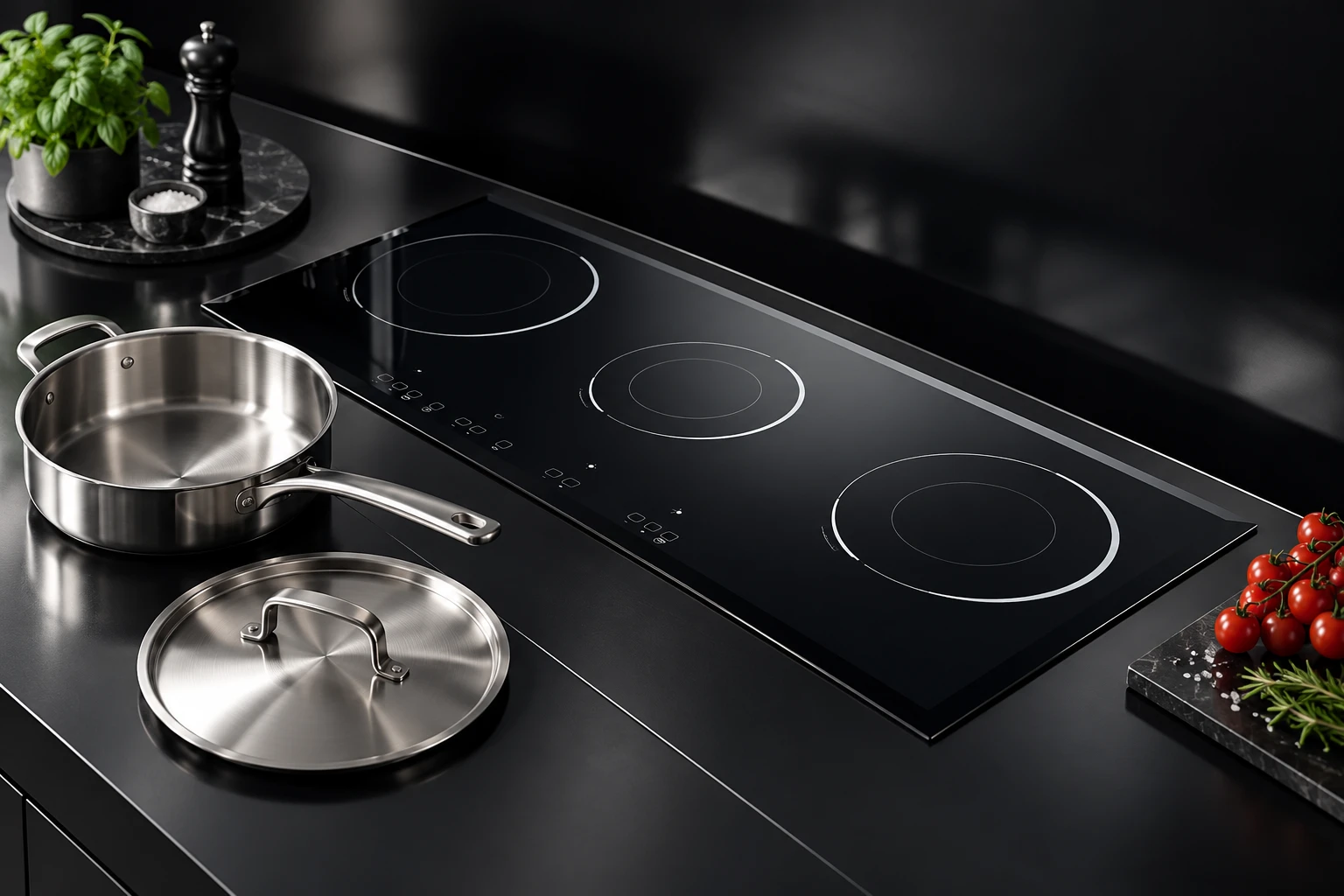
An advertised liquid capacity does not automatically tell you the useful working quantity for turning, stirring or covering food. Follow the pan instructions and the intended recipe together. Leave whatever space that documented combination requires rather than applying an invented universal fill fraction. A vessel selected for a broad cooking floor can still become difficult to move when heavily loaded.
For purchasing comparisons, describe the intended task instead of asking only for the biggest pan. Include whether the vessel must be lifted, whether the lid is removed repeatedly and where it will rest afterward. A smaller manageable arrangement may be more useful than extra nominal capacity that obstructs another zone or makes the final transfer awkward in the actual kitchen.
Use the pan and hob guidance for initial heating, adjustment and stopping. A video made on another appliance cannot supply a universal numbered setting, boost recommendation or heating time. Coatings and constructions may have their own requirements. Resolve any conflict between the intended cooking method and the documented equipment before switching on rather than compensating with repeated high-power attempts.
U.S. Fire Administration cooking-safety guidance advises staying with cooking and keeping combustible items away from the stovetop. Prepare the utensil, ingredients and lid resting space before starting. A fitted lid does not make the process self-supervising. Keep access to the controls clear, and follow the relevant stop procedure if an abnormal condition occurs. This article does not replace the appliance’s instructions or local fire guidance.
If the hob does not recognize the pan, record the displayed message and consult the cookware section of the appliance instructions. Check the exact model, usable bottom and permitted placement. Do not repeatedly move the vessel or introduce an unapproved adapter to force a response. A pan working on a different appliance does not prove its base meets this one’s documented requirements.
If the difficulty is turning food, reaching a grip or removing a lid, describe that separately to the supplier. Those observations concern the shape and workflow rather than proving a glass defect or electrical fault. Useful support records include the pan model, hob model, selected zone and the task that was difficult. Avoid diagnosing the cause from a single photograph or a marketing claim about even heating.
Follow the maker’s cleaning method for the body, base, handle joints and lid. Do not assume that an abrasive or chemical suitable for one finish suits every saute pan. Check a loose grip, damaged coating or distorted bottom before use. Cleaning cannot establish that a visibly damaged component has become fit for service again, and a lid should not be used to hold an unstable pan down.
Lift cookware instead of dragging it over the glass. Our article on understanding glass surface marks helps separate ordinary surface deposits from concerns needing service advice. Maintain the panel according to the appliance instructions, including the stated cooling condition before cleaning. Do not use the glass surface as a repair bench or attempt to flatten a cookware base against it.
Record the pan model, size, base information, matching lid and hob model together. Keep written supplier answers where a feature was unclear. Recheck a replacement even when its nominal capacity and appearance resemble the old vessel. Shared kitchens should keep the correct lid with the pan and make the actual instructions available to the person using it.
Kanger’s Kanger black glass-ceramic cooktop panel and black glass-ceramic material overview provide component and material context for the glass cooking surface. They do not certify an individual pan or promise a finished appliance’s heating performance. OEM buyers should document glass-panel geometry, printing and integration requirements separately, then validate complete-appliance cookware suitability through the responsible process. That distinction keeps the sourcing discussion accurate and the saute-pan decision practical.
This neutral educational video explains induction heating and cookware geometry. It provides background for the lower pan base, not approval of a saute pan, pasta insert, screen or finished appliance.
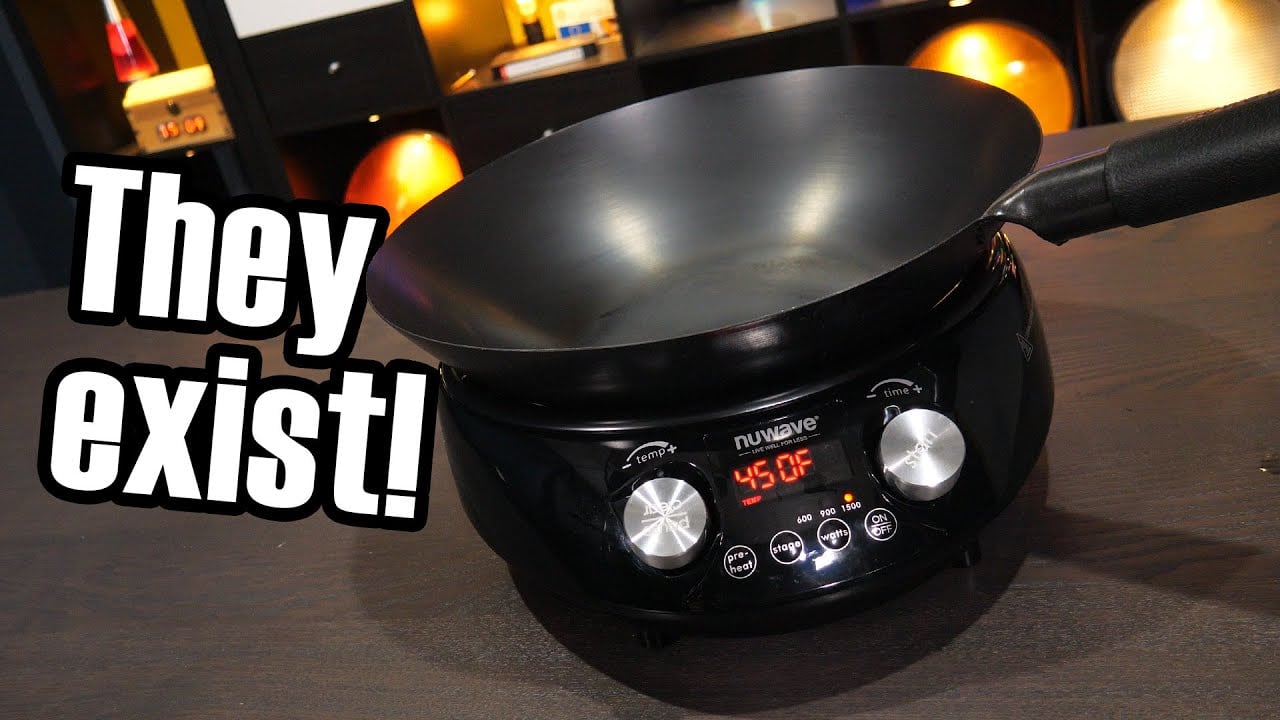
Video: Induction cooking – but what about woks?, Technology Connections. Open the educational video on YouTube.
No. Check the actual body, base and supplied components; naming differs across product ranges.
No. Compare the designated usable bottom and exact cookware model with the hob instructions.
No. Follow the maker’s handling method and choose a complete load and route the user can manage.
No. Oven use needs separate permission for the lid, knob, handles and pan body.



