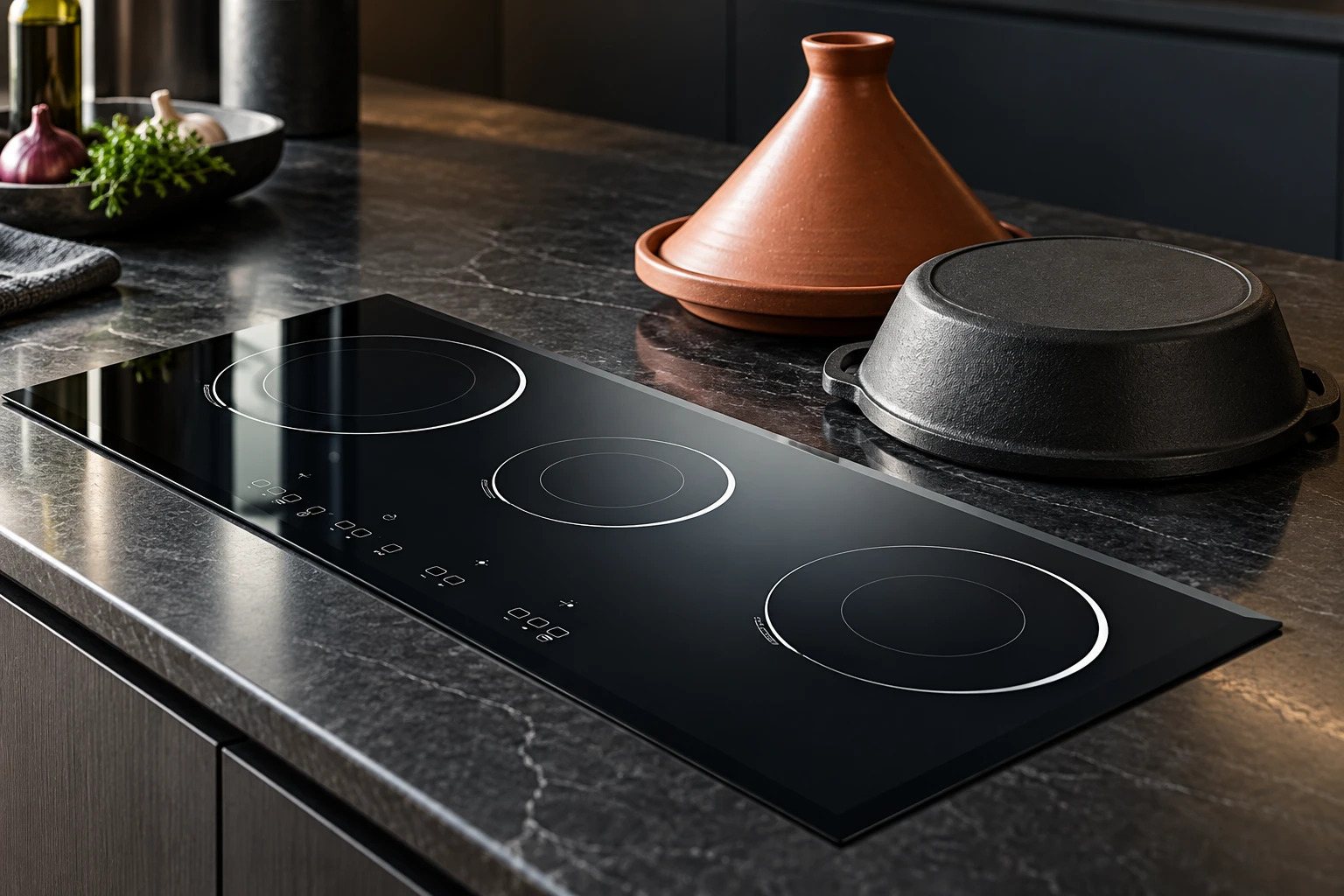
An induction hob tagine needs an exact product designation that permits induction use; a traditional shape or ceramic appearance does not establish that permission. Check the lower base, matched conical lid and complete model instructions together. Some tagines use a metal base, while specialized constructions may follow other designs. Do not transfer one product’s compatibility statement, preparation method or power guidance to every vessel with a conical lid.
This guide addresses product selection and cold handling around a glass cooking surface. It supplies no recipe, universal seasoning method or cooking temperature. The objective is to distinguish cooking cookware from serving pieces and to understand which base is approved for the actual appliance. Any adapter, support or alternative heat source is a separate documented decision rather than an automatic solution.
Start with the maker’s intended-use statement and exact model number. Decorative or serving tagines can look similar to vessels intended for direct cooking. A photograph of food inside a dish does not establish permitted heat sources. Confirm what is sold, including whether the lower base and conical lid form the stated matched set.
Keep the product label and instructions available when comparing versions. Similar-looking tagines within one range may differ in material, size or purpose. If a listing combines several options, ask which specific version permits the intended use. Do not test an uncertain item on the hob to discover its suitability through heating. Select a documented alternative when the necessary information cannot be obtained.
ENERGY STAR guidance on electric cooking products explains the magnetic interaction used by induction with suitable cookware. That directs attention to the actual lower-vessel construction, not the silhouette of the lid. A plain clay vessel and a specialized induction-designated product need not have the same behavior. Neither the word ceramic nor the color of a finish establishes the complete construction.
A preliminary magnet check may be useful where the supplier recommends it, but it does not establish all aspects of the product’s permitted use. Read the exact designation and the appliance’s cookware guidance. Do not assume a lid needs to be a magnetic heating base; it instead needs to be intended for the documented tagine assembly and its handling conditions.
Search results include induction-designated tagines as well as traditional clay cookware. That mixture can make general advice misleading. A specialized ceramic product’s permission does not extend to an ordinary ceramic vessel. Equally, a metal-based tagine’s instructions should not be used to prescribe care for a different material. Keep any product-specific clarification with that exact item.
Before ordering, obtain the base material description, size designation, supplied lid and permitted heat sources. Ask for the relevant instructions rather than a broad assurance that the range is versatile. This guide intentionally avoids recommending a brand or ranking products. A buyer benefits more from a traceable match between the actual vessel and appliance than from a list of superficially similar options.
Obtain the usable base dimensions separately from the widest upper rim. The shallow lower vessel may flare outward, leaving a different area relevant to the hob guidance. Our guide to measuring the usable pan base explains that distinction. Compare the actual measurement with the selected hob model’s instructions rather than inferring fit from the diameter in a product title.
Inspect the cool, empty base on a stable surface. It should sit as the maker intends, with a clean underside and no unsupported rocking. Do not move it partly off the required position to accommodate the cone or another vessel. If the documented arrangement cannot fit without obstructing controls, choose another permitted setup rather than inventing support or forcing the cookware into place.
Confirm the lid belongs to the base and that its rim seats as instructed. A replacement of a similar nominal diameter may have a different seating depth or grip. Do not grind, clamp or modify it to imitate a matched product. Record missing or damaged parts before the vessel is used and obtain the responsible supplier’s guidance.
Rehearse lifting the cold lid and setting it down on a broad, stable, appropriate surface. Consider its height, shape and grip rather than balancing it on a narrow edge. Follow the maker’s instructions for protection and handling during use. A conical shape does not establish that the top remains cool or that any part is safe to grip without the specified method.
The induction principle follows ENERGY STAR guidance on electric cooking products. Preparation, power, filling and care requirements belong to the exact tagine and appliance documentation. This checklist does not provide generic operating limits or authorize ordinary clay cookware on induction.
| Check | Evidence to obtain | If unresolved |
|---|---|---|
| Intended purpose | Cooking use for the exact item | Do not heat a serving-only piece |
| Induction designation | Specific base and model approval | Choose a documented alternative |
| Usable bottom | Dimensions and hob placement guidance | Resolve fit before heating |
| Conical lid | Matching rim and grip instructions | Obtain the intended component |
| Preparation and care | Material-specific maker instructions | Do not transfer soaking or seasoning from another design |
An induction adapter is an additional product with its own limits and appliance compatibility questions. A general internet recommendation is insufficient to establish permission for a particular hob and vessel. Check the appliance and cookware instructions and any accessory requirements together. Do not treat the presence of a metal disk as a universal workaround for missing tagine approval.
The same applies to support rings and improvised spacers. They change the arrangement and need explicit support from the responsible product guidance. If that documentation is absent, do not experiment with high power to see whether the vessel heats. A directly designated compatible tagine or a different appropriate documented cooking method is the more usable procurement choice.
Assemble the permitted parts cold and empty and check the view of the controls. Include the space needed to lift the cone without hitting a cabinet or extractor structure. Our guide to keeping cookware handles clear of controls explains access around the panel; a tall tagine lid adds another dimension to that check. The user should not have to reach across another active pan.
Plan where the lid and base will rest separately if the instructions call for opening or moving them. Keep the route clear of packaging, loose cloths and other obstacles. Do not use the glass control area as an improvised resting surface. Follow the actual product instructions for supports and protective equipment, and change the arrangement before cooking if the cold rehearsal reveals awkward access.
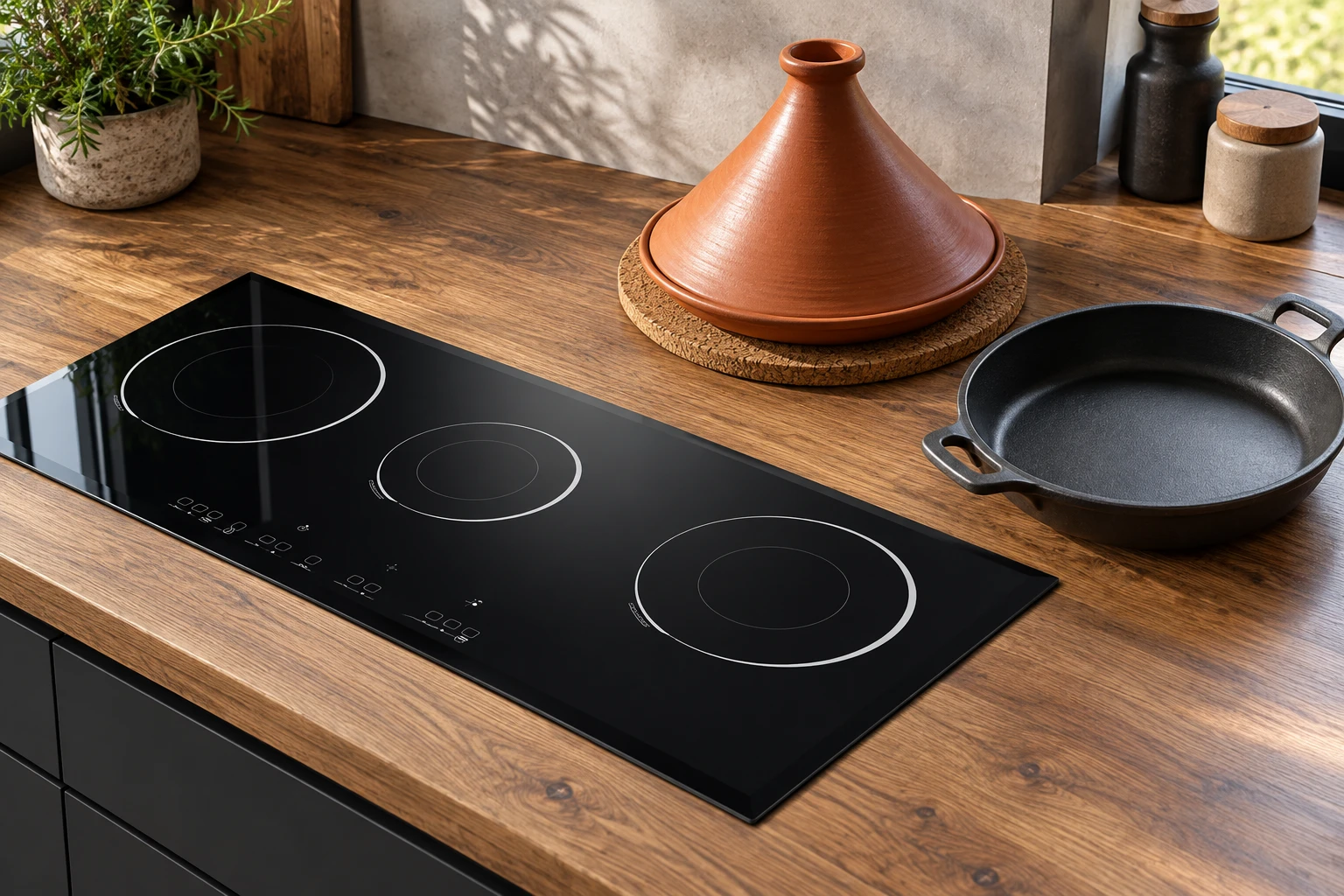
Some traditional cookware guidance describes soaking or seasoning, but those steps are not universal to all tagines. A coated metal base and a specialized ceramic product may require different preparation. Read the instructions supplied with the actual item. Do not add a generic seasoning recipe simply because the lid has a familiar traditional shape.
Follow the tagine and hob guidance for heating sequence and adjustment. Do not copy a setting from a demonstration on another appliance or promise a universal cooking time. This article does not validate recipes, pressure processing or food preservation. Resolve any conflict between the intended task and the equipment instructions before operation rather than changing the cookware’s designed behavior.
U.S. Fire Administration cooking-safety guidance advises attending cooking and keeping combustible materials away from the stovetop. Prepare ingredients and resting places before switching on. A covered tagine is still operating cookware; its lid does not substitute for supervision. Keep the controls accessible and follow the product-specific stop instructions when there is an abnormal condition.
Do not block openings, weight the lid or clamp the assembly to create pressure. A conical lid is not evidence of a pressure rating. If the vessel rocks, a component fails to seat or the appliance reports an error, stop according to the relevant instructions and address the actual issue. Do not press down on the lid or add makeshift supports while heating.
Follow the tagine maker’s cooling, washing and drying directions for the base and lid individually. Do not assume that a method permitted for one material or finish suits the other. Inspect the underside and seating rim before storage and before the next use. Cleaning cannot establish that a visibly damaged vessel has become suitable to use again.
Lift the base instead of dragging it over the panel. Our guide to understanding glass surface marks distinguishes surface deposits from concerns needing service advice. Seek the responsible product support when damage, instability or a loose attachment exceeds normal maintenance. Do not modify the bottom or use the appliance surface as a workbench for repairs.
Record the tagine model, size, base description, matching lid and permitted heat sources alongside the hob model. Preserve instructions and written clarifications. Recheck the combination when a replacement component changes. In shared kitchens, pass the actual guidance to the person using the vessel so a serving-only piece is not mistaken for approved cooking equipment.
Kanger’s Kanger black glass-ceramic cooktop panel and black glass-ceramic material overview provide material and component context for the glass surface. They do not certify individual tagines, adapter arrangements or finished-appliance use. OEM buyers should document panel and integration needs within their project and validate complete-appliance cookware compatibility through the responsible process. This keeps the sourcing discussion accurate while giving cookware purchasers a practical, product-specific decision record.
This neutral explanation covers induction heating and cookware geometry. It helps explain the lower base, but does not approve a particular saucepan, casserole, tagine, accessory or installation.
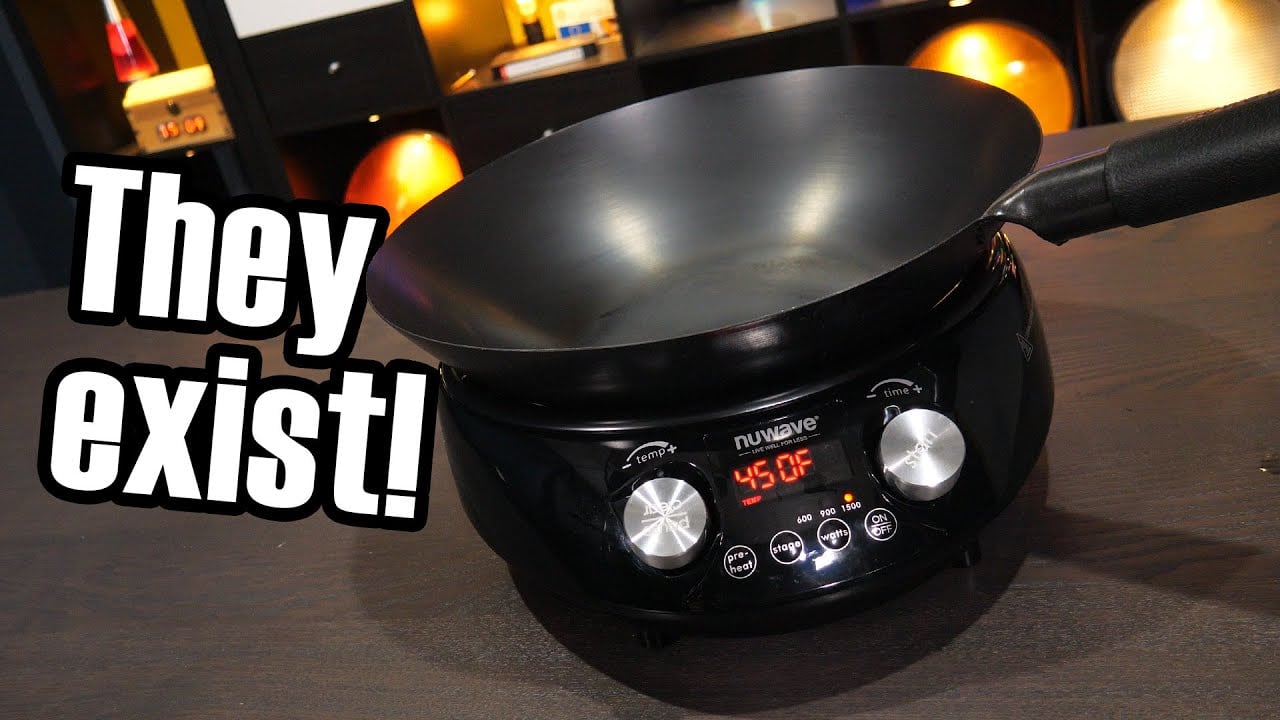
Video: Induction cooking – but what about woks?, Technology Connections. Open the educational video on YouTube.
No. Use the exact product designation and instructions; shape and ceramic appearance do not establish induction suitability.
The lower base is the induction cookware interface. The lid needs to be the intended matching component with its own handling instructions.
No. Check the appliance, vessel and accessory instructions together; do not treat an adapter as a universal workaround.
No. Follow the exact material and product instructions instead of transferring preparation steps from another construction.