An induction hob tamagoyaki pan must have a base construction and dimensions permitted by the appliance instructions. Its rectangular cooking area shapes a rolled omelette, while the underside may use a different geometry. Check both separately. The outside length and width do not establish the effective heating footprint, and a rectangular pan is not automatically approved to bridge two zones or heat evenly into every corner.
This guide focuses on choosing the equipment: a small rectangular pan, the turning end, the base and the utensil approach. It does not provide an omelette recipe, food-temperature guidance or a cooking-time promise. The aim is to distinguish a suitable documented arrangement from a pan that merely looks right in a recipe photograph.
Tamagoyaki pans are used for Japanese rolled omelettes and can appear in rectangular or square forms. Listings may also use terms such as Japanese omelette pan or makiyakinabe. Those names help identify the category but do not establish a particular material or heat-source approval. Record the manufacturer, model and size rather than relying on the search title alone.
Different variants can use different surfaces, handles and bases. A coated aluminium model should not inherit instructions from an uncoated steel version with a similar outline. Confirm the exact product supplied, including any turner or other accessory. Do not assume that every item pictured together forms a tested set, or that the care information for a larger size applies unchanged to a smaller one.
ENERGY STAR electric-cooking guidance explains induction’s interaction with suitable magnetic cookware. A pan can combine a rectangular upper body with a base construction that has another outline. Obtain a clear underside view and the actual base dimensions. Do not calculate compatibility by multiplying the outer length and width or comparing the diagonal with a circular zone marking.
Our article on measuring the usable pan base covers measurements of usable bases. Ask the pan supplier which measurement applies to its induction designation, then compare that information with the hob instructions. Avoid assuming that every square centimetre inside the pan is directly above an active induction area. This guide makes no temperature-uniformity claim for corners or the sloped end.
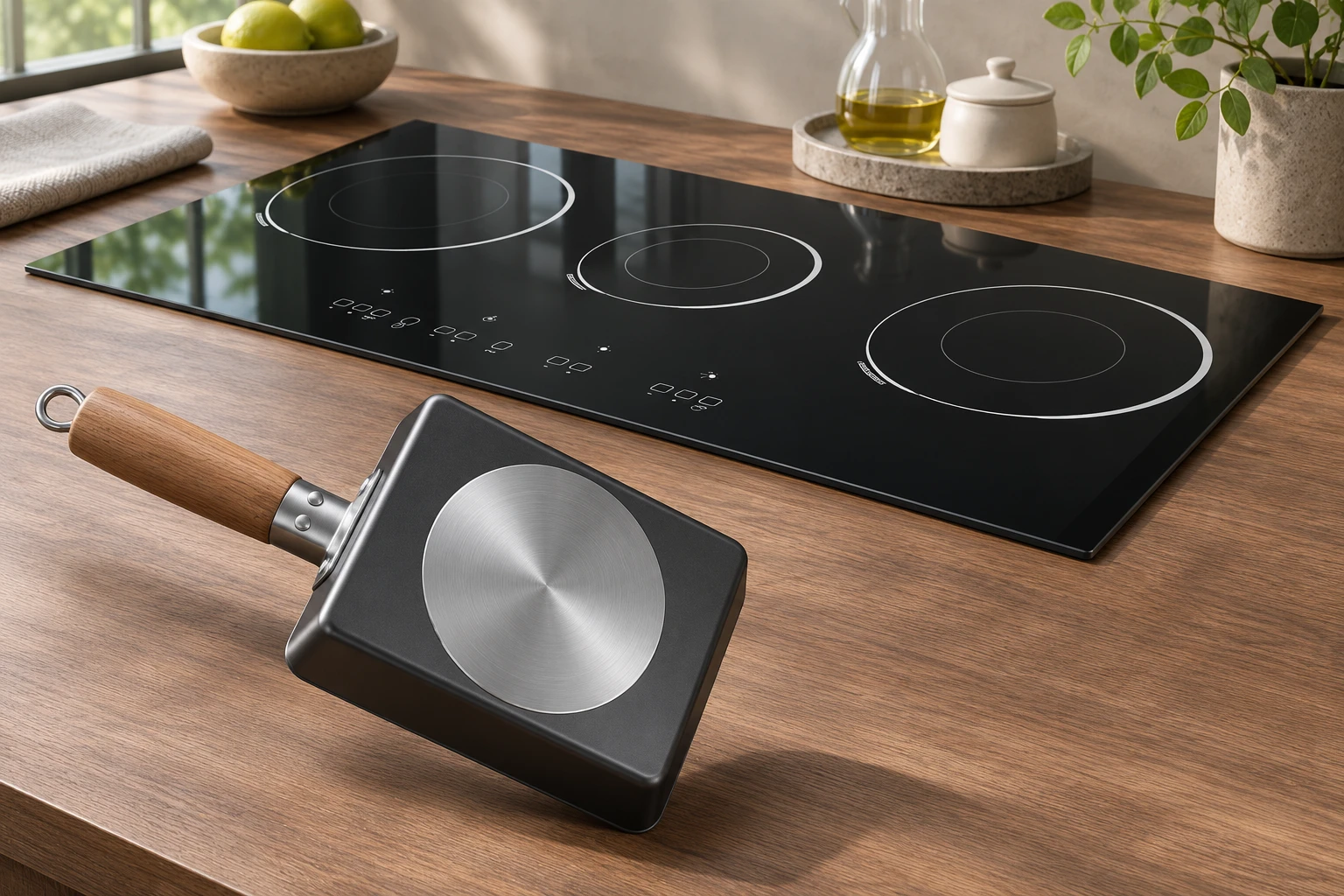
A small rectangle may fit visually across a large circle while presenting an unsuitable base underneath. Conversely, a compact magnetic disk can require a different documented placement from the upper walls. Use the instructions for the actual combination. Do not straddle two zones, activate a bridge or add an adapter simply because the outer shape suggests that arrangement.
If the intended pan is outside the appliance cookware range, choose another documented option. If a supported arrangement reports a recognition problem, follow the appliance troubleshooting process and record the exact model and message. Repeatedly increasing power is not a substitute for resolving a geometric mismatch. Keep recognition, stable placement and intended use as separate checks.
The far end of a tamagoyaki pan may have a slope that supports the intended rolling approach. Inspect the actual shape rather than assuming every rectangular pan has the same end profile. With the equipment cold and empty, bring the permitted utensil toward that end. Check whether the tool reaches without forcing the wrist over a neighboring cooking area.
Choose a turner or other tool that the surface-care instructions permit. A broad tool should fit inside the actual working width rather than simply matching the pan’s outer measurement. Do not bend a tool against the rim or scrape corners to compensate for poor fit. If a supplied accessory is unsuitable for the user’s reach, resolve the equipment choice before heating.
The rolling direction and handle direction interact. A convenient turning end can leave the grip pointing into a walkway, while rotating the vessel may move its base outside the permitted placement. Review these requirements together with the appliance off. Our article on planning clearance around cookware handles provides the wider layout checks for controls, neighboring cookware and accessible grips.
Do not slide the pan around while cooking to create tool space. Plan a documented orientation that permits the intended movement from the start. Keep the receiving plate and utensil rest on suitable separate surfaces. If the work area cannot provide enough access without reaching across another active position, reconsider the layout or equipment rather than relying on an awkward last-minute movement.
The magnetic-heating principle follows ENERGY STAR electric-cooking guidance. Actual base measurements, surface instructions and tool arrangements must come from the selected equipment. The table deliberately avoids universal heat settings, corner temperatures and recipe results.
| Feature | Evidence to check | Selection consequence |
|---|---|---|
| Model and surface | Exact material and coating variant | Use that variant’s care instructions |
| Heating base | Underside geometry and dimensions | Compare with the appliance cookware range |
| Turning end | Actual slope and usable interior width | Check permitted utensil access cold |
| Handle orientation | Approved placement and control clearance | Keep the grip out of walkways |
| Operating sequence | Pan, hob and appropriate recipe instructions | Do not borrow another model’s power setting |
A nonstick surface and an uncoated iron surface can need different preparation and cleaning methods. Identify the selected pan before following seasoning tutorials. Do not apply an oven seasoning process to a coated pan or a handle with unverified oven restrictions. A dark surface alone does not tell you which process is appropriate.
Check directions for utensils, washing, drying and storage. Keep the correct information with the model reference so a replacement pan does not inherit the old one’s routine. If the surface is damaged or its identity cannot be confirmed, seek support before use. Do not attempt to repair a coating, grind a base or heat-test a questionable pan to resolve uncertainty.
A recipe may describe a burner level or a visual cooking cue for its own equipment. That does not establish equivalent power on another induction hob. Use the actual pan and appliance directions, and appropriate recipe guidance for the intended food. This article supplies no empty-preheat interval, boost recommendation or promise of a particular omelette texture.
The rectangular shape alone does not validate even heating. If a recipe depends on a uniform cooking surface, obtain suitable information about the selected equipment rather than inferring it from the panel markings. Do not compensate for an unverified setup with repeated high-power trials. A manufacturer’s statement for one pan is not evidence of performance for every rectangular vessel.
Set an appropriate receiving plate on a stable separate surface before starting. Use cold, empty rehearsal to check the route from pan to plate, including the grip and tool movement. Rehearsal can reveal inadequate clearance or a poorly fitting utensil; it does not prove that a hot load can be handled safely or that the food has reached a suitable temperature.
Keep the utensil rest away from controls and active zones. Do not balance a turner across the pan rim or leave a plate on the cooktop merely because a zone is currently unused. Follow the actual equipment handling directions throughout. If the transfer depends on tilting or lifting, ensure that the documented method suits the user and available space before cooking.
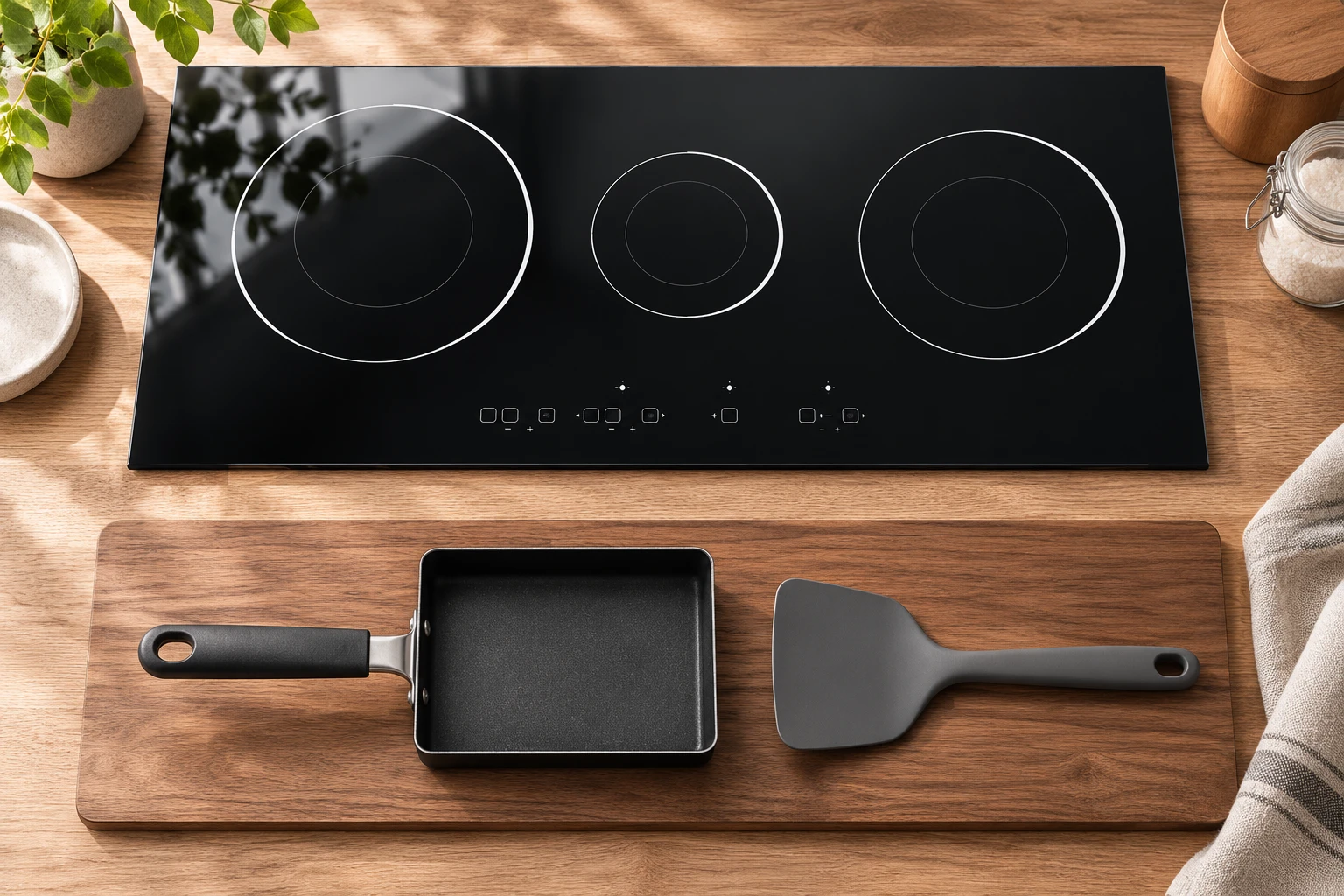
U.S. Fire Administration cooking-safety guidance recommends attending cooking and keeping combustible materials clear of the stovetop. Arrange ingredients, tools and the receiving plate beforehand. A compact pan and short recipe still require attention. Follow the equipment stopping procedure if the pan behaves abnormally instead of treating a protective appliance feature as a replacement for supervision.
For egg handling and doneness, consult appropriate recipe and food-safety guidance. A neatly shaped roll, a clean release or successful hob recognition does not establish internal temperature. This selection guide does not validate a food process. Keep equipment suitability separate from any safety conclusion about the prepared food, especially when the recipe or intended consumer requires specific precautions.
Follow the pan’s cooling and cleaning directions. Rectangular corners can retain residue, but that does not authorize sharp tools or abrasives excluded by the surface instructions. Use the permitted method and inspect the actual result. Do not immerse a hot pan or prescribe a temperature-change tolerance based on another material’s description.
Lift the vessel rather than dragging it across the glass. Our guide to understanding marks on the glass surface concerns appliance-surface deposits, a separate cleaning question from residue in the pan. Keep cookware cleaners away from printed glass or seals unless the appliance directions permit them. If the base appears distorted or damaged, obtain support rather than trying to flatten it on the cooking surface.
Kanger’s Kanger black glass-ceramic cooktop panel and black glass-ceramic material overview explain the cooking-surface material supply context. They do not approve a tamagoyaki pan, define an appliance’s recognition threshold or certify corner heating. OEM records should distinguish glass geometry, printing and integration from the finished appliance’s cookware testing and operating guidance. A shared photograph cannot replace those separate records.
Retain the exact pan reference, underside measurements, turning-end profile, tool choice and documented orientation. Review them when changing the pan or appliance. This produces a practical purchase decision based on the parts that matter, while leaving recipe results and system performance tied to evidence from the responsible source.
This independent educational explanation covers magnetic heating and cookware geometry. It provides background on the vessel base, not approval of a particular pouring pan, rectangular omelette pan, food press or completed glass-panel appliance.
Video: Induction cooking – but what about woks?, Technology Connections. Open the educational video on YouTube.
Do not decide by the upper shape. Compare the actual base and permitted placement with the appliance instructions.
Only use a zone arrangement explicitly permitted for the actual equipment; the outer shape does not authorize bridging.
Do not assume so. Follow the instructions for the exact surface and handle variant.
No. Recognition and heating distribution are separate questions requiring appropriate evidence.



