Kanger Glass-ceramic Co., Ltd.
Heat-soaked tempered glass has undergone an additional controlled heating process after tempering to reduce the risk associated with certain inclusions that can cause delayed breakage. Heat soaking reduces a risk; it does not guarantee that glass will never break. Buyers should specify the applicable process basis, identify which finished parts are included, and request traceable batch evidence. For appliance components, this requirement belongs within the complete material and qualification specification. It cannot replace checks of panel support, edge condition, thermal exposure, or the safety requirements for the finished appliance.
Understand the purpose before adding it to an order
The NGA glazing manual discusses heat soaking as a way to reduce spontaneous breakage associated with inclusions in fully tempered glass. Some susceptible panes break during the controlled process rather than later in service. This is different from a product’s operational thermal-cycle test, which evaluates the component or assembly under specified use conditions. The two activities answer different questions and should have different records.
Ask why heat soaking is being considered for the actual part. The reason might be a project specification, a risk assessment, or a customer’s requirement. Avoid adding the phrase solely because it sounds like an upgraded glass grade. A sensible decision considers the glass type, consequence of breakage, installation, replacement access, applicable rules, and other controls. These are project decisions, not evidence that every appliance fascia needs the same additional process.
Confirm the material and treatment state
Tempered soda-lime glass, heat-strengthened glass, chemically strengthened glass, borosilicate glass, and glass-ceramic are different material or treatment descriptions. Do not apply a heat-soak requirement written for one family to another by copying the wording. Ask the supplier to identify the exact substrate and treatment route in the quotation. The product name alone may not tell the buyer which process basis applies.
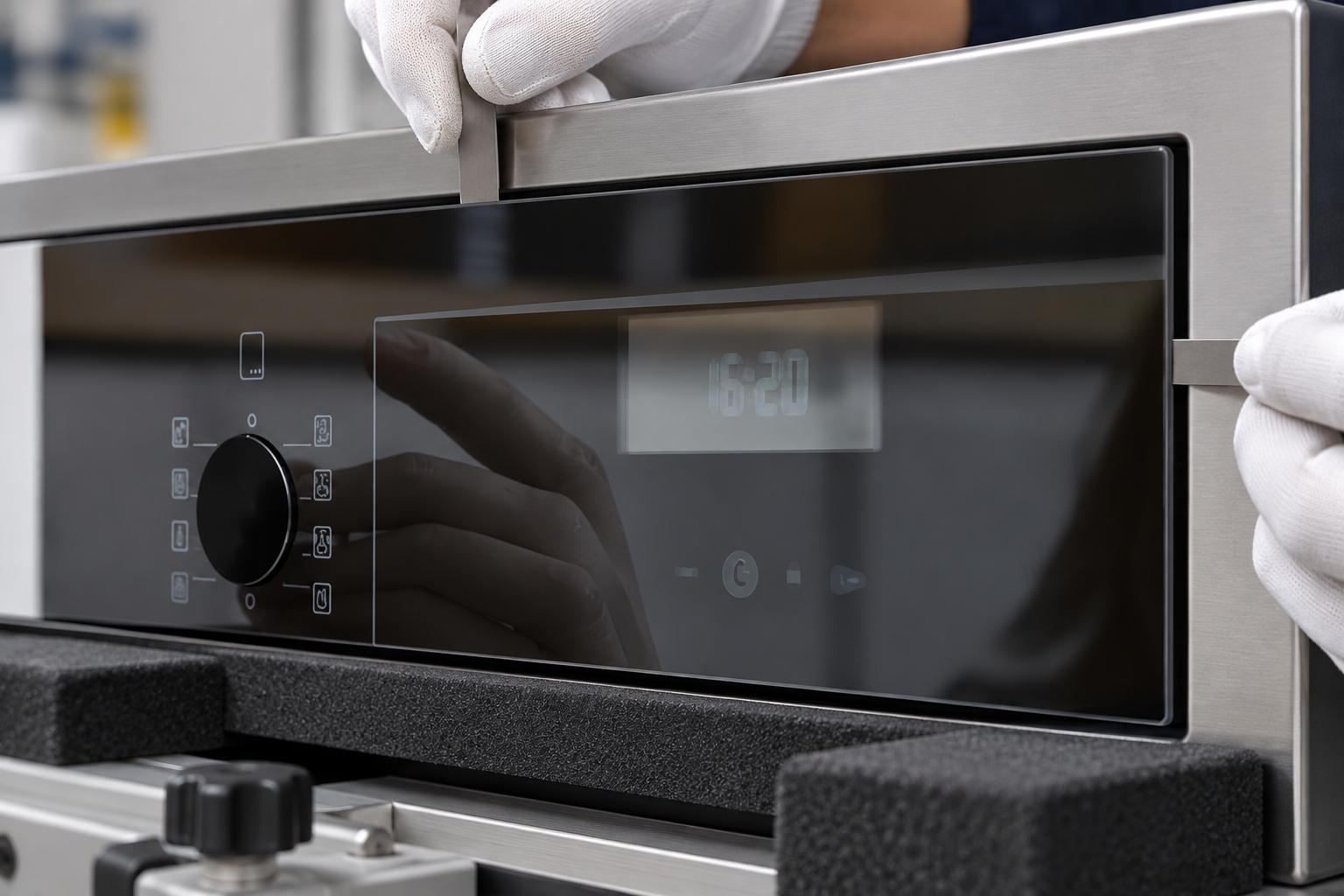
For an appliance-control part, the drawing should also identify thickness, finished geometry, print, coatings, holes, and edge treatment. A report for an unprinted test pane is not automatically evidence for a finished printed panel. If the additional process is to occur after printing or another surface treatment, the supplier should confirm that the complete part is compatible with the approved process. Qualification should resolve this before production quantities are ordered.
State the process basis without inventing a cycle
NGA describes EN 14179-1 and ISO 20657 as process references used for heat-soaked tempered soda-lime safety glass in architectural applications. Those references provide context, but their architectural scope does not establish an appliance’s approval requirements. The buyer and supplier should identify the relevant edition, scope, and agreed application to the actual component. Resolve conflicting specifications before a purchase order is released.
Do not write a heating temperature, holding period, or tolerance into a supplier instruction from memory or an internet summary. The responsible processor needs the applicable controlled procedure and equipment capability. The quotation should make clear whether the requested process is included, which standard or procedure governs it, and what documentation will accompany delivery. If a requirement is outside the referenced standard’s scope, describe that boundary explicitly instead of implying certification.
Define the population covered by the requirement
A buyer asking for heat soaking needs to know which panes actually received it. The NGA manual distinguishes full treatment from statistical sampling and discusses the coverage required by the referenced standards. A successful test on a few samples does not establish that all delivered parts underwent the process. Put the coverage requirement in the order and verify it against the batch record.
Identify replacements and additional production lots as well. A supplier may process the original quantity, replace breakages, and then ship a mixed delivery unless traceability is controlled. Ask how replacements receive the same required treatment and how the final shipment is reconciled. Keep the relationship among part quantity, furnace batch, breakage during processing, replacements, and shipped quantity understandable. Do not count a pane that broke in processing as a delivered conforming part.
Request evidence that belongs to the delivered batch
Useful evidence connects the part number and revision with a treatment batch, date, processor, and procedure. Where the agreement requires a process record, ask for the relevant controlled record rather than a generic sales certificate. A certificate with a company name and a broad claim about tempered glass may say nothing about the particular shipment. Check the report’s scope before treating it as acceptance evidence.
Ask the supplier to explain how load identity is maintained through processing and packing. The method may use rack positions, labels, batch travelers, or other controlled records. The buyer does not need to prescribe the supplier’s whole factory system, but it needs enough information to verify coverage. Sensitive production details can remain with the processor when an agreed summary still provides a reliable link to the delivered parts.
Plan for yield, timing, and replacement parts
An additional process takes time and may remove parts from the shipment. Build that possibility into the quotation and delivery plan. Ask who carries the replacement responsibility, how replacement processing is scheduled, and what happens if the quantity falls below the assembly requirement. Do not assume that the process is included in the standard tempered-glass price or lead time unless the supplier has confirmed it.
For example, an OEM could order a delivery of panels with documented full process coverage and a specified spare quantity. The agreement should distinguish the delivered requirement from the processor’s starting quantity. This is a planning example, not a recommended scrap allowance. Avoid inventing a standard loss percentage: actual outcomes depend on the material, supply, and process, and the supplier should support any production estimate used in the commercial agreement.
Inspection and purchase-order checklist
| Requirement | What the order should identify | Evidence to review |
|---|---|---|
| Material and treatment | Substrate, finished part revision, and tempering state | Quotation and material description match the drawing |
| Process basis | Applicable standard or approved procedure and its scope | Processor’s declaration identifies the agreed basis |
| Coverage | Finished parts included, including replacements and spares | Batch-to-shipment reconciliation shows the required population |
| Part compatibility | Print, coating, holes, edges, and finished geometry | Qualification covers the actual component configuration |
| Traceability | Part number, lot identity, treatment batch, and delivery identity | Records can be connected without guessing from dates |
| Commercial planning | Processing time, replacement responsibility, and required delivered quantity | Order acknowledgement includes these conditions |
| Final acceptance | Appearance, dimensions, functional checks, and product-specific safety evidence | Additional treatment has not displaced the normal acceptance plan |
The table is a procurement checklist, not a heat-soak recipe. Numerical cycle conditions belong in the applicable controlled procedure and should not be inferred from this overview.
Check the finished part after the additional process
Continue to inspect the conditions that matter to the appliance. Verify edge condition, geometry, appearance, printed features, and fit according to the released drawing. When a display window, adhesive, or functional coating is involved, the qualification plan should include those interfaces. A panel’s completion of the additional process does not establish that its assembly support or surface finish is acceptable.
Keep the ordinary incoming-inspection record and the process evidence separate but linked. If a component later breaks, both records help the investigation. The engineer may need to examine impact, edge loading, mounting contact, handling damage, and thermal conditions as well as inclusions. Treat a claimed inclusion cause as a hypothesis requiring evidence rather than a conclusion automatically implied by delayed breakage.
What to discuss with Kanger for appliance glass
Provide the appliance application, drawing, material family, finished features, required documentation, and the reason for the additional treatment request. Ask the supplier to confirm availability and applicability for that exact part. Kanger’s tempered appliance-glass product page is a relevant starting point, but it is not proof that heat soaking is included in every quotation or available for every finish and geometry.
Use the reply to close the technical and commercial questions before ordering. If a processor proposes a different risk control, evaluate it through the responsible engineering team instead of silently dropping the original requirement. The agreed specification should explain what is being supplied, which evidence will be delivered, and what limitations remain. This makes the order reviewable without promising zero breakage.
Frequently asked questions
Does heat soaking eliminate spontaneous breakage?
No. It reduces a particular risk but cannot guarantee that no pane will break later. Impact, mounting damage, edge loading, and other causes still require attention.
Is heat soaking the same as tempering?
No. Tempering establishes a heat-treated state. Heat soaking is an additional process applied afterward for an identified risk-control purpose. The order should identify both requirements when both are needed.
Can a sample report prove the whole shipment was heat soaked?
Only if the agreed scope and traceability actually support that conclusion. Check population coverage, replacement parts, and batch-to-shipment records rather than relying on a report title.
Should an appliance buyer copy an architectural standard automatically?
No. Confirm the material, scope, applicable product requirements, and approved procedure with the responsible team. A building-glass reference is useful context, but it does not certify the complete appliance.
Related appliance-glass resources
- Thermal Shock Resisitance Tempared Glass For Household Appliances Panel Product
- Tempered Glass Appliance Panels: OEM Specification Guide
- Does Tempered Glass Shatter? Key Facts and Practical Guidance
- When should an appliance team request tempered-panel thermal evidence?
Sources and further reading
- NGA GANA Glazing Manual — heat-soak process scope and limitations
- NGA — fabrication before heat treatment
- NIST — measurement uncertainty
Educational video: Annealing and Tension in Glass
This museum explanation introduces tension and thermal history in glass. It supports the material discussion; it is not a heat-soak procedure or a failure diagnosis.

Watch Annealing and Tension in Glass from Corning Museum of Glass