Kanger Glass-ceramic Co., Ltd.
Induction cooker glass sealing interface design must keep spills and cleaning liquid away from electrical parts while allowing the glass, frame, gasket, adhesive, and supports to move through production tolerances and thermal cycles. A seal cannot be selected by bead size alone. The OEM must define the fluid path, pressure and cleaning exposure, joint geometry, surface preparation, compression or bondline, venting, assembly controls, inspection, and validation in the complete appliance.
This OEM guide addresses induction cooker glass sealing interface design without inventing a universal limit, product claim, certification, or guarantee. Released drawings, approved supplier data, applicable standards, and representative appliance validation remain controlling.
Map the liquid and contamination paths
Study the top surface, exposed perimeter, frame joints, corner transitions, control area, fasteners, vents, cable routes, and drainage. Use the installed appliance orientation and likely spill volumes, not only a flat drawing. Separate the primary barrier, secondary diversion, and drainage route. Identify electronics, coils, sensors, insulation, adhesives, and metal interfaces that must remain protected.
Record the owner, input source, method, acceptance evidence, and reaction to missing information. Review this item with engineering, quality, manufacturing, purchasing, service, and the glass supplier. Use production-intent parts and tolerance extremes when nominal samples cannot resolve risk, and keep evidence linked to the controlled lot and revision.
Define the joint geometry and tolerance stack
Control glass size, frame opening, corner radii, step height, land width, gap, flatness, support position, and assembly offset. Calculate minimum seal contact and maximum bondline across relevant tolerance extremes. Avoid narrow lands, abrupt corner changes, uncontrolled squeeze-out, and local gaps. The drawing should state datums and how the assembled interface is measured.
Record the owner, input source, method, acceptance evidence, and reaction to missing information. Review this item with engineering, quality, manufacturing, purchasing, service, and the glass supplier. Use production-intent parts and tolerance extremes when nominal samples cannot resolve risk, and keep evidence linked to the controlled lot and revision.
Choose gasket or adhesive by function
A gasket may provide controlled compression and serviceability; an adhesive seal can locate and bond while sealing. Either route needs approved material data for temperature, chemicals, aging, compression set or cure, movement, and substrate compatibility. Do not infer appliance suitability from a generic label. Review supplier limits, process window, storage, and change control.
Record the owner, input source, method, acceptance evidence, and reaction to missing information. Review this item with engineering, quality, manufacturing, purchasing, service, and the glass supplier. Use production-intent parts and tolerance extremes when nominal samples cannot resolve risk, and keep evidence linked to the controlled lot and revision.
Control glass and frame surfaces
Specify which glass face is bonded, the permitted print or coating under the seal, surface cleanliness, treatment, primer if approved, and time between preparation and assembly. Oils, dust, release agents, cleaning residue, moisture, and sharp frame burrs can create leaks or damage. Define handling gloves, lint control, cleaning material, and inspection before dispensing or gasket placement.
Record the owner, input source, method, acceptance evidence, and reaction to missing information. Review this item with engineering, quality, manufacturing, purchasing, service, and the glass supplier. Use production-intent parts and tolerance extremes when nominal samples cannot resolve risk, and keep evidence linked to the controlled lot and revision.
Design corners and transitions carefully
Corners combine radius mismatch, diagonal movement, gasket joints, adhesive starts and stops, and frame distortion. Use continuous paths or controlled splices, and keep the seal away from sharp metal features. Provide enough land through the full radius and define how excess material is managed. Validate all corners because a straight-side section cannot represent their compression and flow.
Record the owner, input source, method, acceptance evidence, and reaction to missing information. Review this item with engineering, quality, manufacturing, purchasing, service, and the glass supplier. Use production-intent parts and tolerance extremes when nominal samples cannot resolve risk, and keep evidence linked to the controlled lot and revision.
Stabilize the assembly process
Define dispensing path, bead or gasket dimensions, placement fixture, centering, compression stops, clip or fastener sequence, cure time, environmental limits, and rework. Verify equipment setup and material lot. Use measurable in-process checks rather than operator judgment alone. Protect the glossy glass and avoid fixtures that introduce point loads or shift the panel during cure.
Record the owner, input source, method, acceptance evidence, and reaction to missing information. Review this item with engineering, quality, manufacturing, purchasing, service, and the glass supplier. Use production-intent parts and tolerance extremes when nominal samples cannot resolve risk, and keep evidence linked to the controlled lot and revision.
Validate sealing with the real appliance
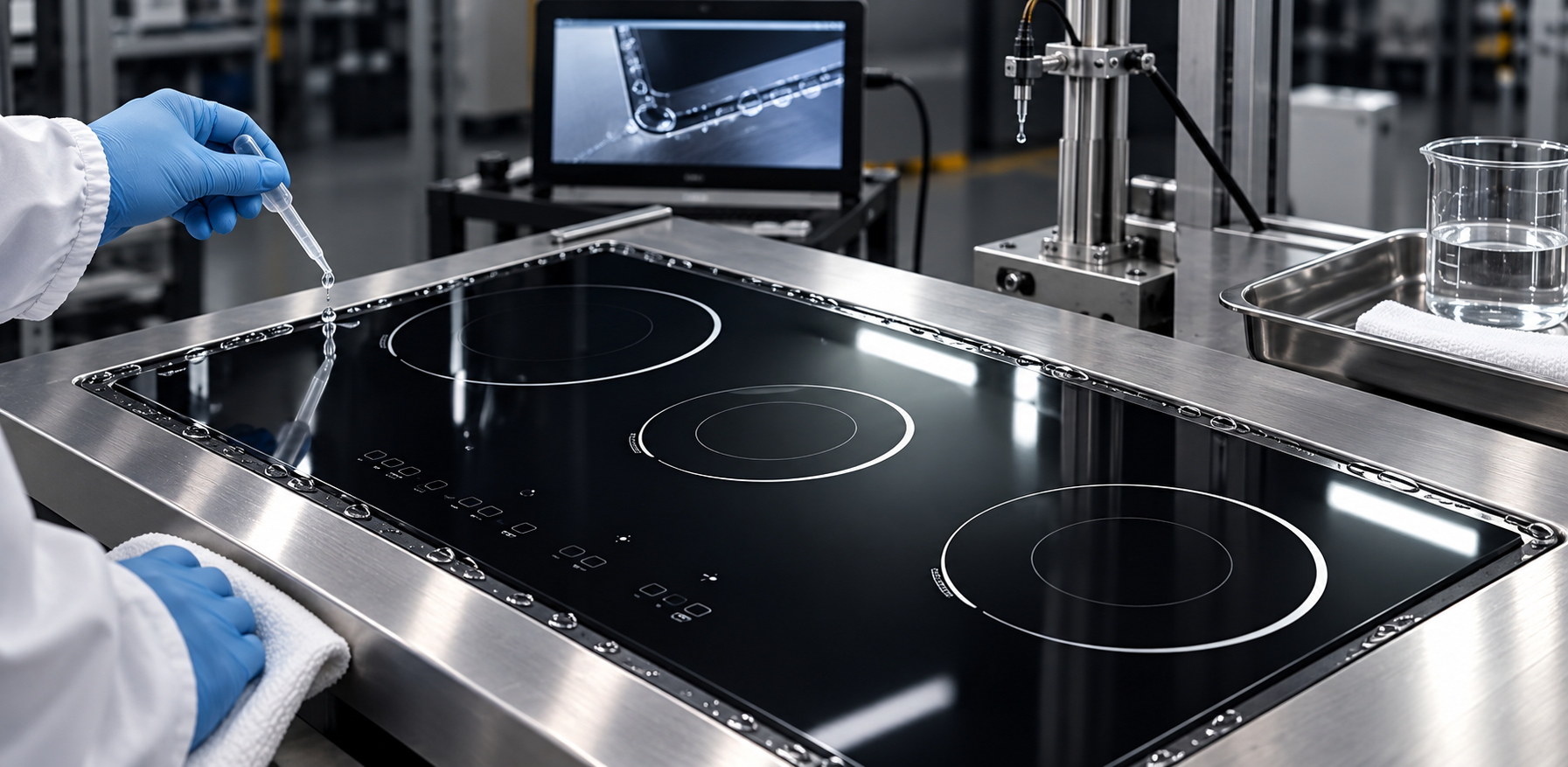
Run controlled spill, cleaning, dwell, tilt, thermal cycle, power cycle, and aging sequences appropriate to the product. Add tracers or witness materials where safe to locate ingress. Inspect seal movement, edge contact, electronics, corrosion, adhesive condition, and drainage. Test dimensional extremes and production-intent parts. A single room-temperature water drop is not a complete qualification.
Record the owner, input source, method, acceptance evidence, and reaction to missing information. Review this item with engineering, quality, manufacturing, purchasing, service, and the glass supplier. Use production-intent parts and tolerance extremes when nominal samples cannot resolve risk, and keep evidence linked to the controlled lot and revision.
Release inspection and change controls
Specify incoming material identity, storage, surface preparation, bead or gasket checks, assembled gap, cure confirmation, leak test frequency, acceptance, and reaction plan. Record lot, revision, equipment, operator, and results. Revalidate changes to glass, print, frame, sealant, gasket, primer, fixture, cure, supplier, packaging, or thermal duty.
Record the owner, input source, method, acceptance evidence, and reaction to missing information. Review this item with engineering, quality, manufacturing, purchasing, service, and the glass supplier. Use production-intent parts and tolerance extremes when nominal samples cannot resolve risk, and keep evidence linked to the controlled lot and revision.
Engineering table
| Interface item | Drawing/process control | Validation evidence |
|---|---|---|
| Seal path | Continuous route, corners and drainage | Ingress map and photos |
| Geometry | Land, gap, compression or bondline | Tolerance stack and measurements |
| Materials | Approved gasket/adhesive and surfaces | Compatibility and aging data |
| Assembly | Cleaning, placement, cure and retention | First-article records |
| Appliance test | Spill, cleaning and thermal sequences | No harmful ingress or interface damage |
RFQ, first-article, and serial-production workflow
At RFQ, provide controlled files, application, panel dimensions, edge and surface details, graphics, quantities, packaging, and validation conditions. Ask the supplier to identify feasibility limits, assumptions, and deviations in writing. The quotation, traveler, purchase order, and inspection instruction should reference the same released package.
Before approving a first article, verify identity, geometry, edges, surface, artwork, packaging, and the topic-specific evidence in this guide. Assemble production-intent samples with the real frame, supports, seal, coils, controls, and fixtures when those interfaces influence the result. Record equipment, setup, sample lot, measurements, photographs, exposure, and disposition.
For serial production, translate the release into measurable checks with named methods, sample identity, and reaction plans. Trend results by lot, tool, material batch, print screen, package position, and supplier. When a nonconformity appears, contain related material, preserve original evidence before rework, compare it with the approved setup, and verify corrective action on later lots.
Educational video
This neutral Corning Museum of Glass video provides useful background on glass processing and stress. It does not replace calculations, drawings, appliance instructions, or qualification.

Related Kanger resources
- Black glass-ceramic product page
- Glass-ceramic material overview
- Induction cooker glass mounting clearance design
- Glass ceramic cooktop panel sealing interface design
For a drawing-led quotation, send Kanger the application, controlled files, quantities, validation requirements, and schedule. Technical review can identify missing information without turning this general guidance into an unsupported guarantee.
Frequently asked questions
Should the seal also locate the glass?
Only if the design and selected material are validated for both locating and sealing loads through tolerance, temperature, aging, and service.
Is a larger adhesive bead always safer?
No. Excessive material can squeeze into functional areas, change bondline, trap contamination, or restrict movement.
Why must corners be tested separately?
Corners combine radius mismatch, assembly offset, joints, frame distortion, and diagonal thermal movement.
What changes require revalidation?
Changes to glass, print, frame, gasket, adhesive, primer, fixture, cure, supplier, packaging, or thermal and cleaning duty should be reviewed.