 Kanger Glass-ceramic Co., Ltd.
Glass-ceramic recycling requires a collection route that explicitly accepts the material; an ordinary bottle-and-jar recycling bin is not a safe default. Cooktop panels, fireplace glass-ceramic, tempered appliance glass, and container glass should be identified and kept in the streams specified by the receiving recycler. Before sending a batch, disclose the substrate, decoration, coatings, attached materials, and whether it comes from production scrap or an end-of-life appliance. Obtain acceptance instructions for that exact stream. A material being technically recyclable does not mean it is accepted by a particular local collection service.
For manufacturers and appliance buyers, the most useful improvement is often better segregation and documentation. Clean, identified production offcuts are a different proposition from mixed broken appliance parts with adhesives, electronics, and unknown glass types. This guide explains how to prepare a practical recycling inquiry without claiming that Kanger operates a take-back program or that every product has a confirmed recycling destination.

Start by separating material identity from appearance
Clear appearance does not establish that two glass products have the same composition or processing history. Likewise, a black surface may be a decorated substrate rather than a complete material description. Use the bill of materials, purchase specification, supplier documentation, and part identification to establish what is actually being offered to the recycler.
Do not combine glass-ceramic cooktop scrap with bottles merely because both feel like glass. The receiving process may have specific restrictions on composition, coatings, contaminants, or particle size. Those restrictions belong to the recycler’s accepted-feedstock specification. Guessing at compatibility can reduce the usefulness of an otherwise well-separated collection.
The US Environmental Protection Agency’s guidance on common recyclables emphasizes checking what the local program accepts. Apply that principle directly: ask about the exact appliance material, rather than using a general statement about glass recycling as evidence that a specialized panel belongs in a curbside bin.
Why household recycling advice is not an industrial acceptance sheet
Municipal collection programs serve a defined waste stream and sorting system. Industrial recycling routes may use different equipment, contracts, and quality requirements. A household page is useful for preventing an inappropriate curbside disposal choice, but it does not establish whether a specialist processor can recover a clean manufacturing stream.
For example, the City of Fort Worth’s recycling guidance describes its own collection program. Its instructions should not be generalized to every location or to every industrial agreement. Record the location and date of the instructions used for an actual disposal decision.
If a panel remains part of an appliance, ask the appliance collection provider about the complete unit. Removing glass, wiring, or other parts yourself can create additional handling risks and may not improve the recovery route. Follow the appliance manufacturer’s service instructions and the collector’s preparation requirements.
Use a material-separation table
| Material stream | Information to retain | Before shipment |
|---|---|---|
| Known glass-ceramic production offcuts | Material designation, lot and decoration status | Obtain explicit acceptance for that glass-ceramic stream |
| Tempered appliance glass | Substrate, print, coating and attached components | Confirm whether treatment and decoration affect acceptance |
| Mixed end-of-life appliance panels | Available part identities and unknown materials | Disclose uncertainty and ask about sorting requirements |
| Complete appliances | Appliance type and collector’s preparation instructions | Use an appropriate appliance collection route |
| Ordinary bottles and jars | Local program’s accepted container types | Keep excluded specialty glass out of the stream |
| Unidentified broken glass | Source, contamination and safe containment | Request guidance instead of assigning a material by appearance |
The table is a routing aid, not permission to place any item in a particular bin. The receiving organization must confirm the actual stream. If that confirmation is unavailable, keep the material safely contained and clearly identified while the responsible waste-management team determines the next step.
Build an accurate recycler inquiry
Describe the material in plain language and include its technical designation where available. State whether it is glass-ceramic, soda-lime glass, borosilicate glass, or an unidentified mixture. If the designation is uncertain, say so. An uncertain but honest description is more useful than a confident guess that contaminates a downstream process.
Next describe the physical form: intact panels, offcuts, fragments, or complete appliances. Give the approximate quantity and collection frequency using actual records. Include photographs of representative material and packaging, while avoiding claims that a photograph proves chemical composition. Ask whether the recycler needs a sample or additional documentation before acceptance.
List attached or applied materials, such as ceramic decoration, organic coatings, adhesives, gaskets, metal trim, or electronic components. Do not remove these by an improvised process to satisfy a presumed requirement. Ask which separation steps are necessary and who should perform them, then use a suitable controlled procedure.
Request written acceptance conditions, preparation instructions, packaging requirements, and the destination or intended recovery route at the level the provider can document. A generic quotation for “glass waste” should be clarified before a specialized appliance material is shipped.
Keep production scrap traceable
Segregate material at the point where its identity is still known. Use containers that distinguish different substrates and decoration states. Record the part family, source process, and date or lot. Once unrelated offcuts are mixed, the original identification may be difficult to recover without additional testing.
Keep the material protected from avoidable contamination. The appropriate container depends on the size, weight, condition, and collection arrangement. Review the handling method with the receiving provider and the site’s responsible personnel. The purpose is safe containment and preservation of a useful feedstock description, not merely a tidy-looking storage area.
Use separate records for material generated, material accepted by a recycler, and material actually confirmed as recovered. These quantities answer different questions. Sending a shipment out of the factory does not by itself establish the final recycling outcome.
Connect purchasing decisions with recovery planning
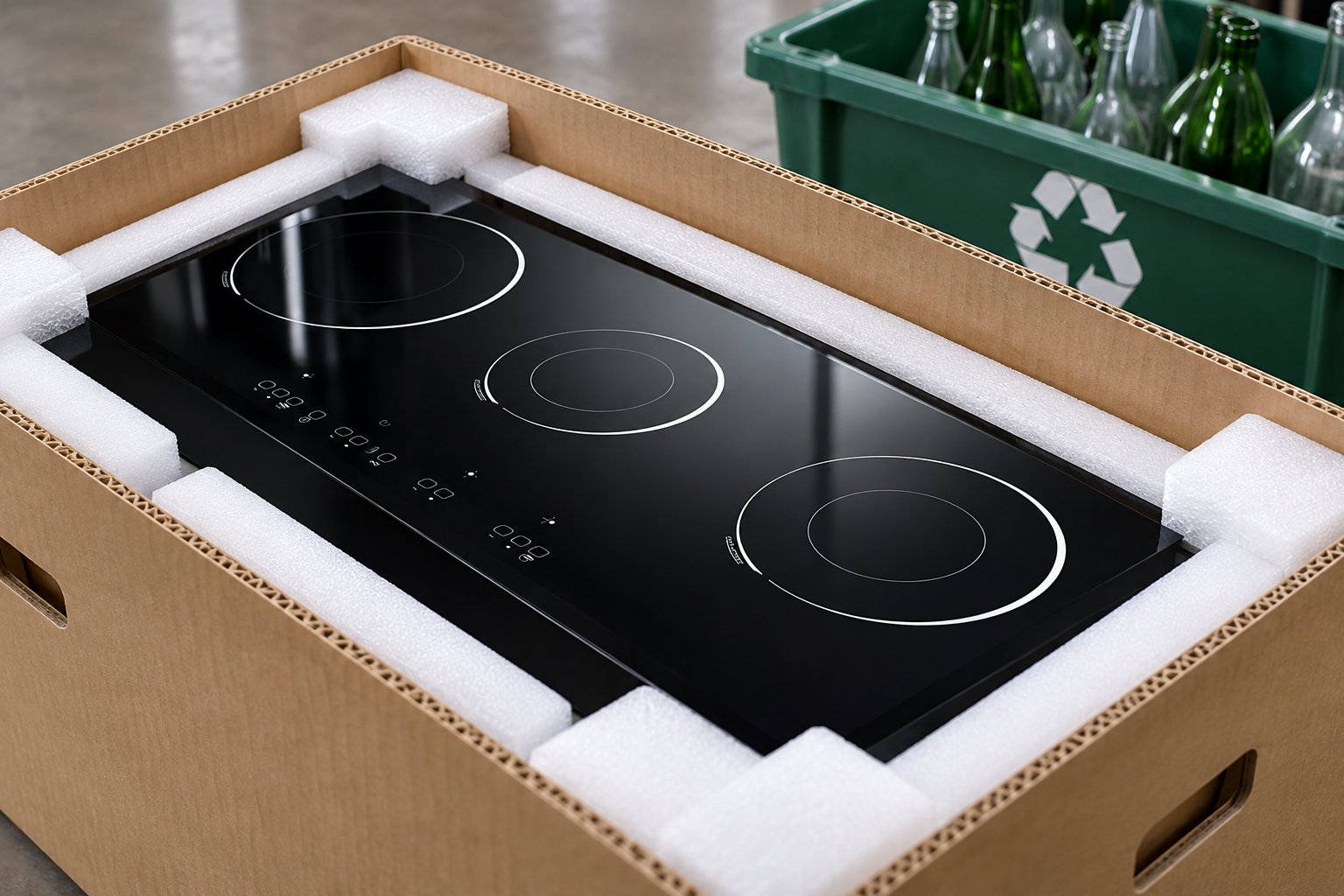
Kanger’s black glass-ceramic cooktop product illustrates why material-specific communication matters. A finished panel combines material, decoration, geometry, and an appliance application. Recovery planning should use the actual ordered specification rather than a broad category name.
At the purchasing stage, request enough information to identify the substrate and applied materials later. Keep that information associated with the part revision. If a coating, decoration system, adhesive, or assembly configuration changes, check whether existing recovery instructions still apply.
The environmental specification guide addresses a related purchasing issue: environmental claims should be tied to evidence. Do not describe a panel as recyclable everywhere, fully circular, or part of a closed loop unless the particular claim has an appropriate basis.
Understand the difference between technical potential and an available route
The National Glass Association’s resource on glass recycling and circularity discusses the benefits and challenges of glass recovery. Its architectural-glass context is useful background, but it does not establish acceptance of a particular appliance glass-ceramic stream. Different glass sectors and receiving processes can have different requirements.
A technical possibility may depend on sufficient volume, separation quality, transport arrangements, or a processor with suitable capability. If no practical local route is available, record that limitation instead of presenting potential recovery as an accomplished outcome. This distinction makes sustainability reporting more credible and helps identify the actual obstacle to improvement.
When a specialist route becomes available, begin with an agreed trial shipment or sample if the provider requests one. Confirm the acceptance result before expanding collection. Keep records of rejected material and the reason for rejection, because that feedback can improve segregation or supplier documentation.
Report results without overstating them
Use measured weights or another clearly defined quantity basis. State the reporting period, material scope, and destination status. Separate reusable parts, recycling feedstock, other recovery, and disposal according to the records available. Avoid combining unrelated streams into one favorable percentage without explaining what the number covers.
For a procurement review, useful evidence includes the accepted-material specification, shipment records, and any downstream confirmation supplied by the processor. If the final recovery stage is not independently documented, describe the result as collected or accepted for recycling, as appropriate. Do not silently turn those states into proof of completed recycling.
For broader product context, see the black glass-ceramic range and the packaging and shipping documentation guide. Recovery planning works best when material identity and handling information remain available throughout the product’s life.
Further learning: how recycling systems work
SciShow’s educational overview explains sorting and recycling processes. It is general background, not confirmation that a local collector accepts glass-ceramic cooktops or any specific Kanger product.
Frequently asked questions
Can a glass-ceramic cooktop go in a bottle recycling bin?
Do not assume so. Ask the local program or receiving recycler whether it explicitly accepts that material and form.
Does recyclable mean a local service will collect it?
No. Technical recovery potential and an available collection route are different questions. Confirm the actual provider’s acceptance conditions.
Should different appliance glass types be mixed?
Keep them identified and separate unless the receiving processor explicitly accepts the mixture. Disclose unknown materials rather than guessing.
Does Kanger provide a take-back service?
This article does not establish a Kanger take-back service. Confirm any proposed commercial recovery arrangement directly with the responsible provider before relying on it.


