 Kanger Glass-ceramic Co., Ltd.
Rainbow stains on a glass cooktop can be a thin surface film, mineral deposit or transferred cookware material; color alone does not prove that the glass has burned or lost strength. Begin with the appliance switched off and cool, identify the material you are looking at, and use only the cleaning process approved for that model. A smooth colored sheen needs a different investigation from a crack or a depression. If there is visible damage, an unexplained change that remains after approved care, or any operating warning, stop and ask the appliance maker for advice rather than polishing harder.
Make sure the rainbow is on the cooktop
Search results often mix three different subjects: rainbow discoloration on stainless steel pans, colored reflections in oven windows, and marks on a glass-ceramic cooking surface. The material and location matter. Advice for removing heat tint from a steel saucepan should not automatically be applied to printed glass. Similarly, an explanation for a coated oven window does not establish why a new mark appeared on a cooktop.
Check the location in good light while the appliance is cool. Move your viewing position and note whether the appearance changes with the angle. Look for a ring, a streak following a pan’s path, or a broad film left after cleaning. Record those observations without assigning a chemical cause. A photograph from one angle can exaggerate or hide the effect, so take both a context view and an oblique close view.
The GE explanation of rainbow appearance in oven-door glass is a useful example of why location changes the answer: it concerns a coated oven window. It is not evidence that every rainbow on a cooking zone is normal. Keep the object, surface and operating history with the photograph whenever you request support.
Separate a film from surface damage
A film sits on the surface. A pit is a depression where the surface is no longer continuous. A scratch is a line-shaped mark, and a crack can require immediate stop-use action. These descriptions help explain appearance, but they do not measure depth or determine safe use. Never pick at the mark with a blade, pin or fingernail to diagnose it. An uncertain or apparently broken surface should be assessed through the model’s service process.
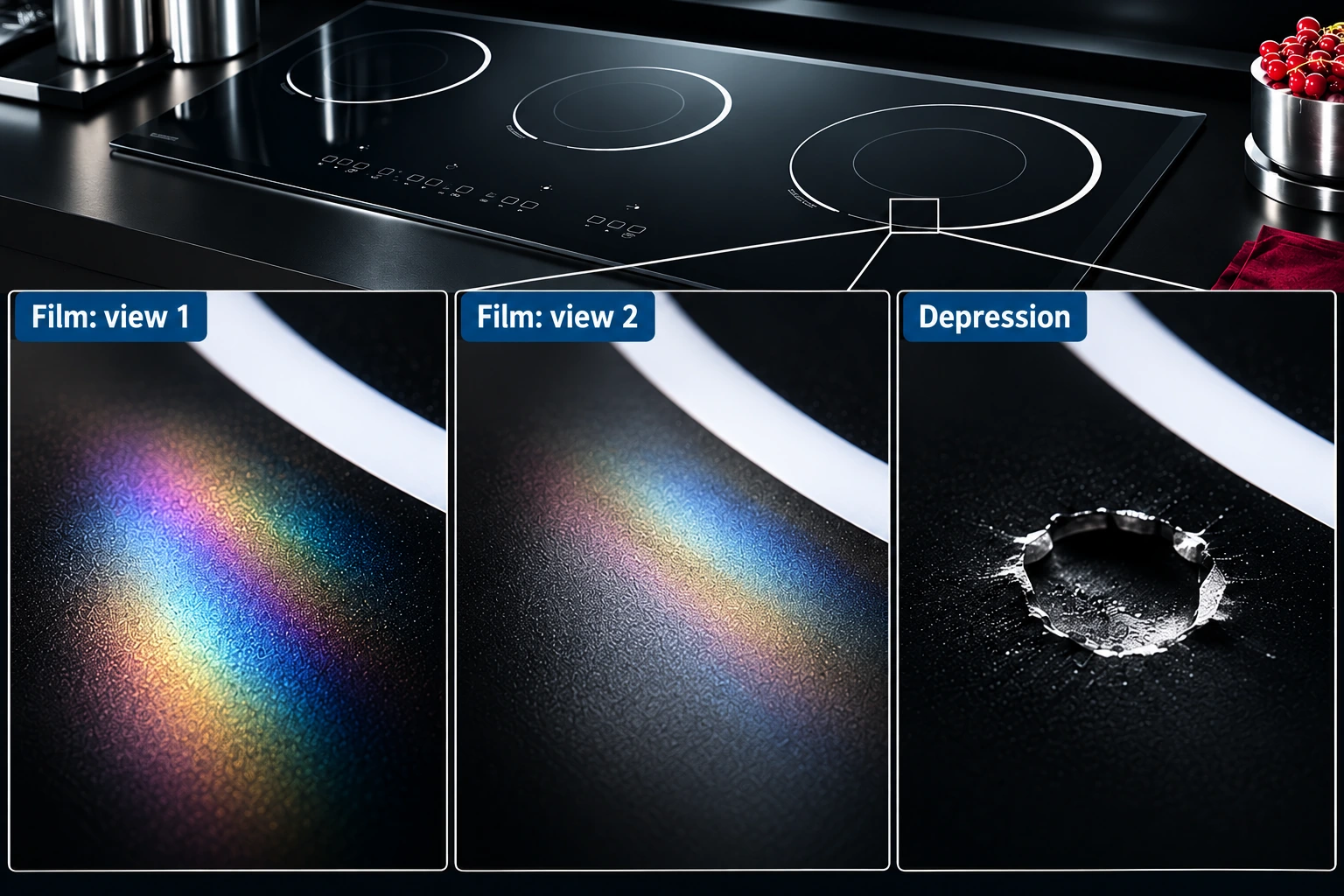
For an intact top, an approved cleaning step can help distinguish removable residue from a persistent appearance change. Document the mark before cleaning and once the top is dry afterward. If some film moves or disappears, record exactly which process was used. If it remains, do not assume you need a stronger chemical. Persistent marks can need identification rather than escalation. See the separate routine glass cooktop care guide for the wider maintenance context.
| Pattern | Question to investigate | Appropriate boundary |
|---|---|---|
| Sheen after water boiled over | Could a water or food deposit remain? | Use the model’s approved cool-surface care process |
| Streak following a pan movement | Could cookware material have transferred? | Do not assume it is a scratch or use metal polish |
| Broad film after cleaning | Was cleaner residue fully removed? | Check product compatibility and instructions |
| Colored effect within an oven window | Is this a coating-related optical appearance? | Use oven-window guidance, not cooktop chemistry |
| Depression, broken line or chipped area | Is actual surface damage present? | Stop experiments and request service assessment |
This table gives investigation prompts, not a diagnosis. It deliberately avoids assigning a universal chemical identity to a color that can arise in several different circumstances.
Check water, food and cleaner history
Write down what happened before the sheen appeared. Was there a boil-over? Was the pan base wet? Was a different cleaning product used? Did the appearance emerge only after the surface dried? These details help separate a deposited film from a change that needs technical inspection. A recollection such as “appeared after cleaning” is useful even when the cleaner’s involvement has not been proven.
In its glass cooktop cleaning guidance, GE describes mineral deposits and cookware metal marks as distinct care issues. That supports checking the history before treating every mark as permanent damage. The instructions are model-related examples, so follow your appliance’s own specified cleaner and method rather than borrowing a branded product recommendation from a different manual.
Keep the cleaner bottle or record its exact name and dilution. “Glass cleaner” is not a complete description because a window product, abrasive paste and cooktop cleaner can have different intended uses. Do not mix chemicals, combine home remedies or leave a product on the surface longer than directed. A stronger smell or a more abrasive texture is not evidence of a better result. If the instructions do not permit the product, do not use it for a trial.
Inspect cookware contact without creating a new mark
When the cookware is cool, inspect its outside base for stuck particles, rough spots and transferred material. Lift the pan when moving it rather than dragging it over the glass. Look at whether the mark follows the path of a pan or sits within a dried spill outline. That relationship is an observation, not proof of a defect in the pan or panel.
The Whirlpool ceramic-glass care page advises clean, dry cookware bases and avoiding sliding. These are practical prevention points, not a guarantee against every surface mark. Do not deliberately rub a suspect pan across a clean area to see whether it reproduces the discoloration. If a comparison is needed, let the responsible service or quality team define a safe controlled method.
Keep separate records for heating behavior and appearance. If a pan is not detected, or makes an unfamiliar sound, those are different user tasks from identifying a colored film. Our induction pan-detection checks help avoid drawing an electrical conclusion from a cosmetic mark. A cooker that heats normally has not thereby proven that an unexplained surface change is harmless.
Use a limited, documented cleaning check
First confirm that the surface is intact and the appliance’s instructions permit cleaning in its present condition. Switch off, allow it to cool, and follow the approved process with the specified accessory. Work on the affected area without extending the chemical or abrasive treatment to an unrelated control strip or decoration. Remove residues and dry the surface as directed before evaluating the appearance.
Compare the result in the same lighting. If the mark improves, note whether it has disappeared or merely looks different while wet. Avoid repeated cycles of different products because they make it difficult to identify what changed. If it does not improve after the allowed process, stop. A service team can work with a clear before-and-after record more effectively than with a surface that has been subjected to several undocumented remedies.
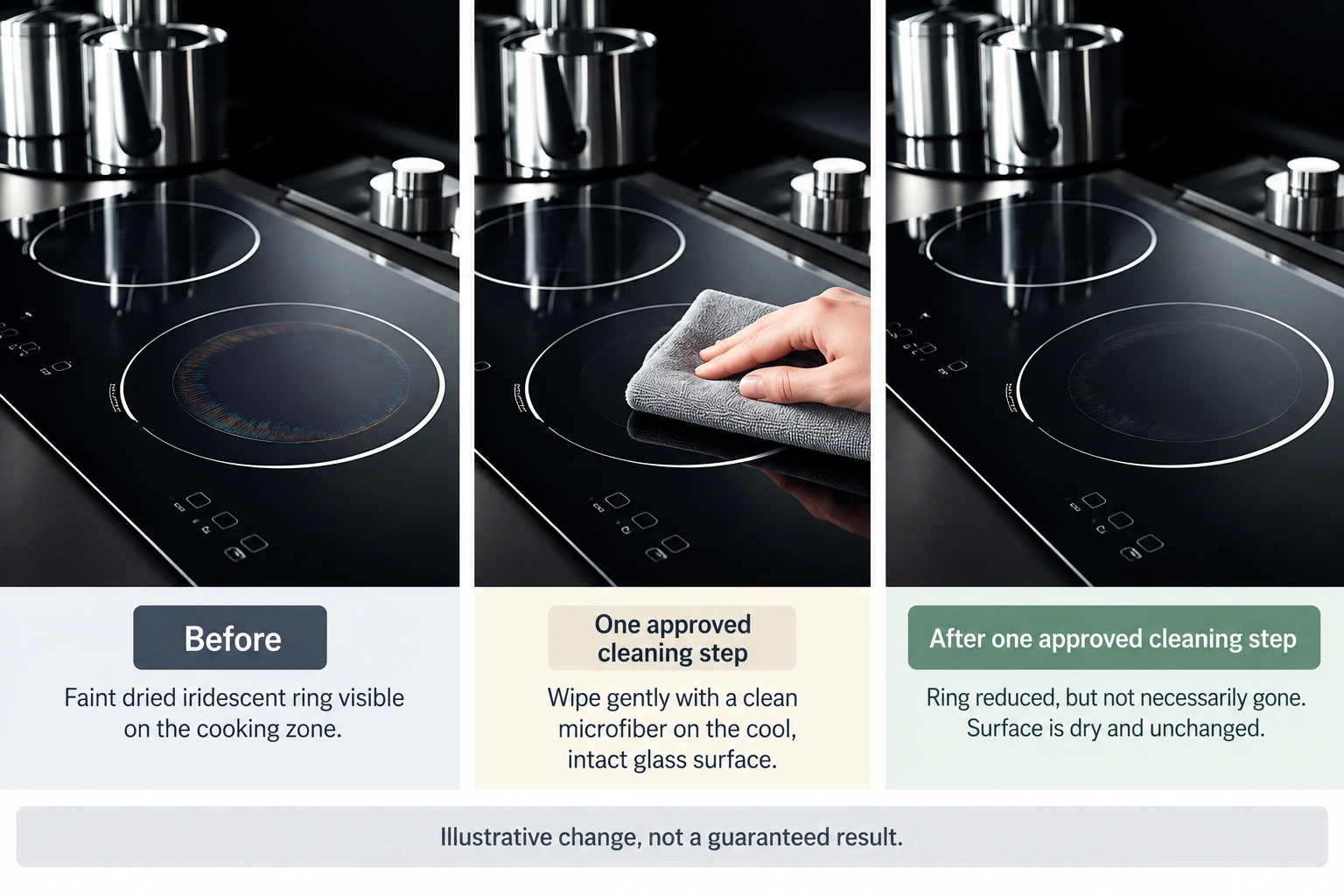
Do not use steel wool, abrasive drill attachments, metal polish, oven cleaner or a razor merely because someone used it on a different material. Some appliance manuals specify a particular scraper for particular soils, but that is not a universal permission. Never scrape an uncertain damaged area or attempt hot cleaning without the exact procedure and protection specified by the manufacturer.
When a remaining sheen needs support
Seek advice if the appearance persists after approved care, becomes associated with a depression or line, affects printed markings, or is accompanied by unusual operation. Provide the model, photographs, cookware and cleaner history. Explain whether the surface feels or looks discontinuous without probing it. Ask the support team to distinguish a removable deposit, appearance variation and actual damage through an appropriate inspection.
Do not promise a warranty outcome based on a color. Warranty terms, inspection findings and the original specification determine the decision. For a new installation, preserve the receiving photographs and packaging records if available. For a long-used appliance, record when the change was first noticed rather than assigning a production date to a condition that has not been traced.
How OEM teams can keep appearance judgments consistent
Define viewing conditions, a clean and dry surface state, approved cleaners and the reference sample before appearance approval. Keep material, decoration and assembly revisions with the record. If a complaint involves color, compare like-for-like photographs and samples rather than images taken under different lamps or with automatic phone filters. This reduces disagreement without inventing a numeric acceptance limit.
Kanger’s black glass-ceramic cooktop product provides the relevant material and application reference. Its website image cannot certify chemical resistance or the acceptability of a returned panel. Request project-specific data and agree the care instructions with the appliance team. Our OEM cleaning and handling record guide describes the documentation needed to compare observations consistently.
Further learning: inspecting and conserving glass
The Corning Museum of Glass video introduces the examination and conservation of glass objects. Use it as background for careful observation, not as a cleaning procedure for an installed cooktop or a repair for missing material. Follow the appliance manual.
Video: Glass Conservation, Corning Museum of Glass. Open the educational video on YouTube.
Frequently asked questions
Does a rainbow stain mean the cooktop is burned?
Color alone cannot establish heat damage. Identify the surface, history and whether the mark is a removable film or a persistent change.
Can I use advice for a rainbow-colored steel pan?
Do not transfer it automatically. Stainless steel cookware and a printed glass-ceramic top are different surfaces with different approved care requirements.
Should I keep polishing until the color disappears?
No. Use only the approved process. If the mark remains, document it and ask for advice instead of increasing abrasion.
What photographs are most useful?
Provide a whole-appliance view, a close view and an oblique view on a cool dry surface, with consistent lighting and the cleaner and cookware history.


