If your induction hob is slow to boil water, first compare the cookware, water quantity, starting temperature, selected function and other active zones under repeatable conditions. A pan that is detected is not necessarily the best-performing pan for that zone. Check its effective magnetic base and the appliance’s cookware guidance before suspecting the glass. Do not compare an open stockpot of cold water with a smaller covered kettle and conclude the hob has failed. If there is an error, damaged glass, abnormal smell or unexpected shutdown, stop the comparison and follow the appliance’s service instructions.
A useful complaint describes a repeatable change: the same saucepan and water quantity now take noticeably longer under the same operating conditions. An unhelpful complaint compares two different meals, different vessels or different starting temperatures. There is no universal boiling time that every induction appliance must achieve, and the printed maximum power does not establish the energy delivered to every pot throughout a heating cycle.
Start with the exact appliance model and its use-and-care instructions. Identify whether the chosen control is a normal power level, a boost function, a temperature program or another automatic mode. Their names and behavior vary between models. Some programs are designed to maintain a condition rather than deliver the fastest possible initial heating. Do not assume that the largest displayed number has the same meaning across different appliances.
The US Department of Energy explanation of induction cooking describes direct electromagnetic heating of compatible cookware. This supports understanding the energy path, but it is not a promise about your vessel’s boil time. The glass remains part of the appliance assembly; its appearance does not reveal the power reaching the water.
When the saucepan is cool and empty, examine its base for damage, contamination and obvious deformation. Follow the cookware and appliance instructions for compatibility checks. A magnet adhering to part of the bottom is a helpful screening observation, but it does not measure the diameter, uniformity or heating performance of the complete base. A large pan can have a much smaller magnetic insert than its upper rim suggests.
Compare the base dimensions with the zone’s documented cookware range. Center the vessel as instructed. A pan outside the accepted size range may not be recognized or may not perform as expected. Do not add a converter disc as a quick diagnostic fix: it changes the heat path and can conflict with the appliance instructions. If available, use another undamaged pan that the manufacturer identifies as suitable for the same zone.
Our pan-detection guide addresses a different starting point: cookware that is not accepted at all. Here the vessel is recognized and heating, but the rate is in question. Keeping those tasks separate prevents repeated replacement of glass or controls when the relevant variable is the cookware.
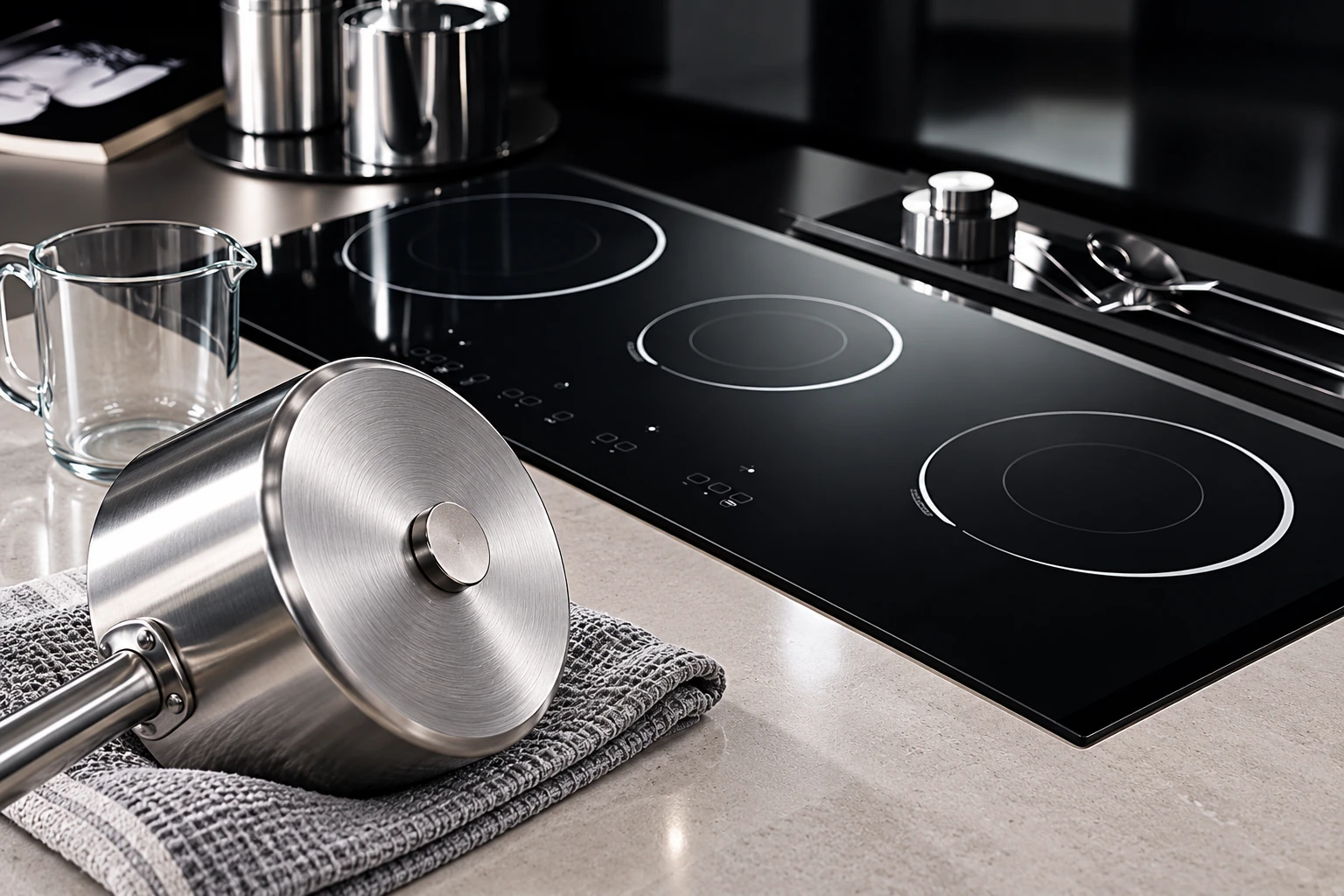
Use an ordinary, manageable quantity of water within the vessel’s permitted fill range. Record the quantity and starting condition rather than guessing from the height in a differently shaped pot. Never heat an empty pan for a boiling test. Place the vessel according to the appliance instructions and remain present throughout heating. Stop at the observation endpoint; do not let the water boil away.
For comparisons, keep the same lid arrangement and define the endpoint before starting. A few bubbles on the base are not the same observation as sustained boiling across the water. Opening the lid repeatedly changes the conditions and can expose you to steam. You do not need to hold a phone above hot water, insert an unsuitable thermometer or handle the vessel during heating to obtain a useful service record.
Starting temperature matters: water from a cold tap on one day and warm water on another do not require the same temperature rise. Ambient conditions and altitude can also affect a comparison. For a practical home observation, consistency is more useful than pretending to produce a laboratory efficiency measurement. Record limitations so a service team understands what the observation can actually show.
| Variable | Keep or record | Misleading comparison to avoid |
|---|---|---|
| Cookware | Same vessel, clean base and permitted zone | Different pot sizes or magnetic inserts |
| Water | Same quantity and comparable starting condition | Cold full stockpot versus warm small saucepan |
| Lid | Same permitted lid arrangement | Covered trial versus open trial |
| Controls | Function, level and boost status | Automatic simmer mode versus maximum heating |
| Other loads | Other zones and oven use | One-zone trial versus simultaneous high-power cooking |
| Endpoint | A clearly defined boiling observation | First small bubbles versus sustained boiling |
This table is an observation checklist, not a pass/fail specification. Use any manufacturer-provided performance procedure in preference to an improvised comparison. A qualitative change can justify service without establishing its electrical cause.
Many appliances manage available power across zones or functions. Record which other zones were active and whether boost was selected elsewhere. If the appliance instructions allow it, compare the ordinary one-zone arrangement with the same arrangement during normal multi-zone use. Do not exceed cookware or operating limits merely to reproduce a complaint.
If heating changes only when another zone is used, the next question is how that model allocates power. It is not proof of a defective panel. Our induction power-sharing guide explains that distinct behavior. Do not change installer settings, electrical connections or supply protection to obtain a faster result; those are matters for the responsible qualified professional and the appliance maker.
Boost may be conditional or time limited according to the model, so note whether it actually remained active. A control indication should be interpreted using the manual rather than assumed to be a measured wattage. Avoid comparing a short initial boost period with an entire cooking cycle and presenting the resulting ratio as appliance efficiency.
Cooling conditions can affect the operation of the electronics beneath an induction hob. Check only accessible areas described in the user instructions: for example, whether ordinary stored items obstruct an identified ventilation path. Do not remove the glass, reach into a fan, dismantle a connected appliance or alter cabinet openings. Installation clearances need to be verified against the actual installation documentation.
KitchenAid’s induction fan guidance identifies poor ventilation as a possible contributor to longer heating and boiling times. That is a manufacturer example of a mechanism worth checking, not a diagnosis of every slow hob. A noise alone cannot establish blocked airflow, a failed fan or a particular component temperature.
Record whether slow heating appears from a cold start or only after extended cooking, whether the oven below was operating and whether an error appears. Those observations help service teams choose the next check. Do not run repeated stress trials if the appliance is already shutting down or displaying a fault.
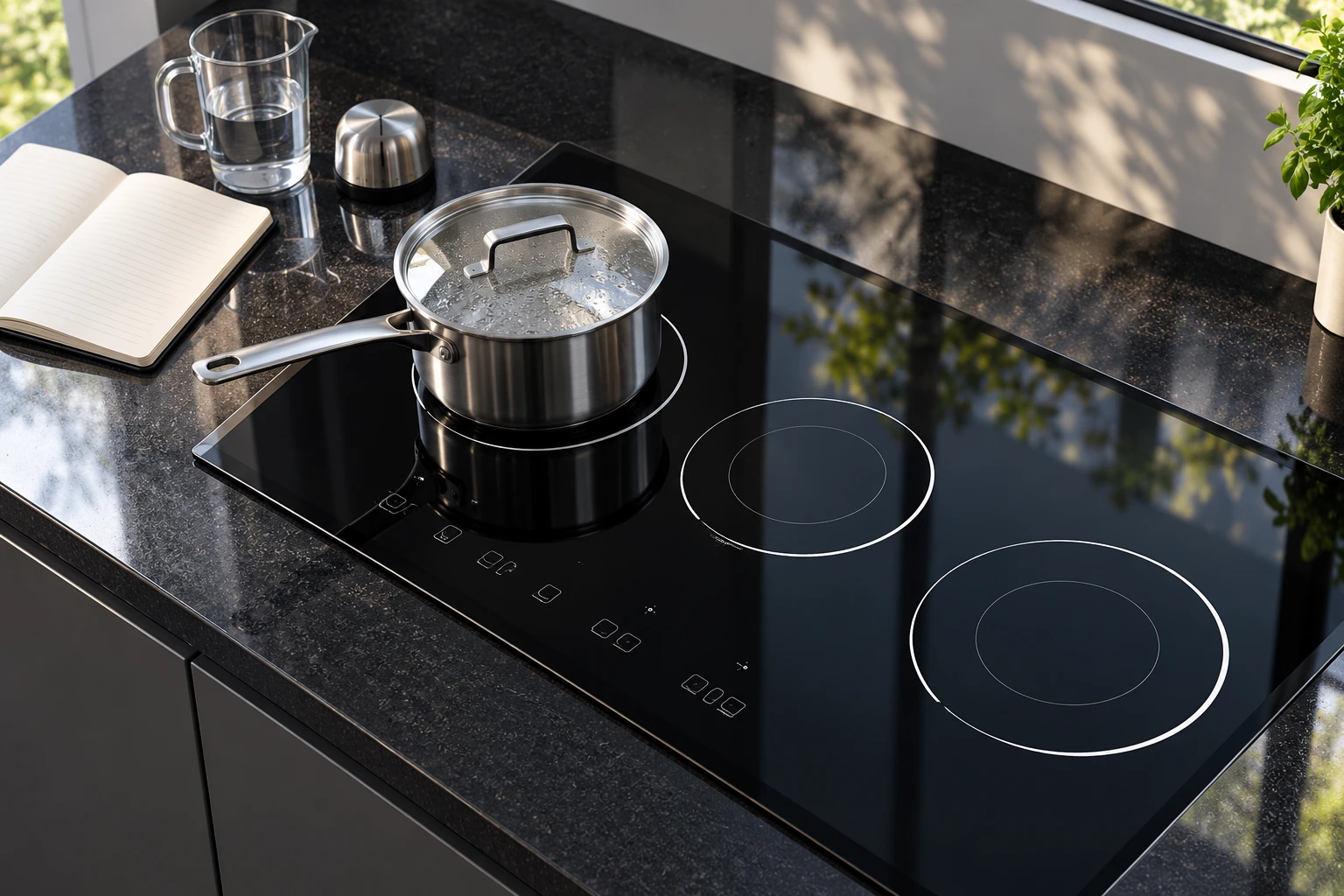
Heating more water through a larger temperature rise requires more energy. A basic relationship is Q = m × c × ΔT, where Q is the water’s energy increase, m is water mass, c is its specific heat capacity and ΔT is the temperature rise. With consistent units, an idealized time would be Q divided by the effective average power entering the water. This is a physical explanation, not a method for measuring your appliance’s electrical output.
The real vessel also absorbs heat, and energy is lost to its surroundings. Actual power can change during the run, while lid use and evaporation affect the conditions. Without suitable instruments and a defined method, a stopwatch cannot separate all these contributions. You can therefore use an observation to describe a symptom, but you cannot derive a reliable efficiency rating or Kanger material parameter from it.
The video below discusses induction cooking and cookware interaction, including why vessel geometry matters. It provides background for the controlled comparison, not a model-specific repair or a promise of a particular boil time. Keep the appliance and cookware instructions as the operating authority.
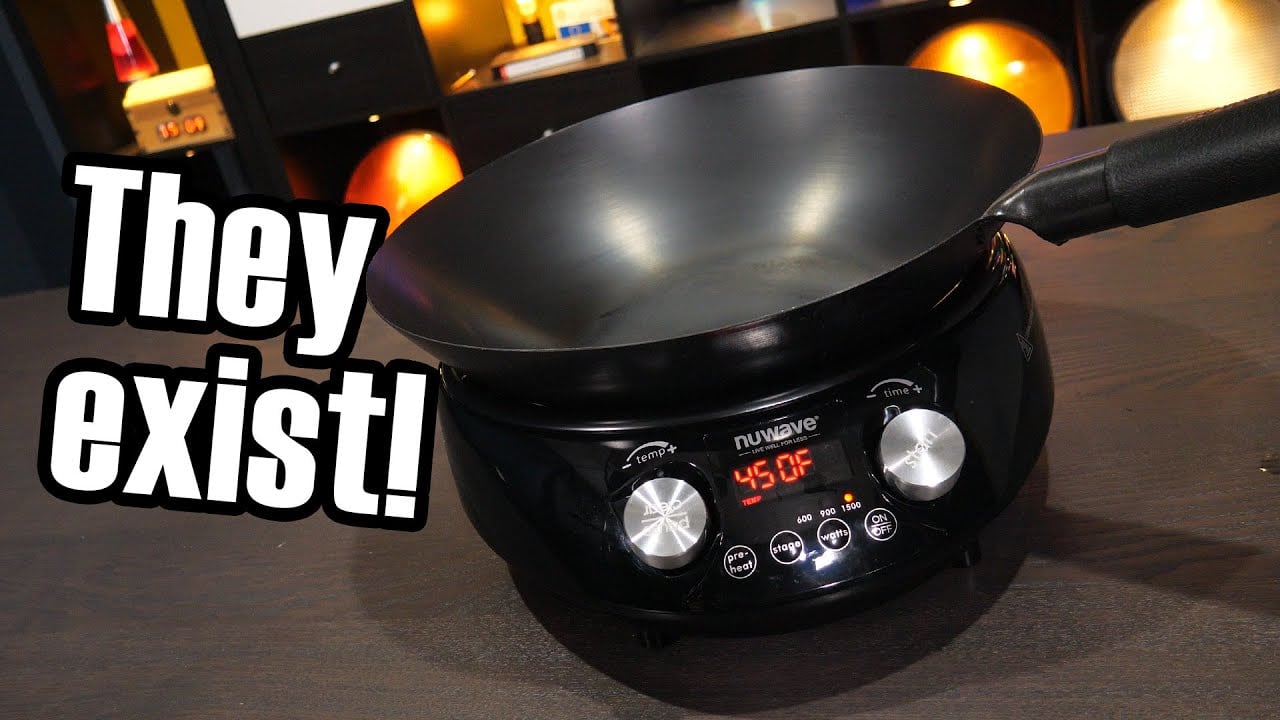
Video: Induction cooking – but what about woks?, Technology Connections. Open the educational video on YouTube.
Stop and seek the manufacturer’s service route if the glass is cracked, an error persists, a burning smell appears or heating stops unexpectedly. Do not open the unit to inspect coils or wiring. If the symptom is an unexpected shutdown rather than consistently slow heating, use our shutdown observation guide to organize the report.
For a stable slow-heating complaint, provide the model, vessel details, zone, water quantity, selected function, other loads and a short observation history. Include whether a suitable alternative pan changed the result. Avoid vague claims such as all induction is slow or the glass is too thick unless the responsible evaluation has established that conclusion.
Kanger’s black glass-ceramic cooktop panel is part of the cooking assembly. Panel selection should follow the approved appliance design, with defined geometry, decoration and integration requirements. A replacement glass sheet is not a power upgrade and cannot correct an unsuitable pan, an installation issue or a control limitation by itself.
For an OEM investigation, keep panel identification and assembly history with the complete-product observations. Compare samples under the responsible team’s controlled method rather than attributing a customer cooking difference to material properties alone. This avoids changing a conforming panel while the actual performance variable remains unresolved.
No. Magnet attraction is a compatibility screen, not a performance guarantee. Effective base geometry, zone matching, control settings, water quantity and operating conditions still matter.
Do not replace it on that symptom alone. Check the permitted cookware and operating conditions, then obtain model-specific service advice if the problem persists. Damaged glass requires separate attention.
Only as a rough illustration. Different water quantities, temperatures, cookware, lids, settings and supply conditions prevent a reliable direct comparison.
That depends on the model and its power-management rules. Consult the manual and record what the controls show; do not alter installation settings to override a limitation.



