Induction hob pan size should be checked at the flat, induction-compatible base of the cookware, then compared with the requirements for the specific cooking zone. The size printed on a frying-pan box often describes its upper rim. That measurement alone does not establish the size of its magnetic base, whether the hob will detect it, or whether it can heat evenly. Start with your appliance manual, choose a flat compatible pan, center it as instructed and keep the controls clear. There is no single minimum diameter, maximum overhang or percentage rule that safely applies to every induction hob.
A pan can have a wide opening, a narrower contact base and an even smaller induction-compatible disc bonded into that base. Those dimensions answer different questions. The opening describes capacity and working space. The contact base describes how the pan sits on the glass. The magnetic area helps determine its interaction with the induction system. Treating all three as the same diameter can lead to buying cookware that looks suitable but performs poorly on the intended zone.
When the cookware is cool, turn it over on a protected counter and identify the flat base. Check the maker’s drawing or specification if the magnetic section is not obvious. Record the actual base diameter separately from the advertised size. A magnet is a useful screening tool for material compatibility, as explained in ENERGY STAR guidance on electric cooking, but attraction does not certify detection, flatness or heating performance on every appliance.
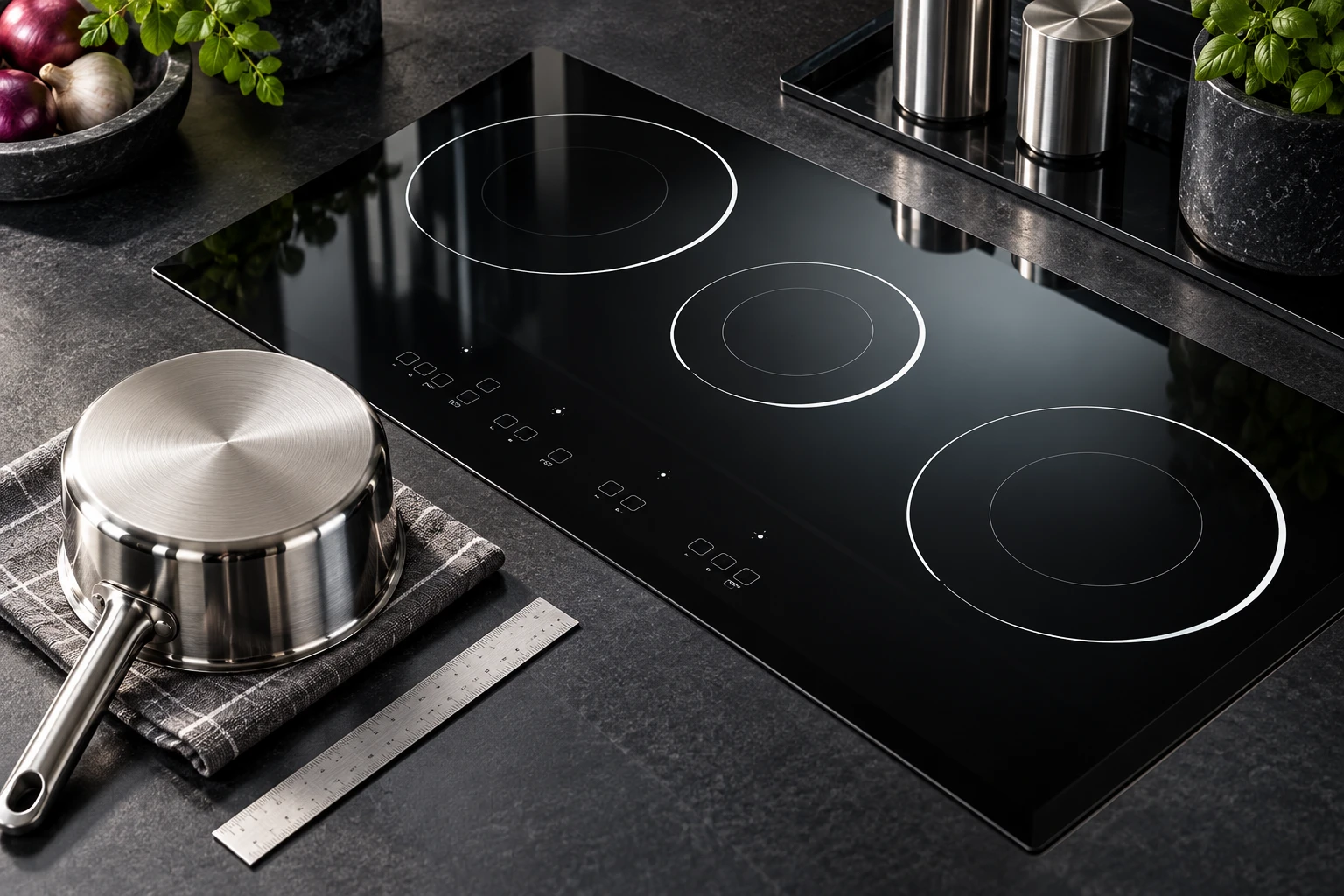
The manual may list recommended cookware sizes, minimum base diameters or instructions for flexible cooking areas. Read the information for the exact zone you intend to use. A large ring printed on the surface is a positioning aid, not a complete drawing of the coil underneath. Likewise, a pan that starts on a small zone is not automatically a good match for all larger zones. Detection and the useful heated area are related but separate requirements.
Do not borrow a minimum diameter from another brand or from a visually similar hob. Sensor design, coil arrangement and control logic vary. Some appliances accept a range of cookware sizes; others have more restrictive instructions for particular zones. If the manual is unclear, ask the appliance manufacturer with the model number and cookware-base dimensions. A glass-panel supplier cannot establish the operating limits of an assembled appliance from a photograph of its top.
| Observation | What to check | Useful next step |
|---|---|---|
| Large rim, small base | Actual flat magnetic footprint | Compare the base with the selected zone’s instructions |
| Pan works on one zone only | Different zone limits and centering | Use the permitted zone; do not assume a glass fault |
| Wide pan with cool edges | Base construction and effective heating area | Try an approved closer size match under comparable conditions |
| Pan covers control symbols | Control clearance and permitted cookware envelope | Move to an approved arrangement or choose smaller cookware |
| Long griddle spans two rings | Explicit bridge-zone permission | Follow the manual for the combined area |
This is a qualitative selection table. It supplies no substitute dimensional limits. Appliance instructions and the cookware maker’s specifications remain the basis for the final choice.
Place the cool pan on the intended zone with the appliance off. Check that the base sits stably, the handle does not create a collision with neighboring cookware and the pan stays clear of the control area. Lift pans into place rather than dragging them across the glass. Remove grit from the base and surface before setting cookware down. A larger pan creates practical clearance questions even when its material is compatible.
Consider the whole cooking arrangement, not just a single pan in an empty kitchen. A saucepan may fit by itself but interfere with a second pan or make a handle awkward to grasp. Check lids, handle travel and access to the controls. Do not solve a clearance problem by shifting the pan far off its prescribed center. Change the cookware arrangement instead, following the manual’s instructions for simultaneous zone use.
If a hob does not recognize a pan, start with the dedicated pan-detection checks guide. That problem concerns establishing an acceptable cookware connection. Pan-size selection goes a step further: a recognized pan may still distribute heat differently across its base. An oversized frying surface can have a useful cooking area that differs from the visible rim. Neither the printed glass ring nor the detection symbol promises uniform temperature everywhere in the pan.
For a practical comparison, use two permitted, compatible pans with different base sizes and a similar amount of water, starting from similar conditions. Keep the zone and selected setting consistent and supervise the test. Record whether the pan is detected and how the water behaves. This observation can help separate cookware matching from other issues, but it is not a calibrated efficiency test or a measurement of coil dimensions. Never heat empty cookware to map hot spots.
If the pan is detected but food cooks unevenly, consult uneven-heating checks. If two zones behave differently when both are used, check shared-power behavior. Those are distinct questions. Buying a bigger pan will not necessarily solve power sharing, and changing the glass will not necessarily solve a base-size mismatch.
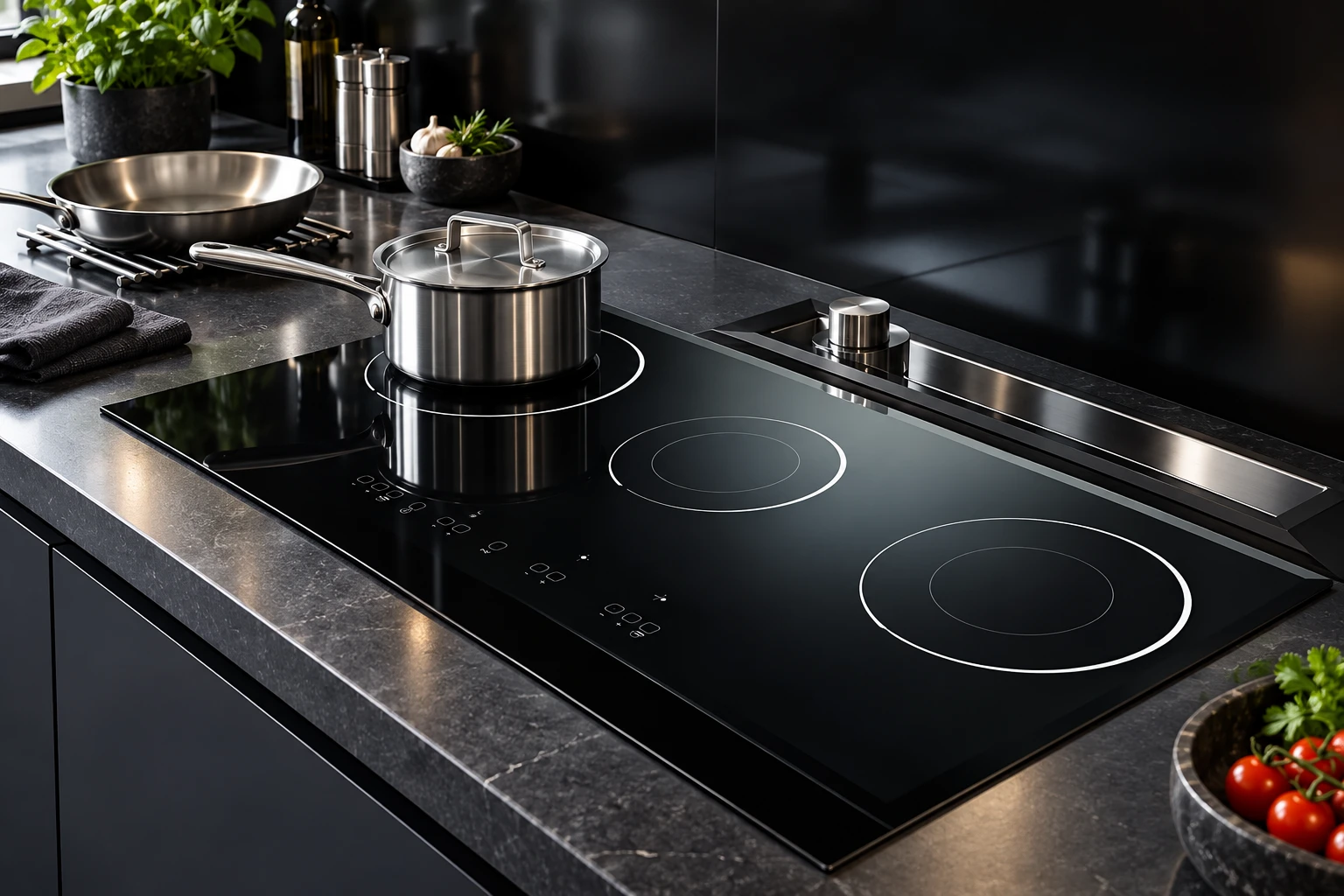
Flexible or bridged areas need their own instructions. Some combine zones for long cookware; some detect pan position within a specified area. Do not assume that a rectangular outline means that any griddle, roasting tray or unusually shaped vessel is permitted. Verify its base material, size, flatness and placement. The appliance’s acceptable cookware envelope may also protect controls and ventilation paths from nearby hot surfaces.
A bridge function is especially relevant when the pan is longer than one ordinary zone. Follow the instructions summarized in bridge-function cookware guidance and the exact appliance manual. Positioning a long pan across unrelated zones without permission is not an equivalent substitute. Also avoid adding an adapter plate solely to make a small pan appear larger: that changes the cooking interface and requires separate appliance permission.
Kanger supplies materials such as the Kanger black glass-ceramic cooktop panel. Glass material, panel outline, printed zone graphics and assembly requirements matter to the complete product, but none of those alone determines the acceptable pan size. For an OEM project, document the electronics supplier’s cookware envelope and the intended control layout before approving the printing drawing. Verify the assembled appliance with representative permitted cookware rather than approving graphics in isolation.
An OEM approval record should name the panel drawing revision, zone layout, cookware samples, base dimensions and appliance configuration used for the review. Include photos that show placement and control clearance. If the artwork changes, review whether users can still understand where cookware belongs. Product imagery on a website cannot replace that verification. The black glass-ceramic overview provides related material information, while appliance operating claims need evidence from the finished system.
Before ordering cookware, collect the hob model number, the manual’s zone requirements, the cookware’s rim diameter, flat base diameter and magnetic-base specification. Ask whether the published size refers to the rim or base. For a bonded disc, request the disc diameter rather than assuming the whole bottom is magnetic. Keep the receipt and manufacturer information so an unexpected compatibility issue can be discussed with clear evidence.
For support, describe the symptom precisely: not detected, detected only on one zone, unstable placement or uneven cooking after detection. Include the setting and whether another zone was running. Avoid claiming that the glass is too thick or the coil is faulty without diagnostic evidence. Continue following U.S. Fire Administration cooking-fire guidance: remain attentive while cooking, and turn the burner off if leaving the kitchen. Cookware fit does not remove ordinary cooking-fire precautions.
When comparing two cookware listings, ask both suppliers for the same base measurement. A drawing that labels only the upper rim cannot settle the choice. Save the written reply with the hob manual so future replacements use the same verified dimensions rather than another visually similar pan.
The neutral video below explains induction-cookware interaction and the special challenge of curved vessels. It supports the physical background; it does not supply a universal pan-size chart or authorize a particular wok on your appliance.
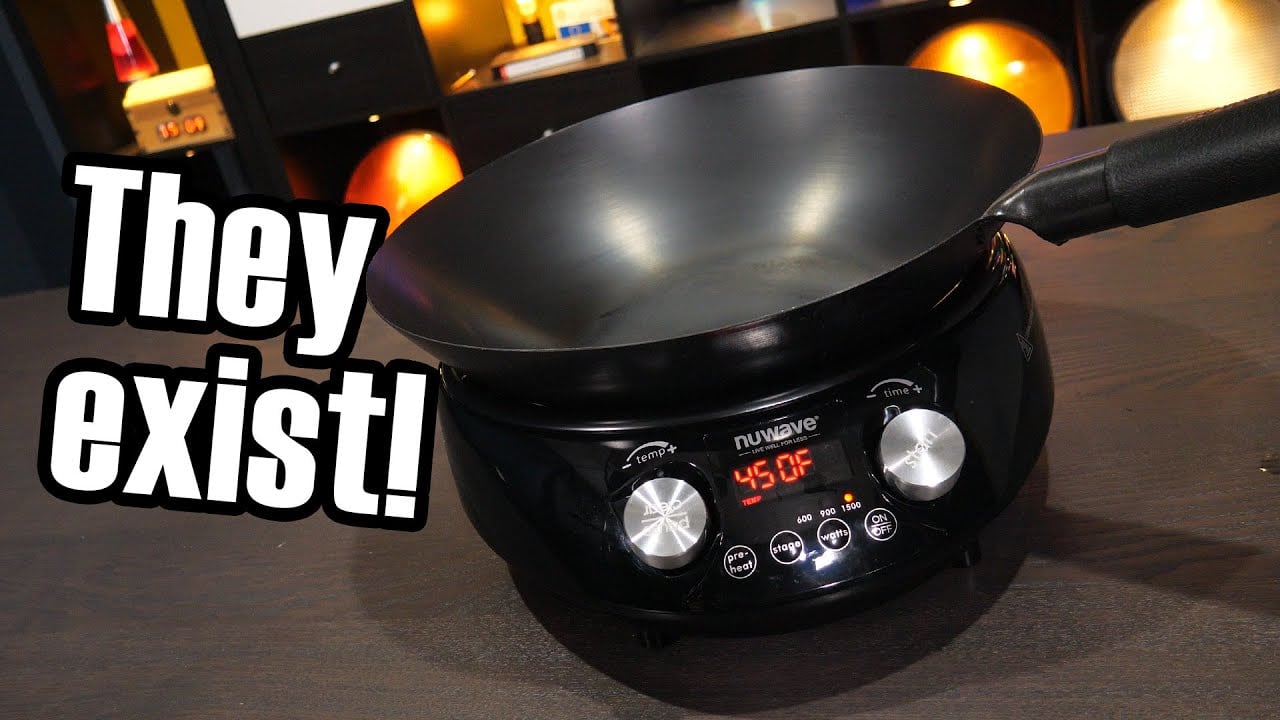
Video: Induction cooking – but what about woks?, Technology Connections. Open the educational video on YouTube.
Record both if needed, but use the flat magnetic base and your hob’s zone instructions for compatibility decisions. The advertised rim size alone is insufficient.
Sometimes, within the appliance’s stated limits. Check the zone’s minimum cookware requirement rather than applying a universal percentage or diameter.
No. It screens material compatibility. Base size, construction, flatness, placement and appliance requirements still affect detection and practical cooking performance.
Do not assume so. Use the manual’s cookware guidance and the manufacturer’s specifications rather than inferring the hidden assembly from surface graphics.



