Kanger Glass-ceramic Co., Ltd.
Induction hob uneven heating can arise from the pan’s magnetic base, its ability to spread heat, the match between pan and cooking zone, or the way power is applied. It does not automatically mean the glass panel is defective. Start with the exact appliance and cookware instructions, a clean suitable pan and a correctly selected zone. Compare one condition at a time using normal supervised cooking. If the same abnormal pattern persists with suitable cookware, document it for service rather than opening the hob or replacing components by guesswork.
This guide concerns uneven heating across a pan. A whole pan warming slowly, power cycling over time and an appliance switching off are related observations with different next steps. Separating them makes a useful comparison possible and avoids turning every symptom into the same generic induction fault.
Describe the pattern before changing anything
Record whether the middle browns earlier than the edge, one side consistently cooks faster, or the entire pan alternates between stronger and weaker heating. Note whether this happens only during preheating, only with a large pan or across different cookware. A description tied to a specific pan and zone is more useful than saying the stove is weak.
Food is not a calibrated temperature sensor. Unequal thickness, moisture, quantity and placement can change browning even when the appliance behaves normally. A pan that looks level can also have a base construction that differs from its top diameter. Do not infer coil dimensions from a single ring of browned food or the first bubbles in water.
Distinguish a repeatable spatial pattern from a changing cooking load. Adding cold ingredients, stirring or moving a pan changes the observation. For an initial comparison, keep the recipe simple and follow both manufacturers’ permitted operating methods rather than deliberately overheating an empty pan.
Understand what induction heats
The US Department of Energy describes induction heating as transferring energy to suitable cookware through an electromagnetic field. The pan then distributes heat through its construction and into the food. That distinction matters: glass appearance alone cannot tell you how uniformly a particular pan will cook.
Two pans with the same advertised diameter can have different magnetic base areas, thicknesses and layers. A broad rim does not guarantee an equally broad working base. An induction-compatible marking establishes intended use, but does not promise identical performance on every zone at every setting.
Visible cooking rings are placement guides, not a map of every component beneath the surface. Use the appliance’s published cookware dimensions and zone instructions. Flexible and linked zones may have their own placement rules. Guessing from the printed circle can obscure a straightforward compatibility issue.
Check the pan when it is cool
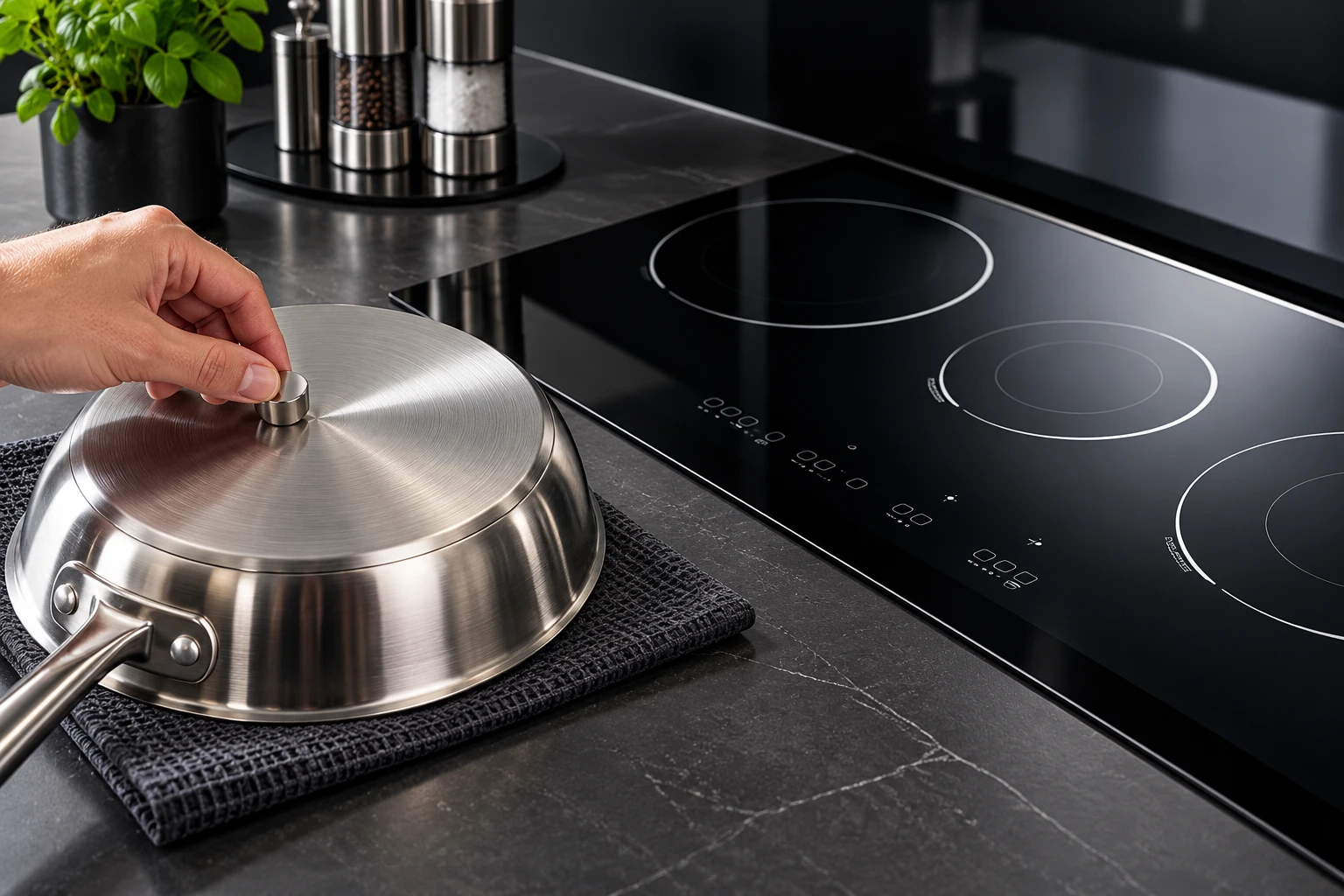
Look at the underside for its usable base diameter, permitted heat source and any obvious damage. Check the cookware maker’s induction instructions, particularly preheating and maximum settings. A small magnet can provide an initial indication of magnetic response, but does not measure heating uniformity, flatness or the complete layered construction.
Keep the base clean and dry as instructed. Do not drag a rough underside across the glass during inspection. If the pan rocks or appears distorted, ask the cookware supplier how to assess it; do not bend it back, grind the base or use a weighted load to force contact.
A useful comparison pan should be known to work properly on induction and fall within the appliance’s permitted dimensions. “Another pan” is not automatically a valid control if it has an unknown base or different use restrictions. Record the identity of both pans so later observations remain interpretable.
Match cookware and zone deliberately
Centre the usable base as shown in the appliance instructions. Check minimum and maximum sizes where specified, and distinguish the base diameter from the rim. For a griddle or an oval vessel, use linked zones only if both appliance and cookware instructions allow that arrangement.
An oversized pan can extend beyond the area receiving energy, leaving its construction to spread heat farther. A small magnetic insert in a much larger pan introduces a similar question. These are reasons to review compatibility, not proof that the induction unit has failed.
Keep the initial comparison to one active zone when practical. This avoids mixing spatial unevenness with shared power behavior. For changes caused by running two pans together, use the separate power-sharing guide. Do not alter the appliance’s installation power configuration as an owner troubleshooting step.
Use a controlled comparison instead of a dramatic test
Begin from comparable cool conditions and use the same permitted food or liquid quantity, pan position and setting sequence. Avoid a maximum-power empty-pan test, which can damage cookware and does not represent normal cooking. Remain present throughout and stop if the pan or appliance behaves abnormally.
Electrolux notes that rapid high-power heating can outpace heat distribution through a pan base, and suggests a lower initial setting with appropriate cookware instructions. Treat this as a useful principle, not a fixed preheat time or permission to heat an empty nonstick pan.
Change only one major variable between comparisons. First compare suitable pans on the same zone, then, if allowed and useful, compare the same pan on another compatible zone. Let equipment cool as necessary. Switching pan, zone, recipe and power setting together produces a different meal rather than a meaningful diagnostic record.
| Observation | Comparison to make | What the result can support |
|---|---|---|
| One pan has a hot centre on several zones | Compare a known suitable pan under similar conditions. | A cookware-related question deserves attention; it does not certify the hob. |
| Several suitable pans show the same unusual pattern on one zone | Document zone, positioning and settings for service. | The appliance provider has a repeatable observation to investigate. |
| Results improve with a gentler permitted start | Repeat the ordinary recipe with the revised method. | The heating sequence may be contributing. |
| Heating changes only when another zone runs | Review the appliance’s shared-power instructions. | Power allocation may explain timing differences. |
| The whole pan heats slowly | Use the dedicated slow-boiling comparison. | Heat-up rate is a separate question from spatial uniformity. |
The table gives qualitative decisions, not acceptance limits. There is no invented permissible temperature difference or universal coil-to-pan ratio.
Avoid misleading measurements
A handheld infrared thermometer does not automatically provide an accurate map of reflective cookware. Its reading depends on surface properties, viewing conditions and instrument setup. Unless the method is suitable and understood, record the cooking observation instead of presenting a false precision.
Do not sprinkle flour across an empty pan, overheat oil to produce a dramatic pattern or place an unsuitable sensor between pan and hob. A test that violates the cookware instructions can create damage while failing to answer the original question. Professional assessment may require instruments and controlled methods beyond an owner’s normal-use comparison.
Keep any photograph honest about what it shows. A bubble pattern, food colour or steam image is an observation of that moment, not a certified thermal survey. Include the setting, elapsed stage of cooking and conditions in the record so the image does not acquire a stronger meaning later.
Know when service is the next step
Stop cooking if there is cracked glass, unexpected electrical behavior, repeated protective tripping or a warning the manual identifies as requiring service. Do not remove the top, inspect coils or adjust internal sensors. A visually intact panel does not authorise continued operation through an electrical fault.
For a persistent performance complaint, send the appliance provider the full model, pan identity, base dimensions, zone, setting sequence and whether other zones were active. Describe the repeatable pattern and the comparison pan result. Ask what additional observation is appropriate before arranging repair.
If the main issue is the time needed to heat water throughout the vessel, follow the slow-boiling comparison guide. If the appliance will not recognise the pan, use pan-detection checks. These separate records keep the investigation focused.
What this means for glass-panel procurement
The panel, coil assembly, electronics and cookware form a system with different responsibilities. A panel drawing can define geometry, appearance and other agreed requirements, but cannot by itself certify pan temperature uniformity. Avoid assigning a cooking-performance complaint to a material supplier without application evidence.
Kanger’s black glass-ceramic cooktop panel is the relevant product family. For an appliance project, provide the approved drawing, markings, mounting interface and agreed application requirements. Retain traceability between the panel revision and the assembled appliance used for evaluation.
Use the induction and infrared panel comparison as wider application context. Do not infer one heating technology from black glass alone. Product-specific performance and safety still require the appliance team’s validation; this article gives no Kanger temperature-uniformity specification.
Further learning: cookware and induction
Technology Connections explains induction cooking and the importance of vessel geometry using a wok discussion. The video is background for understanding energy coupling and cookware, not a test of your pan, your appliance or Kanger panels.
Video: Induction cooking – but what about woks?, Technology Connections. Open the educational video on YouTube.
Frequently asked questions
Does uneven cooking prove the induction glass is defective?
No. Cookware construction, placement, zone compatibility and heating method can contribute. Record a controlled normal-use comparison before attributing the problem to a component.
Can a pan be induction compatible and still heat unevenly?
Yes. Compatibility and heat distribution are different questions. Check the usable magnetic base and the cookware maker’s instructions rather than relying only on the rim diameter.
Should I test a pan empty on maximum power?
No. Follow the cookware instructions and use ordinary supervised cooking conditions. An aggressive empty-pan test can damage cookware and give a misleading result.
What should I send to the appliance service provider?
Provide the model, pan identity and base dimensions, zone, setting sequence, other active zones and a clear description of the repeatable pattern and comparison result.