 Kanger Glass-ceramic Co., Ltd.
UV adhesives for glass should be selected by matching the exact adhesive, the complete material stack, the available curing-light path and the joint’s service requirement. Glass that looks clear or a bond that feels firm is not enough to prove a qualified cure. Before comparing products, identify where light must travel, which surfaces the adhesive contacts and how the supplier will verify the result on representative assemblies. This guide focuses on that selection task, especially when glass is coloured, decorated or attached to an opaque mating part.
Start with the joint and the proposed curing route
Describe what the joint needs to do: position a part, retain a trim, support a seal or transfer a specified load. Record the intended contact region and the consequence of a failed bond. A safety-related assembly requires a qualification plan approved by the people responsible for the finished product, not an informal demonstration with an available glue.
Ask the adhesive supplier to identify the exact candidate and curing requirements. Do not treat “UV adhesive” as a complete technical specification. The applicable light source, process conditions and verification method depend on the selected material and the geometry in which it is used.
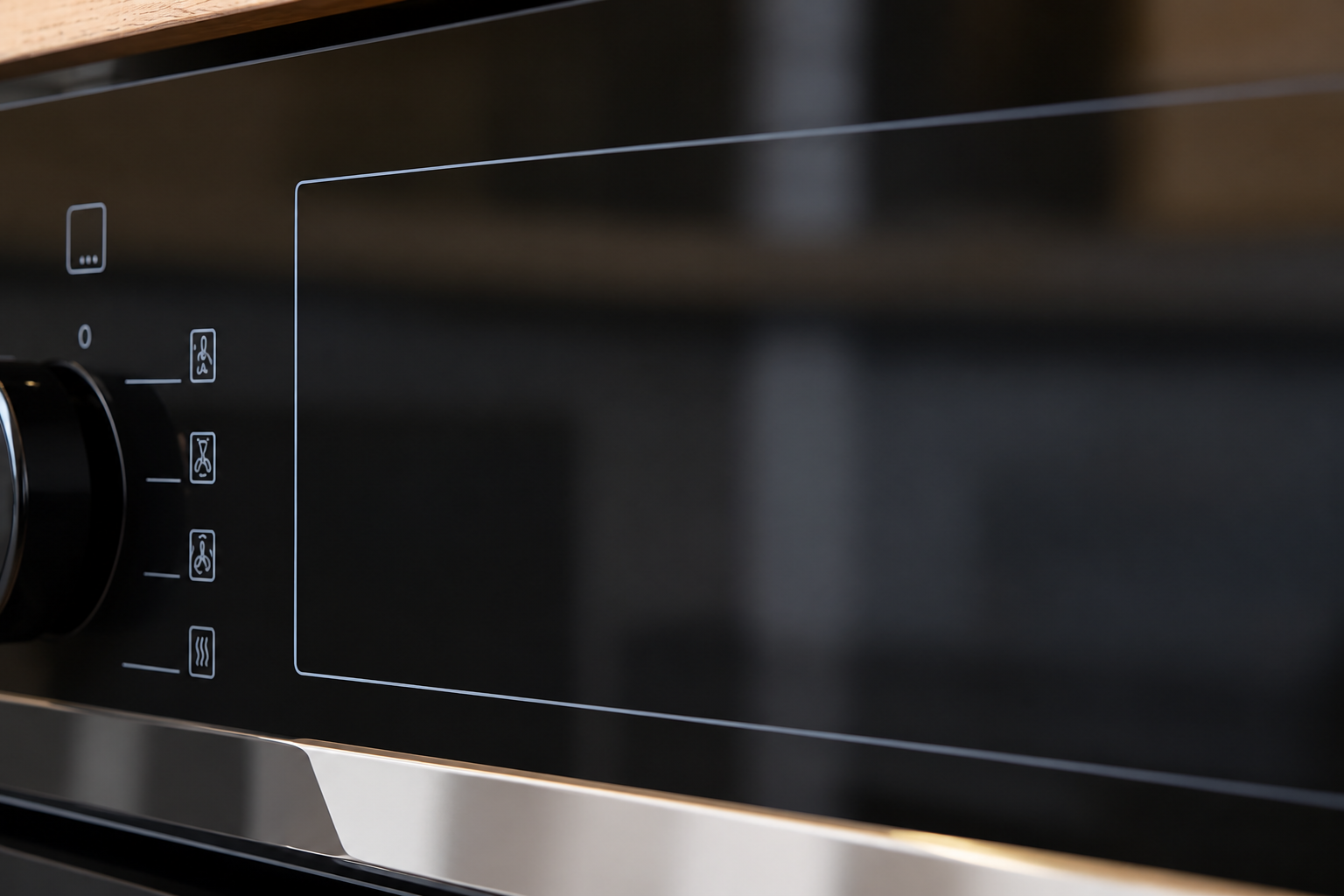
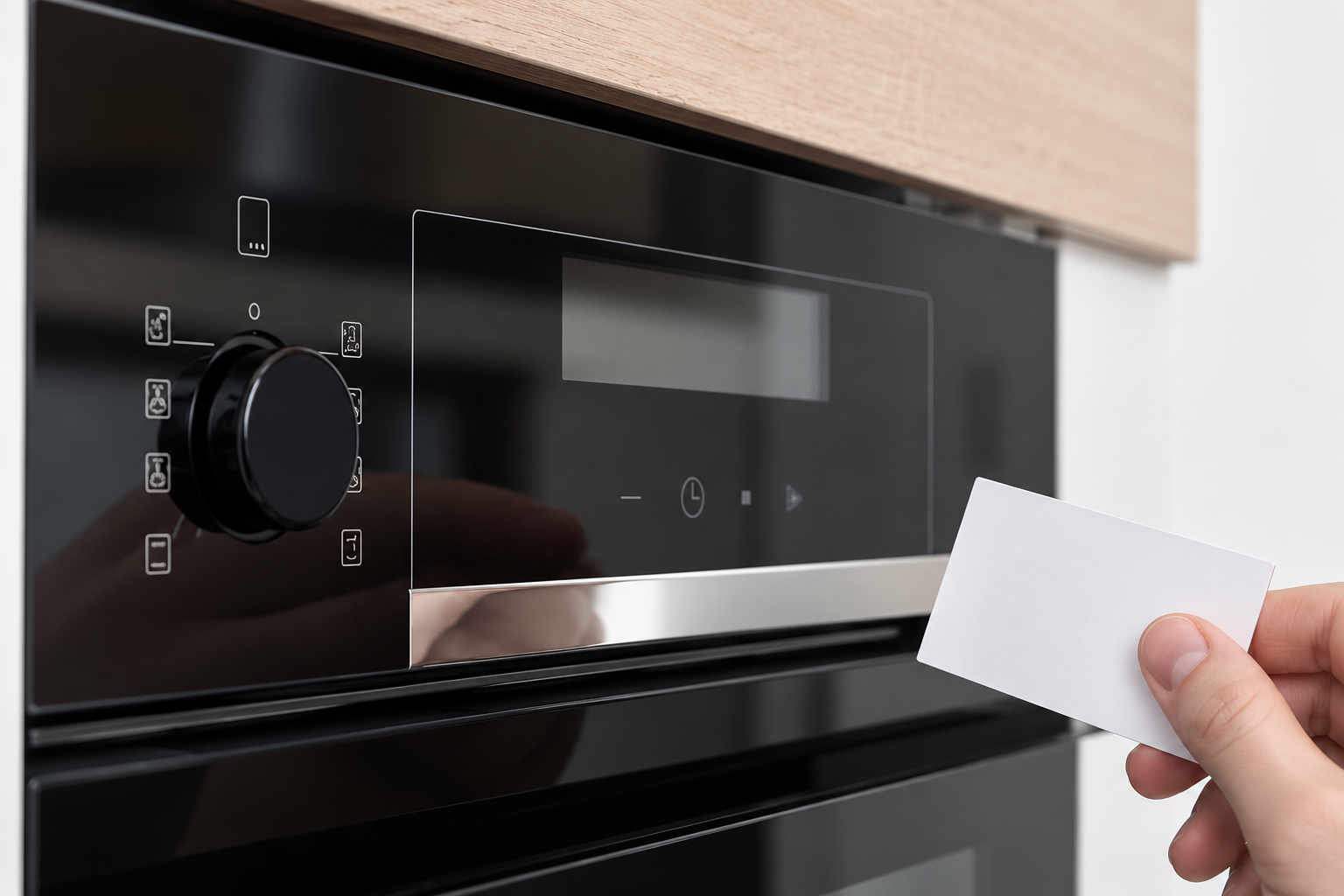
For an appliance component, Kanger’s tempered control-panel glass provides a relevant finished-surface example. The pictured black fascia does not establish a UV-light transmission value, show an internal bond or prove that a light-curing adhesive was used in its assembly.
Draw the complete light path
Identify the source position, the surfaces and layers between the source and the adhesive, the bond region itself and any feature that can obstruct access. Review the whole joint, including regions that are less convenient to inspect. A visible edge may receive light under different conditions from an enclosed or covered area.
Include the mating material in the review. If a metal frame, decoration, fixture or neighbouring component changes the available path, the trial needs to represent that condition. A supplier should not qualify an exposed sample and silently apply the result to a covered production joint.
NASA’s light-and-matter explanation describes why material interactions with light depend on wavelength. For a glass bond, that is background for requesting appropriate transmission and curing evidence. It is not a transmission curve for a Kanger product or a recommendation for a particular lamp.
Do not infer UV transmission from visible appearance
A photograph shows the component under a particular visible-light condition. It cannot determine the useful transmission at the wavelengths required by an adhesive. Identify the actual glass composition and surface layers, then obtain relevant information or measurements for the proposed path.
Treat coloured, printed and coated regions as separate cases where necessary. A surface that appears opaque may make a proposed path unsuitable, but the photograph alone is not a spectral measurement. Ask the responsible suppliers to evaluate the actual stack rather than using the generic word glass as evidence that the curing route will work.
The backlit glass-panel guide discusses the distinct role of masks and viewing regions in a finished control assembly. Those visible-light requirements should not be substituted for the different optical question posed by adhesive curing.
Match the source and the measurement to the formulation
Ask the adhesive supplier which source characteristics and process conditions matter to its candidate. Ask the equipment supplier how the proposed configuration meets those requirements over the relevant bond region. Do not choose a lamp solely because its marketing description includes the same broad UV label.
Define the measurement before comparing numbers. Establish where it is made, what it measures, how it relates to the adhesive’s requirement and how the instrument is maintained. A result taken in a convenient open position may not describe the condition at the covered or partly obstructed joint.
NIST’s UV radiometry overview describes calibration and measurement work for UV applications. It supports the need to consider spectral relevance and a defined measurement method. It supplies neither a universal cure limit nor evidence that a particular factory measurement is traceable to NIST.
Control contact surfaces as well as light access
A suitable light path does not establish adhesion to the intended surface. Distinguish bare glass from decoration, a coating or a temporary film. Identify the exact contact layer and obtain the relevant preparation and compatibility instructions. If the adhesive contacts a printed layer, review the complete interface rather than assuming that adhesion to bare glass answers the question.
Keep the component drawing, surface specification and adhesive process connected. The screen-printing durability specification is complementary to this task: it defines the decorated surface and its service role, while the adhesive trial evaluates the proposed contact and curing route.
Do not improvise abrasion, cleaning or primer application on a delivered finished panel. An apparently effective preparation can change a surface that another requirement depends on. Document the agreed route so that a later repeat order uses the same approved combination.
| Configuration | Question to resolve | Evidence needed before release |
|---|---|---|
| Clear-looking bare glass | Is transmission appropriate to the exact adhesive and proposed source? | Relevant material information or measurements plus a representative cure trial |
| Coloured glass | How does the actual composition affect the proposed path? | Evaluation of the intended colour and material, not a substitute clear sample |
| Printed or coated glass | Which layers lie in the path and which layer is bonded? | A defined stack, contact-surface approval and configuration-specific trial |
| Opaque mating part | Can the complete bond be reached through another approved path? | A demonstrated source and fixture arrangement for the production geometry |
| Hidden or partly covered region | Does the verification represent the least accessible relevant region? | Supplier-defined evidence addressing that region rather than only an exposed edge |
This is a qualitative review table. It does not predict transmission, adhesive strength or the curing conditions for any listed configuration.
Use a representative assembly instead of a convenient sample
Build the trial around the intended glass, decoration, mating material, joint geometry and fixture. Identify every deliberate difference between the sample and the proposed production assembly. A simplified sample may help investigate one question, but its result should remain bounded to the conditions it represents.
Ask the adhesive supplier how cure completion will be verified for the selected system. A surface that is no longer tacky is only an observation; it does not, by itself, establish every relevant part of the bond or its required service performance. Keep the verification method and the release decision in the trial record.
Record the condition before assembly and after the agreed trial. Retain failed samples with their material identities and process information. This allows an investigation to consider light access, contact preparation, geometry and other controlled conditions rather than assigning a cause from appearance alone.
Review service exposure separately from curing
A demonstrated cure does not automatically qualify the joint for the finished application. Describe the relevant temperature history, moisture, cleaning contact, mechanical movement and other service conditions. Have the responsible team define justified exposures and acceptance criteria for that actual assembly.
When an adhesive also supports a seal or retention feature, review the functions together. The appliance control-glass sealing-interface guide provides the assembly-design counterpart. It does not approve a UV adhesive or supply a universal bond-line arrangement.
Do not transfer an exposed coupon result to a service assembly with a different load path or environmental history. Use the supplier’s published evidence to understand the candidate, then establish the additional evidence needed for the proposed configuration.
Keep material documentation and workplace controls current
Obtain the technical and safety documentation for the exact adhesive, preparation materials and equipment used in the trial. Keep product identity and supplier instructions attached to the approved route. A substituted material or a changed source requires a review appropriate to the change.
The Canadian Centre for Occupational Health and Safety’s safety-data-sheet overview explains product hazard and safety information under Canada’s WHMIS system. This is background for reading the document, not a statement of US compliance requirements. The actual site must establish applicable handling, exposure and equipment controls with its responsible specialists. This article does not prescribe a chemical recipe, protective-equipment specification or UV exposure procedure.
Ask the equipment supplier for access, guarding and maintenance instructions. Do not use an adhesive demonstration as a reason to improvise access to a light source. The process should be reviewed as a complete material-and-equipment arrangement.
What to request from an adhesive supplier
Provide the complete material stack, joint function, geometry, source-access constraints and service description. Ask for an exact candidate, its preparation and curing requirements, a representative trial plan and a clear statement of exclusions. Have the supplier explain which parts of its recommendation are already supported and which still need application-specific evidence.
For a glass-component inquiry, supply the approved drawing and finished-surface requirement separately. The OEM appliance-panel specification guide helps define that component identity. It should remain clear that the glass supplier has not automatically approved the adhesive, source or complete assembly.
Use the same requirement sheet to compare recommendations. Prefer an explained approval boundary over an unsupported statement that a product bonds all glass. The purpose of the review is to establish a reproducible, appropriate route for the actual joint.
Educational video: ultraviolet waves
NASA Science’s lesson introduces ultraviolet light and its position in the electromagnetic spectrum. It supports the wavelength discussion above; it does not define a curing setting or demonstrate a qualified glass bond.

Watch NASA Science’s ultraviolet-wave lesson
Frequently asked questions
Can a UV adhesive bond black or printed glass?
That depends on the exact material stack, contact region, candidate adhesive and available curing route. A photograph or generic glass description cannot resolve those conditions; require a representative supplier evaluation.
Does visibly clear glass guarantee the required UV transmission?
No. Visible appearance does not establish transmission at the wavelengths relevant to the proposed formulation. Obtain appropriate material information or measurements for the actual path.
Can lamp brightness be used as the cure verification?
No. Define the relevant source characteristics, measurement method and supplier-approved verification. Visual brightness does not describe every condition required by the adhesive.
Does a tack-free surface establish a qualified joint?
No. It is one observation. The selected system still needs its defined cure verification and application-specific evidence for the complete bond region and service requirement.


