 Kanger Glass-ceramic Co., Ltd.
Glass ceramic thermal conductivity describes how readily a particular glass-ceramic material conducts heat under stated conditions. It is usually reported in W/(m·K), and it is not the same property as thermal expansion, maximum service temperature or thermal-shock resistance. There is no single value that can safely represent every glass-ceramic composition or every cooktop panel. For procurement or appliance design, request the actual material grade, test method, temperature range and uncertainty. A generic internet number, a black appearance or a claim of heat resistance is not a substitute for those data.
What the conductivity value actually tells you
Thermal conductivity, often written k or λ, links a temperature gradient to conductive heat flow. It describes a material property within a specified measurement context. It does not directly state how hot an installed appliance surface will become or how long it takes to cool. Those outcomes also depend on geometry, heat input, contacts, surrounding components and the operating sequence.
For a simplified flat slab at steady state, the conduction rate is Q/t = kAΔT/L. Here Q/t is heat-transfer power in watts, A is area in square metres, ΔT is the temperature difference in kelvins and L is thickness in metres. This model assumes one-dimensional conduction and a suitably defined conductivity. The OpenStax explanation of heat-transfer mechanisms gives the underlying physical relationship. An assembled cooker does not automatically satisfy the model’s assumptions.
Increasing thickness in that simplified model reduces through-thickness conductive heat flow when the other inputs remain fixed. It does not follow that choosing a thicker cooktop is an approved way to change cooking performance. Mechanical fit, optical behavior, heating-system design and the appliance’s approved construction still apply. Treat the equation as a reasoning tool, not a replacement-panel selection rule.
Do not confuse conductivity with expansion or diffusivity
Thermal expansion concerns dimensional change with temperature. Conductivity concerns heat flow through a temperature gradient. Thermal diffusivity concerns how quickly a temperature disturbance spreads relative to stored thermal energy. These properties can appear together on a datasheet, but their units and engineering questions differ. A low expansion value cannot be converted directly into a conductivity value.
In an appropriate material model, conductivity can be related to thermal diffusivity, density and specific heat capacity through k = aρcp. Use a in m²/s, density in kg/m³ and specific heat capacity in J/(kg·K) to obtain W/(m·K). The inputs must refer to compatible material states and temperatures. Do not combine a room-temperature density from one composition with a diffusivity curve from another and label the result a supplier specification.
The ASTM E1461 scope for flash-method thermal diffusivity describes a measurement method and the relationship with other thermal properties. Its applicability depends on specimen characteristics and experimental design. Mentioning a standard number is not proof that a supplier’s panel was tested under it or that a particular laboratory result applies to an assembled appliance.
| Property | Typical reporting unit | Question it helps answer | What it does not establish alone |
|---|---|---|---|
| Thermal conductivity | W/(m·K) | How readily does this material conduct heat at stated conditions? | Installed surface temperature or electrical safety |
| Thermal diffusivity | m²/s, sometimes mm²/s | How quickly does temperature spread relative to heat storage? | A conductivity value without compatible density and heat capacity |
| Specific heat capacity | J/(kg·K) | How much energy changes the temperature of a unit mass? | The complete cooling time of an appliance |
| Coefficient of thermal expansion | K⁻¹ over a stated interval | How does size change with temperature? | Heat flow, shock survival or a service-temperature limit |
The table distinguishes physical quantities; it supplies no Kanger material values. For dimensional specification, see our separate guide to specifying CTE on black cooktop panels. Keeping that task separate avoids using one convenient property to answer several unrelated design questions.
Why a universal glass-ceramic number is misleading
Glass-ceramic is a material family rather than one chemically identical substance. Composition, crystalline phases, residual glass, processing history and the intended application can differ. A property reported for a reference material, a dental specimen or a machinable technical component is not automatically the property of a black cooking panel. Search results can mix those uses while displaying the same broad material name.
The NIST publication on Pyroceram Code 9606 is an example of a specifically identified material being used in thermal-property work. Its specificity is the lesson: a named reference material and its measurement history cannot be silently relabeled as a generic value for Kanger’s product. Request the designation of the actual panel material before comparing figures.
Also distinguish a value measured at one temperature from a curve over the application range. Two candidate materials may look similar at room temperature while having different temperature dependence. Ask whether a displayed number is measured, calculated, typical or guaranteed, and what production variation is covered. If no verified value is available, state that the property remains to be measured rather than inventing a range.
A worked example using hypothetical inputs
Suppose a purely illustrative material has k = 2 W/(m·K), an area of 0.01 m², a thickness of 0.004 m and a maintained temperature difference of 20 K. Under the simplified steady one-dimensional slab model, the calculated conduction rate is 2 × 0.01 × 20 / 0.004 = 100 W. These are hypothetical inputs chosen to show units and arithmetic; they are not Kanger specifications or a measured cooker result.
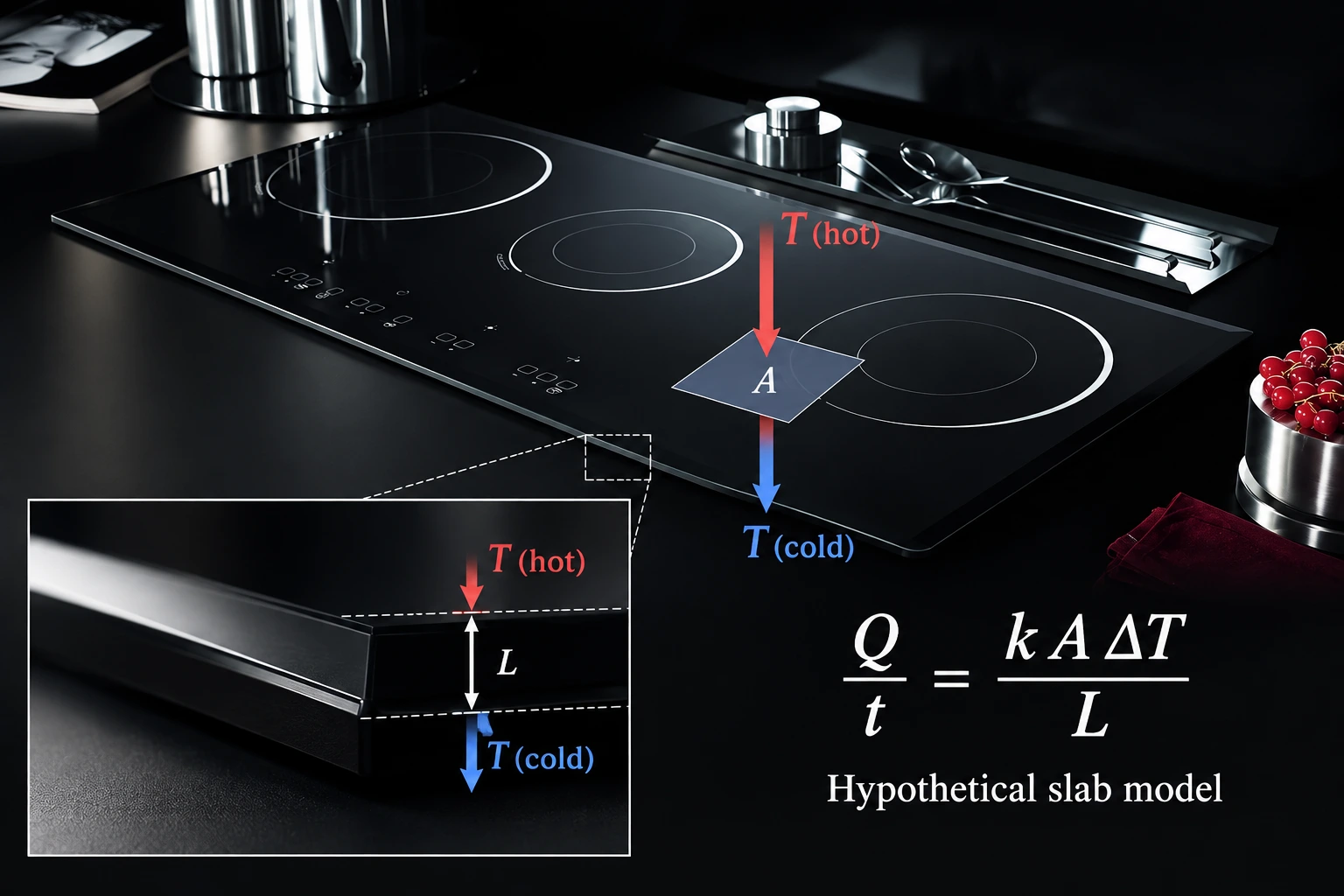
The example cannot predict boiling time, surface burn risk or energy consumption. In a cooker, contact resistance, heat losses, radiation, changing temperatures and the heating system can be significant. Nor is the entire panel necessarily bounded by two uniform face temperatures. If the application requires a thermal model, establish the boundary conditions and compare the predictions with a suitable instrumented appliance trial.
Check unit conversions before using any published data. Millimetres must become metres in the slab calculation, and a diffusivity expressed in mm²/s needs conversion before use with SI density and heat capacity. Preserve the original unit and source in your calculation record so another engineer can audit the conversion. A spreadsheet that produces a neat answer can still contain a unit error.
What a useful test report should contain
Request material identity, sample origin, drawing revision, dimensions, surface condition, test method, apparatus, temperature points and uncertainty. Where a property is derived from other measurements, retain those inputs and their temperature basis. Ask how the laboratory handled specimen transparency, heat losses and contact effects where relevant to the chosen method. The report should identify what was measured rather than simply display a final number.
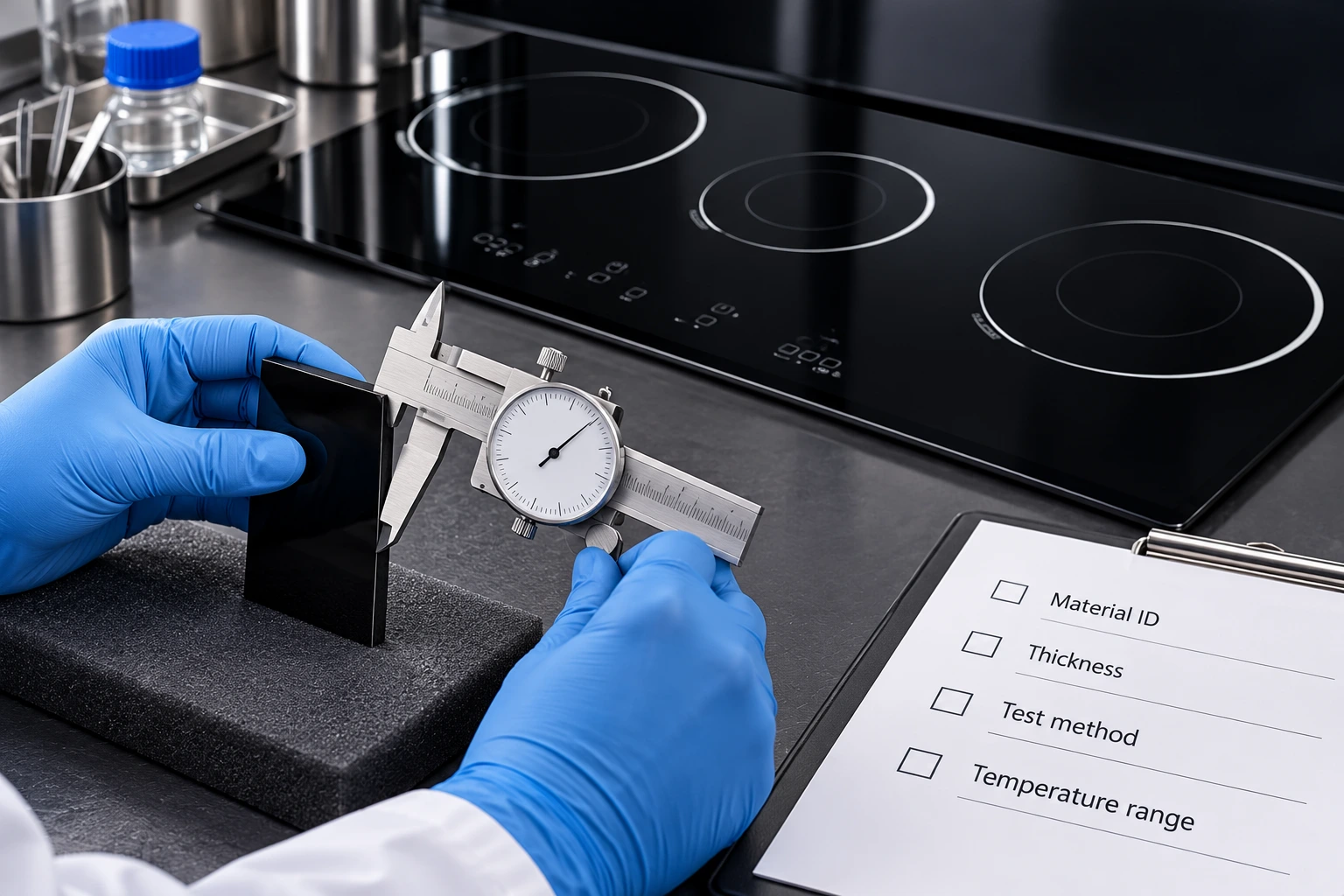
Use a qualified laboratory to select an appropriate method for the material and question. A flash measurement, a steady-state experiment and an appliance temperature trial do not produce interchangeable answers. Agree the method before sending specimens and confirm whether coatings or printed decoration must remain on the sample. Cutting coupons from a finished panel should follow an approved sampling plan; do not improvise post-processing on a safety-critical installed component.
Keep the report with the tested sample identification and purchasing specification. If the material, thickness, decoration or process changes, ask whether the result remains representative. A previous sample’s property does not automatically become a permanent guarantee for every later revision. Traceability is especially important when comparing quotations from suppliers who report different methods or temperatures.
Apply the data to the right appliance question
On induction systems, energy is delivered to suitable cookware electromagnetically, while the top can receive heat back from the pan. Radiant cooking has a different heat path. The induction and infrared panel comparison explains why the heating architecture belongs in the specification. Conductivity alone does not select a replacement top or establish interchangeability between systems.
Thermal-shock performance is another separate question involving the material, geometry, constraints and temperature history. Do not infer a pass from a conductivity number. Use a defined qualification plan such as the considerations in our cooktop panel thermal-shock planning guide, with acceptance criteria set by the responsible engineering team.
Prepare a supplier enquiry that can be answered
For Kanger’s black heat-resistant glass-ceramic cooktop product, specify the intended appliance, drawing, thickness, decoration, operating environment and the design question behind the request. Ask for available material-specific conductivity data and its measurement basis. If new testing is needed, agree specimens, method and responsibility before treating the property as a purchasing requirement.
A useful enquiry asks whether the data support a thermal model, a component comparison or a production acceptance check. Each purpose may need different evidence. Record missing information explicitly and keep illustrative calculations separate from approved specifications. That allows procurement and engineering to make a decision without turning an attractive material description into an unsupported performance promise.
Further learning: three ways heat transfers
The educational video below separates conduction, convection and radiation. It helps interpret what a conductivity value covers, but does not supply a property value for a Kanger panel.
Video: Heat Transfer: Conduction, Convection, and Radiation, Wisc-Online (Part of WisTech Open). Open the educational video on YouTube.
Frequently asked questions
What is the thermal conductivity of all glass-ceramics?
There is no single universal specification. Request the actual composition or grade, temperature, method and reporting basis for the material being purchased.
Does low thermal expansion mean low conductivity?
No. They describe different physical properties and must be specified separately.
Can conductivity prove a cooktop is safe to touch?
No. Surface temperature depends on the complete appliance and operating history. Respect its residual-heat warnings and instructions.
Can I use the worked example as product data?
No. Its inputs are explicitly hypothetical and only demonstrate the equation and units.


