 Kanger Glass-ceramic Co., Ltd.
Glass interleaving powder is a separation material used in some glass handling and storage processes, but it must be qualified for the actual surface and downstream operation. It is not a universal treatment for finished appliance panels and should not be sprinkled onto an assembled appliance. Buyers should confirm the powder’s intended function, compatibility with glass and decoration, application controls, storage conditions, removal method, and effect on later washing, printing, coating, or bonding. A powder that helps one process can create an unwanted residue or handling problem in another.
This guide is a supplier-qualification framework, not a formulation or application recipe. It does not prescribe a chemical blend, dosage, or storage life. Use the material supplier’s documentation and a validated process for the specific component. Where paper, film, pads, or individual packaging are more appropriate, compare those options explicitly instead of assuming that powder is required.
Clarify what the separation material is meant to do
Start by identifying the problem: direct surface contact, movement during transport, moisture exposure, or preparation for a later process. These are related but different concerns. A separator may create physical spacing without providing every form of environmental protection, and an anti-staining claim needs evidence for the intended conditions.
Patent literature on interleaving powder illustrates that formulations and intended functions can differ. A patent describes proposed technology; it is not independent proof that a commercial product is suitable for Kanger panels, nor is it a recommended recipe. Use it only as background for asking the supplier precise questions.
Describe the glass state at the point of application. Raw sheet, processed blank, printed panel, coated component, and complete appliance assembly are not interchangeable. The same surface treatment may have different consequences at each stage, especially if subsequent washing or bonding requires a controlled surface.
Identify every surface that may contact the powder
Document the substrate, exposed decoration, coatings, protective films, adhesives, and any other contacting materials. Include both faces and the edges where relevant. A compatibility statement for uncoated float glass does not automatically cover a printed appliance mask or a specialized glass-ceramic surface.
For Kanger’s tempered appliance-panel components, the visible fascia may include a display region, opaque decoration, trim, and other interfaces. Confirm the actual supply stage and layer specification. A reference photograph cannot establish chemical compatibility or an approved packaging method.
Ask whether the separator will touch a surface that later receives ink, coating, or adhesive. If so, include the downstream process owner in the review. A packaging decision made without that input can transfer the problem from transport damage to poor print coverage or uncertain bonding preparation.
Use a compatibility and removal checklist
| Question | Evidence to request | Decision affected |
|---|---|---|
| What is the intended function? | Supplier’s technical description and stated limitations | Whether powder addresses the actual risk |
| Which surfaces are compatible? | Material-specific guidance and representative trials | Suitability for bare, printed or coated zones |
| How is application controlled? | Approved equipment and process instructions | Consistency and avoidance of excess residue |
| How is it removed? | Validated washing or removal procedure | Readiness for the next manufacturing step |
| What storage conditions apply? | Packaging and environmental requirements | Permitted route, handling and storage duration |
| What happens after a change? | Change notification and requalification plan | Continuity of the approved process |
The table is deliberately qualitative. Numerical settings belong to the supplier’s approved process and the user’s validation. Do not infer an application rate or allowable residue from photographs of another factory’s glass stack.
Treat moisture protection as a system question
Review the complete storage and shipping environment, including packaging, temperature changes, exposure to water, and the ability to identify a wet or compromised shipment. A separator should not be assumed to compensate for every environmental condition. Ask the supplier to define the conditions under which its performance claim applies.
The Canadian Conservation Institute’s care guidance for ceramics and glass explains that glass condition and composition affect deterioration behavior. Its museum context is not an industrial storage specification. The relevant lesson is to avoid treating all glass and all surface conditions as identical, not to copy collection-care humidity limits into an appliance factory.
If moisture or staining is found, preserve the shipment identity, packaging condition, and affected locations. Separate observations made before cleaning from those made afterward. Do not assume that a removable deposit and permanent surface damage are the same problem, or that adding more powder will prevent a recurrence.
Validate removal before approving the material
Removal is part of the qualification, not an afterthought. Test the proposed method on representative surfaces using the actual process sequence. Confirm that the method does not damage print, coating, or another component. Record the elapsed time and storage condition before removal if they are relevant to the intended route.
Define what “clean enough” means for the next operation. A visually clear panel may still require a more specific surface-control check before printing or bonding. Conversely, a visible harmless trace may be unacceptable for a customer-facing appearance requirement even if it does not affect another process. Tie the acceptance method to the actual function.
The glass washing-machine guide addresses equipment and process qualification. Include the separator material in representative washing trials rather than testing only an easy-to-clean laboratory sample that does not reflect production.

Check downstream wetting and bonding requirements
Where a later liquid must wet the surface, the process team may use a defined surface check as one part of qualification. NPTEL’s interfacial engineering lecture explains the underlying wetting concepts. That background does not identify an unknown residue or establish that a particular adhesive will bond successfully.
Use the actual ink, coating, or adhesive system in representative trials. Record the surface preparation and curing or drying process specified by the responsible supplier. Do not assume that a favorable water-drop appearance proves the success of every downstream material.
The UV adhesive qualification guide covers complementary interface questions. If the separator or removal procedure changes, review whether the existing bond or print qualification still represents production.
Compare powder with other protection methods
Paper, polymer film, pads, racks, and individual packaging may offer different advantages and limitations. Compare them against the actual component geometry, decoration, handling route, and downstream process. Do not rank them by a single claim such as “scratch protection” without considering contamination, movement, edge protection, and removal.
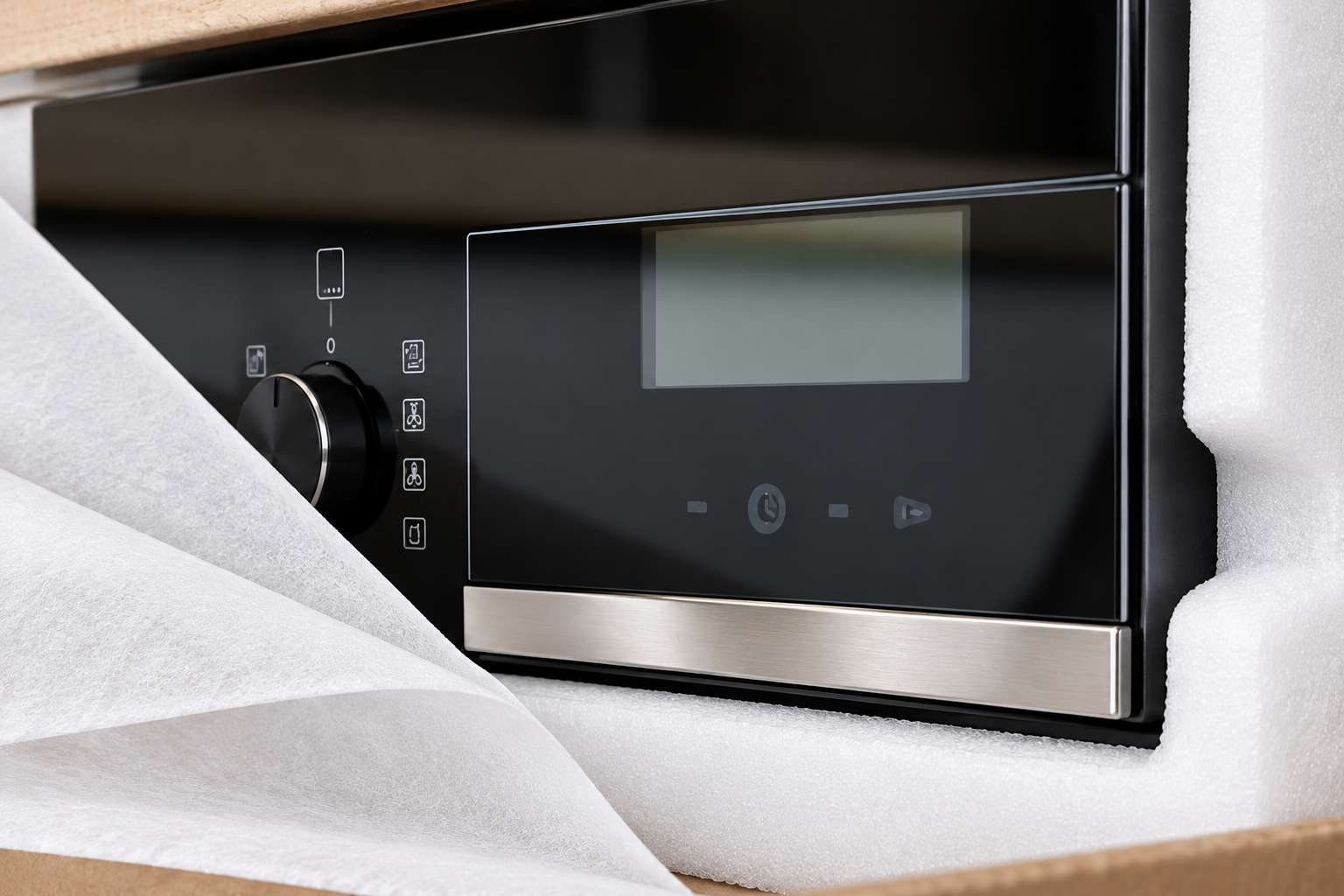
For a finished fascia with protruding controls or attached trim, a sheet-glass interleaving approach may not describe a sensible packing arrangement. Use a packaging design appropriate to the supplied component. The illustration in this article shows a finished reference product to establish business relevance; it is not proof that loose powder is approved for that assembly.
Request representative packaging samples and inspect after a relevant handling trial. Record the test route and what was assessed. A successful small demonstration does not establish every transport condition, but it can identify obvious incompatibilities before a larger rollout.
Keep receiving and process records connected
At receipt, document the package condition and material identity before mixing stock. If residue, staining, or damage is found, record where it occurs and whether it follows a package position, lot, or surface. Keep samples of the separator where useful and safe, following the site’s handling procedure.
Link the receiving observation to the washing, printing, or bonding outcome. Without that connection, the same issue may be logged separately as a packaging defect and a process defect, hiding the relationship. Use consistent lot and part identifiers rather than relying on a descriptive filename alone.
The appliance-panel specification guide provides the broader purchase framework. Add the approved protection and removal requirements to that package, with clear responsibility for supplier changes and the response to a nonconforming shipment.
Close the qualification with explicit limits
The approval record should name the separator product, supplier, relevant revision, compatible surfaces, application process, storage assumptions, and removal method. Include the evidence reviewed and any conditions that were not evaluated. Avoid a blanket “approved for glass” statement that loses the boundaries of the actual trial.
Define when the review must be repeated, such as a change in the separator formulation, exposed coating, print system, cleaning process, or transport arrangement. Retain the previous evidence so the change can be assessed efficiently. The objective is a stable, traceable interface between protection and manufacturing, not a permanent approval detached from the process.
Further learning: wetting and surface contact
National Tsing Hua University’s lecture explains wetting and contact angle, which helps explain why a surface residue can matter before a liquid-based downstream process. It does not recommend an interleaving powder or provide a removal recipe.

Frequently asked questions
Can one powder be used on every glass surface?
No universal compatibility is established. Confirm the actual substrate, print, coating and downstream process with the supplier and qualification team.
Should powder be applied to a finished appliance?
No such use is recommended here. This is an industrial process discussion; follow the appliance manufacturer’s instructions for finished equipment.
Does interleaving replace moisture control?
Do not assume it does. Evaluate the complete packaging, storage and transport system within the supplier’s stated conditions.
Is visual cleanliness enough before bonding?
Not necessarily. Use the surface preparation and verification required by the qualified adhesive and assembly process.


